The rules of search engine optimization are being rewritten, and not by another algorithm update. This time it is artificial intelligence itself doing the rewriting, at the core of how search works. In 2026, AI-driven SEO is no longer a competitive edge reserved for enterprise brands. It is the baseline requirement for any business serious about organic visibility. From Google’s AI Overviews and AI Mode to generative engines like ChatGPT and Perplexity, the entire discovery landscape has shifted.
This guide breaks down the AI-driven SEO strategies that digital marketers, SEO professionals, and business owners need to implement right now. It covers AI-powered keyword research and content optimization, Generative Engine Optimization (GEO), Answer Engine Optimization (AEO), topical authority, E-E-A-T, and the technical SEO foundations that AI search systems reward.
Whether you want to improve your search rankings on Google or earn citations in AI-generated answers, this guide gives you an actionable framework for search in the age of AI.
Table of Contents
- Understanding AI and SEO in 2026
- What Is AI-Powered SEO?
- The 2026 AI Search Landscape: What Has Changed
- Core AI-Driven SEO Strategies for 2026
- Generative Engine Optimization (GEO) and Answer Engine Optimization (AEO)
- Building Topical Authority with AI
- Benefits of AI-Powered SEO for Your Business
- Future Trends in AI-Driven SEO
- Frequently Asked Questions
- Conclusion
1. Understanding AI and SEO in 2026
Artificial intelligence has fundamentally changed how search engines understand content, evaluate quality, and deliver results. What began as machine learning assisted ranking signals has grown into a parallel search ecosystem, one where AI models generate, synthesize, and present answers without a user needing to click a single link.
1.1 How AI Has Revolutionized the SEO Landscape
The impact of AI on business outcomes is measurable and growing. In sales and marketing, 30% of businesses that have adopted AI reported a revenue increase of 6% to 10% after implementation.
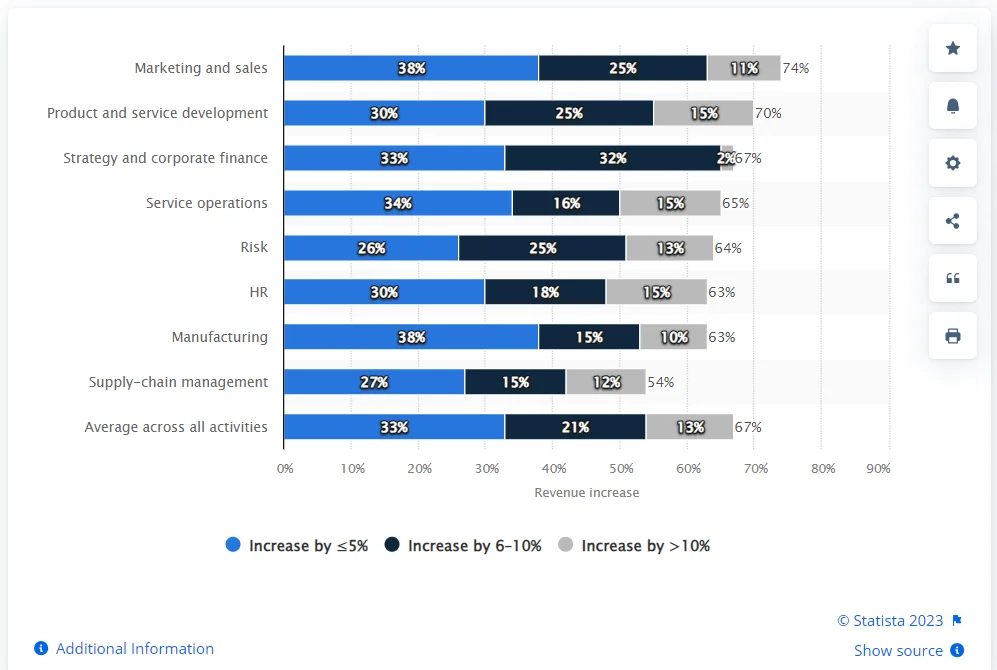
The implications for SEO go well beyond revenue dashboards, though. Google now runs multiple AI-powered systems at once: RankBrain and BERT for query understanding, Google AI Overviews (formerly SGE) for generating direct answers at the top of the SERP, and the newer Google AI Mode, powered by Gemini 2.5, for conversational deep research. Meanwhile, platforms like ChatGPT, Perplexity AI, and Microsoft Copilot are capturing a growing share of search intent, particularly for complex, research-heavy queries.
For SEO professionals, this creates two goals running in parallel: ranking well in traditional organic results, and earning citations in AI-generated answers. The two require overlapping but distinct tactics, both anchored to the same principle, producing content that AI systems trust, understand, and want to reference.
1.2 The Role of Machine Learning in SEO
At the heart of modern search algorithms sit several interlocking processes:
- Natural language processing (NLP) that understands search queries in full context
- Evaluation of page content, HTML structure, speed, security, and Core Web Vitals
- Assessment of authoritativeness and trustworthiness through E-E-A-T signals
- Reading of user experience signals like dwell time, engagement rate, and bounce patterns
- Parsing of images, video, and other media for topical relevance
- Generation of AI Overview summaries by citing the most semantically relevant sources
The machine learning models behind search keep evolving. For SEOs, success in 2026 means aligning content with how AI evaluates relevance, not just how a human reader does.
1.3 Key AI Algorithms Powering Modern Search Engines
Knowing which AI systems evaluate your content helps you optimize more precisely:
- Google RankBrain. Uses machine learning to parse search queries and match them to pages based on meaning and context. It handles over 15% of searches, mostly the ambiguous ones traditional algorithms cannot interpret reliably.
- BERT (Bidirectional Encoder Representations from Transformers). Analyzes words in relation to surrounding text to understand natural language at the phrase and sentence level, not just individual keywords.
- Google MUM (Multitask Unified Model). Processes text, images, and video together across languages to interpret complex, multi-part queries.
- Google Gemini (AI Overviews and AI Mode). Powers Google’s generative search features, synthesizing answers from multiple trusted sources and surfacing them above organic results.
- Microsoft Bing Copilot. Uses large language models to match web pages to user intent inside a conversational interface.
2. What Is AI-Powered SEO?
AI-powered SEO refers to optimization strategies and tools that use artificial intelligence, machine learning, and data science to gain organic visibility. In 2026, the definition has expanded well beyond simply automating traditional tasks.
2.1 Definition of AI-Powered SEO
At its core, AI-driven SEO uses predictive analytics, natural language processing, and large language model optimization to understand search intent, build semantically rich content, and establish the kind of authoritative presence that both traditional search engines and generative AI systems trust enough to cite.
Modern AI SEO tools handle keyword clustering, semantic gap analysis, content scoring, automated site audits, backlink opportunity identification, and real-time SERP monitoring, at a scale and speed no human team could match manually. Paired with real strategic oversight, these capabilities compound into a genuine advantage in organic search. Our SEO services are built around exactly this human-plus-AI approach.
2.2 How AI Tools Analyze Keywords and Site Performance
AI programs can process thousands of keywords at once to surface monthly search volume, competition levels, semantic clusters, and difficulty scores. Looking at historical trends, AI can predict which terms are likely to gain or lose popularity, which supports proactive content planning instead of reactive keyword chasing.
One myth worth retiring here: keyword density has stopped being a meaningful ranking signal. A recent analysis across more than 1,500 search results found no real correlation between keyword density and high rankings, and top-ranking pages often use the target term less often than the pages below them, not more. What matters instead is semantic coverage, using the related concepts, entities, and language a topic naturally requires.
For site audits, AI crawlers analyze page speed, mobile friendliness, Core Web Vitals, security, structured data, technical SEO health, and content quality signals in depth. With enough data, AI tools can identify which pages rank for target keywords and where a site lags competitors, enabling real content gap analysis and topical authority mapping.
2.3 AI-Powered SEO Tools Worth Using in 2026
The tool landscape has matured considerably. Leading platforms in 2026 include:
- Surfer SEO, for real-time NLP content scoring and SERP analysis
- Clearscope, for semantic keyword research and topical completeness grading
- MarketMuse, for AI-driven content strategy, topic modeling, and authority gap analysis
- Semrush and Ahrefs, for keyword research, backlink intelligence, and AI-assisted competitive analysis
- Jasper and Copy.ai, for AI content drafting, always with human editorial review
- Screaming Frog with AI integrations, for technical audits enhanced with machine learning anomaly detection
3. The 2026 AI Search Landscape: What Has Changed
The most significant shift in SEO history is happening right now. Understanding this new landscape is not optional. It is the prerequisite for everything that follows.
3.1 Google AI Overviews and Zero-Click Search
Google AI Overviews now appear in roughly 13% of all search queries, but that figure varies enormously by industry. In information-heavy categories like health, AI Overview presence climbs as high as 82.5%. In transactional categories like retail and ecommerce, it drops to as little as 2%, since Google still tends to send shopping queries straight to organic and paid listings. When AI Overviews are present, zero-click rates climb to around 83%, and for Google AI Mode queries specifically, zero-click rates reach as high as 93%. Traditional organic CTR on queries featuring an AI Overview has fallen by an average of 34.5%.
This is not the death of SEO. It is its evolution. Brands that earn a citation inside an AI Overview gain visibility even without a click. Brands that disappear from both traditional results and AI-generated answers lose out entirely. A dual-visibility strategy, ranking well and getting cited, is now mandatory rather than optional.
3.2 The Rise of Alternative AI Search Platforms
Google still processes roughly 14 billion search queries daily, but alternative AI platforms are growing fast. ChatGPT handles tens of millions of queries a day, Perplexity AI is expanding aggressively (India is now its largest single market), and Google AI Mode reached 75 million daily users as of 2025. Together, ChatGPT and Gemini control an estimated 86% of the AI search market.
For SEO professionals, this means optimizing for Google alone is no longer enough. Content needs to be structured so large language models across multiple platforms, including ChatGPT, Perplexity, Claude, and Gemini, can cite it.
3.3 The Shift from Rankings to Multi-Surface Visibility
In 2026, search success is not measured by a single ranking position but by presence across multiple surfaces at once: traditional organic results, AI Overview citations, featured snippets, People Also Ask boxes, knowledge panels, image search, and voice search. Brands that focus exclusively on traditional ranking position risk becoming invisible to high-value buyers even while their reported rankings look perfectly stable.
3.4 AI-Generated Content: Opportunities and Oversight Requirements
AI content generation tools are now standard in editorial workflows. Google’s quality evaluators, however, still apply E-E-A-T principles rigorously. Here is what that means in practice.
Benefits of AI in content production:
- Scalability, since AI can produce hundreds of personalized content assets in the time it takes a person to write one
- Cost efficiency, since it is more affordable for generating foundational drafts at volume
- Personalization, since AI can tailor content to specific keywords, audiences, and contexts
- Consistency, since AI reliably adheres to a brand’s voice and style guide
- Round-the-clock output, since AI content generation runs without human limitations on time
Critical limitations to manage:
- No genuine first-hand experience, which is exactly what E-E-A-T rewards and AI cannot demonstrate on its own
- Hallucination risk, since AI can confidently fabricate statistics, citations, and facts that need human verification
- Thin content patterns, since AI tends toward broadly accurate but shallow coverage without deliberate, detailed prompting
- Duplicate content risk, since AI output can mirror existing web content too closely
- Mandatory human oversight, since every piece needs expert editing before it goes live
The winning formula in 2026 is simple to state and hard to execute: AI accelerates production, humans supply the expertise, depth, and narrative authority. This is exactly how our content marketing services are structured.
Also Read: SEO 101: Beginner’s Guide to Search Engine Optimization
4. Core AI-Driven SEO Strategies for 2026
With the landscape established, here are the strategies actually delivering results. These are the tactics top-performing brands are using right now to earn both traditional rankings and AI-generated answer citations.
4.1 Leveraging AI for Keyword Research and Semantic Clustering
Thorough keyword research is still the foundation of SEO success, but the approach has shifted from targeting individual keywords to semantic clustering: grouping related keywords, subtopics, and questions into content clusters that signal topical authority to both traditional algorithms and AI systems.
Using Advanced AI Tools to Identify Winning Keywords
Modern AI-powered tools like Semrush, Ahrefs, and Surfer SEO use large datasets and machine learning to pinpoint the keywords actually driving relevant traffic and conversions. Instead of evaluating keywords in isolation, these tools map full semantic ecosystems, showing which subtopics and related queries you need to cover to rank for your primary term.
AI evaluates monthly search volume, historical trends and seasonality, competition levels, difficulty scores, and topical coverage gaps, across both short-tail and long-tail variations. That lets brands build a data-driven keyword list that informs both content strategy and internal linking architecture.
Analyzing Competitiveness Through AI Data
To gauge keyword competitiveness accurately, AI analysis looks at which domains currently rank for a target term, along with their domain authority, topical relevance, and content depth. This surfaces both quick-win keywords where you can gain traction fast and highly competitive terms that need real on-page and off-page optimization investment.
With enough data, AI can also forecast whether a keyword’s competitive landscape is intensifying or softening over time, helping brands move on emerging opportunities before competitors notice them.
4.2 AI-Powered Content Creation and Optimization
Content in 2026 has to satisfy two audiences at once: human readers and AI interpretation systems. Content that wins with both shares the same traits: clear structure, direct answers, genuine expertise, and real semantic depth.
Structuring Content for AI Readability
AI systems favor content with a logical hierarchy, proper heading tags (H1 through H4), short declarative sentences that can be lifted out as answers, and a clear topic focus at the paragraph level. Each section should fully answer one specific question rather than burying the answer under qualifying language.
Write the direct answer early in each section, use subheadings that mirror actual search intent, and explain ideas in plain language an NLP model can parse cleanly. Thin sections, ones that introduce a topic without genuinely covering it, actively hurt your odds of being cited in an AI Overview.
Employing AI Content Optimization Techniques
Beyond drafting text, AI optimization extends to structured data and schema for better indexing, automatic image alt text, and A/B testing content variations at scale. Our on-page SEO optimization process builds in these AI-assisted techniques so every page element supports both ranking signals and AI citability.
AI can also test thousands of meta title and description combinations to find which ones drive the highest CTR for a given query type, turning what used to be an intuition-driven copywriting task into something closer to a data science function. When writing for entity-heavy topics, tools like Surfer SEO or Google’s own NLP API can also surface the related brands, concepts, and terms an AI system expects a genuinely expert page to mention, which is a useful check against content that reads shallow even when it is technically accurate.
4.3 E-E-A-T Optimization: The Foundation AI Systems Trust
Experience, Expertise, Authoritativeness, and Trustworthiness (E-E-A-T) are not abstract quality signals. They are the specific attributes both Google’s quality evaluators and generative AI systems use to decide which sources deserve citation. In 2026, E-E-A-T is the single most important foundational investment in AI-era SEO.
Building Demonstrable Experience and Expertise
First-person experience signals, case studies, original data, client results, author credentials, and real-world examples, are exactly the content attributes AI systems cannot easily replicate or manufacture. Publishing content with verifiable author expertise, linking to author credential pages, and backing claims with original research all send strong E-E-A-T signals.
Strengthening Authority and Trust Signals
Authority is built through high-quality backlinks from relevant, trusted domains. Our link building services focus on earning editorially placed links from authoritative industry sources, exactly the kind of signal generative AI models use to calibrate source trustworthiness. Trust signals also include HTTPS security, transparent authorship, clear editorial policies, accurate citations, and consistent brand mentions across the web.
Building what is increasingly called an “authority footprint” matters here too. AI models weigh consistency across the open web: a bio, credentials, and tone that line up the same way on your website, LinkedIn, and any podcast or press mention you have earned. Even an unlinked mention of your brand on a podcast, in an industry roundup, or in a trade publication contributes to this footprint, since AI systems connect these dots when deciding whether a source is a real, verifiable expert or an anonymous website. Our guide to competitive SEO analysis covers how to find where competitors are already earning this kind of visibility so you can target the same opportunities.
4.4 Enhancing User Experience with AI
Delivering a genuinely personalized, relevant experience matters for user satisfaction and for the behavioral engagement signals AI ranking systems read. Using big data and predictive analytics, AI lets brands tailor a seamless experience at every touchpoint.
Accurately Understanding User Intent Through AI
By processing large behavioral datasets and search queries in context, AI algorithms can read user behavior, trends, and motivation to decode the intent behind a query accurately. That makes it possible to match each query to the right page and content, satisfying not just the literal keyword but the informational, navigational, or transactional need actually driving the search.
Personalizing Experiences Across Touchpoints with AI
From personalized product or content recommendations to dynamic landing pages and custom search results, AI lets brands tailor the full experience to each user at every touchpoint. That drives real improvements in satisfaction, engagement, conversions, and retention over a one-size-fits-all approach. Research shows 86% of consumers are willing to pay more for a personalized experience.
4.5 AI-Driven Link Building Strategies
Link building remains one of the most important ranking factors in 2026, and it directly influences AI citation too, since models use link signals as a proxy for trustworthiness. AI-powered link building turns what used to be a labor-intensive manual process into a data-driven, scalable one.
Identifying Quality Backlink Opportunities with AI
AI tools can assess millions of links and domain authority signals to pinpoint the highest-potential link targets in your niche. Instead of cold outreach to irrelevant directories, AI qualifies opportunities by relevance, domain authority, traffic, and editorial standards, maximizing the value of every link earned.
Reverse Engineering Competitor Link Profiles
AI crawlers can analyze a competitor’s backlink profile to reveal which publications link to them, what content types earn editorial links in your niche, and which anchor text strategies correlate with strong rankings. That intelligence feeds directly into your own content and outreach strategy, letting you reverse-engineer what already works before spending resources on something untested.
4.6 AI-Enhanced Technical SEO
Technical SEO is the infrastructure layer that determines whether your content and authority investment actually pays off. AI has made technical optimization faster, more thorough, and more proactive than it used to be.
Automating Audits and Identifying Critical Issues
AI site crawlers run comprehensive technical audits, flagging crawl errors, broken links, page speed bottlenecks, Core Web Vitals failures, security vulnerabilities, mobile gaps, duplicate content, and structured data errors. Analysis that used to take weeks manually now runs in hours.
The crawl budget side of this is worth calling out specifically. It is a common pattern for larger ecommerce sites to lose a large share of their crawl budget to faceted navigation URLs that add little value, which quietly starves the orphaned or newly published product pages Google never gets around to crawling. AI-assisted log file analysis surfaces this kind of waste far faster than a manual review, and fixing it is often one of the highest-leverage technical fixes available on a large site.
Automated Remediation and Optimization
AI tools go beyond flagging problems. They generate specific fixes for broken links, metadata gaps, accessibility errors, image compression opportunities, and duplicate content patterns, saving real engineering time and keeping a site technically healthy at scale.
Site Speed and Core Web Vitals Optimization
Slow load times hurt both rankings and AI Overview eligibility directly. AI tools evaluate page speed and Core Web Vitals at scale and provide recommendations specific to your tech stack. For comprehensive technical foundations, explore our technical SEO services.
4.7 Tracking and Analyzing SEO Performance with AI
Solid performance tracking is essential for understanding what is actually working across both traditional and AI search surfaces. In 2026, the measurement framework needs to expand well beyond rankings and organic traffic alone.
Robust and Integrated Tracking with AI-Powered Tools
AI analytics platforms integrate with Google Search Console, Google Analytics 4, CRM systems, and third-party tools to give real-time tracking across keyword rankings, traffic and leads, conversions by channel, AI Overview citations, share of voice in generative answers, and ROI. That unified view is nearly impossible to build manually across fragmented platforms.
Expanding Measurement to Multi-Surface Visibility
New visibility metrics are emerging specifically around AI search citations. Track not just where you rank but whether your content appears in AI Overviews, People Also Ask boxes, featured snippets, knowledge panels, and voice search results. These surfaces often generate real brand exposure even without a click, which matters especially for local SEO and brand authority work.
It is also worth setting expectations correctly here. AI-referred traffic often makes up a small share of total sessions, frequently under 1%, but tends to convert at a meaningfully higher rate than average organic traffic, since someone arriving from a specific AI-cited answer usually already has strong purchase or decision intent. For B2B companies in particular, that small slice of AI-driven traffic can end up disproportionately responsible for pipeline and revenue, which is a good reason not to judge AI SEO success by raw session count alone.
Making Confident Data-Driven Decisions
The multidimensional insight AI uncovers lets you ground strategy decisions in real data instead of assumptions, and decide where to put limited time and budget for maximum impact, cutting out the guesswork that costs most businesses months of wasted effort.

Also Read: What is an SEO Audit? Find New Website Optimization Opportunities
5. Generative Engine Optimization (GEO) and Answer Engine Optimization (AEO)
Two disciplines have emerged alongside traditional SEO in 2026, and every brand producing digital content needs to understand both: Generative Engine Optimization (GEO) and Answer Engine Optimization (AEO).
5.1 What Is Generative Engine Optimization (GEO)?
Generative Engine Optimization is the practice of optimizing content so AI-powered answer engines, including Google AI Overviews, ChatGPT, Perplexity, Claude, and Gemini, understand, trust, and cite it when generating a response. Traditional SEO optimizes for a human choosing from a ranked list of links. GEO optimizes for an AI system synthesizing an answer from trusted sources.
A useful mental shift underneath GEO is that these systems increasingly evaluate entities, not just URLs. That means the goal is not only ranking a specific page but making sure your brand is clearly understood as a distinct, credible entity within a topic, something a model can reliably attach a name and a body of expertise to, rather than just one more link in a results list.
The core principles of effective GEO:
- Structured content architecture: clear headings, logical information flow, and modular content blocks an AI can extract and cite independently
- Direct, concise answers: placing the definitive answer to a question early in a section, before the elaboration
- Unique, proprietary information: original data, case studies, and insight that exist outside AI training data and require real retrieval
- Semantic depth: full coverage of a topic, including adjacent subtopics, related concepts, and common follow-up questions
- Strong E-E-A-T signals: verifiable expertise, author credentials, and institutional authority AI models use to judge trustworthiness
5.2 What Is Answer Engine Optimization (AEO)?
Answer Engine Optimization focuses specifically on structuring content to appear in AI-generated answers, featured snippets, People Also Ask boxes, and voice search results, the SERP features that deliver visibility without necessarily generating a click. In an environment where a large share of searches now end without a click, AEO directly determines whether your brand exists in a user’s search experience at all.
Effective AEO tactics:
- Formatting key answers as concise, standalone paragraphs that directly answer one specific question
- Using structured data markup (FAQ schema, HowTo schema, Article schema) so search engines understand content context
- Writing question-based H2 and H3 subheadings that mirror natural language queries
- Writing in plain, conversational language a voice assistant can read aloud naturally
- Building comprehensive FAQ sections that cover the real follow-up questions around a topic
A simple version of this in practice: for a query like “best SEO tools,” lead with the direct list itself (Ahrefs, Semrush, Surfer SEO, and so on) before diving into the detail on each one, rather than making a reader or an AI system scroll past paragraphs of setup to find the actual answer.
5.3 Optimizing for Google AI Overviews
Google AI Overviews pull from top-ranking content but do not necessarily cite the number one ranking page. To improve your odds of citation:
- Cover the full semantic scope of the query comprehensively
- Use clear, factual statements that can be extracted as standalone pieces of information
- Implement FAQ schema and other structured data markup throughout the content
- Build topical authority through content clusters that establish your site as the definitive resource on the subject
- Earn authoritative backlinks that signal trustworthiness to the AI Overview selection system
6. Building Topical Authority with AI
Topical authority, the depth and breadth of a site’s demonstrated expertise on a subject, has become the most durable competitive advantage in modern SEO. Both traditional ranking algorithms and generative engines strongly favor sources that show comprehensive, consistent expertise in a domain.
6.1 The Content Cluster Strategy
Topical authority is built through deliberate content cluster architecture: a comprehensive pillar page covering a broad topic, supported by a network of in-depth cluster pages addressing every subtopic and related question. Each cluster page links back to the pillar, and the pillar links out to each cluster, forming a semantic web that signals genuine expertise to search algorithms.
For example, a pillar page on “AI-Driven SEO” might be supported by cluster pages on GEO, AEO, AI keyword research tools, AI technical SEO audits, E-E-A-T optimization, and AI content creation, each going deep on its own subtopic. This structure is exactly how AI systems judge topical completeness when deciding which sources to cite. Our content marketing services are built to construct exactly this kind of authority architecture for clients.
6.2 Internal Linking for Topical Signals
Internal linking is the structural backbone of topical authority. Both AI systems and traditional crawlers use internal link patterns to understand how pages relate and to judge a site’s subject matter expertise. Every piece of content should link contextually to related service pages, supporting posts, and deeper explorations of the topic, using descriptive anchor text that reflects the real relationship between the pages.
For local businesses, topical authority also means location-specific content that demonstrates genuine, real-world expertise in your market. See how our local SEO services build topical authority into location-based organic growth.
6.3 Structured Data and Schema Markup
Structured data is the technical bridge between your content and AI understanding. JSON-LD schema helps search engines and generative AI models understand what your content covers, who created it, what entities it references, and how it relates to other information in their knowledge graph. Priority schema types for 2026:
- Article schema, which establishes content type, authorship, and publication date
- FAQ schema, which makes question-and-answer content directly parsable for AI Overviews and PAA boxes
- HowTo schema, ideal for instructional content that can appear in rich results
- BreadcrumbList schema, which communicates site hierarchy and content relationships
- Organization schema, which builds brand entity recognition inside knowledge graphs
7. Benefits of AI-Powered SEO for Your Business
Applying artificial intelligence across your SEO strategy compounds advantages that manual work simply cannot match at scale.
7.1 More Effectiveness, Efficiency, and Speed
How AI Saves Time and Resources in SEO Tasks
AI tools automate the tedious, time-consuming parts of SEO: keyword research, content gap analysis, site audits, metadata optimization, rank tracking, and backlink monitoring. That lets marketing teams scale campaigns far faster than manual effort allows, with AI handling data volume that would otherwise require a team of dedicated specialists.
With AI, hundreds of content variations, landing pages, or meta descriptions can be created and tested in the time it takes a person to produce one asset. AI systems also work continuously, staying current on algorithm updates, competitor movement, and emerging keyword opportunities in real time.
Accurate and Up-To-Date Competitive Intelligence
Using large datasets, AI algorithms can identify strong keywords, flag technical vulnerabilities, benchmark performance against competitors, and track SERP movement including AI Overview appearances. That turns reactive SEO into proactive strategy. This is especially powerful for ecommerce businesses, where our ecommerce SEO services build AI-powered competitive monitoring in as a core component.
7.2 Improved User Experience and Satisfaction
AI’s Role in Personalized Experiences
With machine learning, brands can build genuinely personalized experiences based on behavioral signals, search history, and demographic data. AI enables custom product recommendations, individualized email campaigns, and dynamic landing pages that adapt to visitor context.
Streaming platforms use AI to recommend content that keeps viewers engaged, and ecommerce platforms use it to surface product recommendations tuned to a store’s specific customer base. Applied to your own SEO and digital marketing strategy, this same kind of personalization drives real improvements in engagement, conversion rate, and retention.
7.3 Higher Rankings and AI Visibility
The Impact of AI SEO on Search Results
Optimizing for how AI search algorithms actually evaluate pages produces sustained ranking gains. Google’s RankBrain and BERT favor content that shows real semantic depth and genuine alignment with search intent, not keyword density. Content structured for GEO and AEO earns AI Overview citations that deliver brand visibility even in an increasingly zero-click environment.
Using AI to Discover the Right Keywords and Content
With AI, brands can identify high-potential keyword clusters and optimize content for them at scale, grounded in real data on volume, competition, intent, and topical gaps. The real competitive advantage comes from pairing human creativity and strategic judgment with AI’s analytical power, a combination that supports durable dominance in almost any niche.
8. Future Trends in AI-Driven SEO
The pace of AI development in search keeps accelerating. Understanding where things are heading lets forward-thinking brands build durable advantages now instead of scrambling to catch up later.
8.1 Personalization as the Operating System of Search
In 2026, search personalization is moving from a feature to the fundamental architecture of how results get served. Google’s systems increasingly draw on a user’s entire digital history, which makes “position one” a more relative concept than it used to be. Your position for one searcher may look nothing like your position for another searcher on the exact same query. That makes brand authority, topical depth, and multi-surface visibility matter more than any single ranking position.
8.2 Voice Search and Conversational Query Optimization
Voice search optimization keeps growing in importance as assistants like Siri, Google Assistant, Alexa, and ChatGPT handle more conversational queries. Voice searches tend to be longer, more naturally phrased, and more often full questions, which makes AEO tactics (direct answers, FAQ sections, conversational language) directly applicable. Brands optimizing for voice now are building a structural advantage as the shift from text to voice keeps accelerating.
8.3 Multimodal Search and Visual SEO
AI-powered multimodal search, combining text, voice, and image input, is reshaping how people discover products and information. Google Lens, visual search inside Perplexity, and AI-powered image recognition are all creating discovery surfaces beyond traditional text search. Optimizing images with descriptive alt text, structured captions, and proper metadata keeps your visual content discoverable across these emerging channels.
8.4 The Rise of Human-Voice Content in AI Rankings
Alongside brand-published content, community platforms like Reddit and niche forums are holding, and in some cases gaining, visibility inside AI-generated answers, precisely because that content carries a genuinely human, first-hand voice that is harder for AI systems to source elsewhere. This does not replace the need for strong owned content, but it is a reminder that a presence strategy limited to your own website is incomplete. Contributing genuine expertise to the communities where your industry already discusses a topic is increasingly part of a real AI SEO strategy, not a side activity.
8.5 LLM Optimization: Earning Citations Across AI Platforms
The newest frontier in SEO is optimizing not just for Google’s algorithms but for how large language models like GPT, Claude, and Gemini incorporate your content into their responses. LLMs synthesize information from training data and real-time retrieval together, and brands that show up consistently across trusted web sources build a probabilistic presence in AI-generated answers that compounds over time. That requires a brand presence strategy spanning high-authority publications, not just optimization of your own website.
8.6 Challenges and Ethical Considerations in AI SEO
Balancing automation with human oversight and genuine expertise remains the central challenge. AI-generated content published without expert review risks both quality failures and E-E-A-T penalties. New questions around AI transparency, content attribution, and algorithmic fairness are surfacing, and may eventually shape regulation affecting how AI gets used in digital marketing. Agencies and brands that build responsible AI workflows now, with humans directing strategy and validating output, will be best positioned for whatever governance frameworks emerge.

9. Frequently Asked Questions About AI-Driven SEO
What is AI-driven SEO?
AI-driven SEO is the practice of using artificial intelligence, machine learning, and data science tools to optimize a website for both traditional search engines and AI-powered answer engines. It covers AI-assisted keyword research, content creation, technical auditing, link building, and performance tracking, all aimed at improving organic visibility, earning AI Overview citations, and driving qualified traffic at scale.
How does AI affect search engine rankings in 2026?
AI affects rankings through several systems at once: Google’s RankBrain and BERT evaluate semantic relevance and natural language understanding, Google AI Overviews generate answer summaries that sit above organic results, and generative platforms like ChatGPT and Perplexity create a second discovery layer independent of traditional SERP rankings. Ranking well in 2026 means optimizing for all of these simultaneously through semantic content depth, E-E-A-T signals, structured data, and topical authority.
What is Generative Engine Optimization (GEO)?
Generative Engine Optimization (GEO) is the practice of structuring and optimizing content so AI-powered answer engines, including Google AI Overviews, ChatGPT, Perplexity, and Gemini, understand, trust, and cite it in generated responses. GEO focuses on structured content architecture, direct answers, unique proprietary information, and the E-E-A-T signals AI citation systems reward.
What are the best AI tools for SEO in 2026?
Leading AI SEO tools in 2026 include Surfer SEO and Clearscope for content optimization and NLP scoring, MarketMuse for topical authority and content gap analysis, Semrush and Ahrefs for keyword research and competitive intelligence, Screaming Frog for technical auditing, and Jasper or Copy.ai for AI-assisted drafting, always with human editorial oversight. Google Search Console and Google Analytics 4 remain essential for tracking performance across all of it.
How do I optimize content for Google AI Overviews?
Make sure your content comprehensively covers the full semantic scope of your target queries. Place direct, factual answers early in each section. Use FAQ schema and other structured data. Build topical authority through content clusters. Write in clear, declarative language an AI model can extract as discrete information. Earn high-quality backlinks from authoritative sources, since AI Overviews favor content from established, trusted domains.
Is AI-generated content good for SEO?
AI-generated content can support SEO when it is used strategically and reviewed thoroughly by a human editor. Google evaluates quality based on E-E-A-T, experience, expertise, authoritativeness, and trustworthiness, not on whether AI was involved in the writing. The real risk is publishing AI content without expert review, which tends to produce shallow, occasionally inaccurate, generic content that fails E-E-A-T outright. The reliable approach uses AI to accelerate production while a human expert ensures depth, accuracy, and original insight.
What is topical authority and why does it matter for AI SEO?
Topical authority is the depth and breadth of a site’s demonstrated expertise on a subject. Both search algorithms and generative AI systems favor sources that consistently publish comprehensive, accurate content across every dimension of a topic. Building topical authority through content clusters, pillar pages backed by in-depth subtopic articles, signals to both traditional algorithms and AI citation systems that your site is a reliable resource worth ranking and referencing.
How can I measure the ROI of AI-driven SEO efforts?
Measuring AI-driven SEO ROI in 2026 needs a measurement framework wider than rankings and organic traffic alone. Track traditional metrics (keyword rankings, organic sessions, conversions) alongside newer AI search metrics: AI Overview citation frequency, share of voice in generative answers, branded search volume growth, SERP feature appearances (featured snippets, PAA boxes), and engagement quality metrics like dwell time and conversion rate by channel. Integrating Google Search Console, Google Analytics 4, and a dedicated AI visibility tool gives the most complete picture.
Conclusion
Artificial intelligence has become inseparable from effective search engine optimization in 2026. The landscape has genuinely split in two: brands now need to perform well in traditional organic rankings and earn citations in AI-generated answers across Google AI Overviews, ChatGPT, Perplexity, Gemini, and the growing field of AI discovery platforms.
The AI-driven SEO strategies that actually deliver results in this environment rest on a few foundations:
- Semantic depth and topical authority, covering a subject thoroughly enough that AI systems recognize your site as the definitive resource
- E-E-A-T optimization, demonstrating genuine experience, expertise, authority, and trust through every content and technical signal
- Structured content architecture, making content easy for both search algorithms and generative AI models to parse, cite, and extract
- GEO and AEO implementation, optimizing specifically for AI Overview citation, featured snippets, and conversational query satisfaction
- Technical excellence, keeping your site fast, crawlable, secure, and schema-marked for maximum machine readability
- Human and AI collaboration, using AI to scale and accelerate while human expertise and editorial judgment do the work E-E-A-T actually requires
Companies that adopt AI-powered techniques while keeping real human oversight in place gain an advantage today and stay well-positioned for whatever the search landscape produces next. The goal is not to automate SEO out of existence but to pair human strategic thinking with AI’s analytical power, delivering more value to searchers, earning more trust from AI systems, and producing measurable business growth.
If you are ready to put a results-driven, AI-powered SEO strategy in place for your business, explore our digital marketing services or speak with our team about a custom SEO roadmap for your organization.