Recently updated: May 20th, 2026
If you invest in online advertising, you have already faced the central question of modern digital marketing: should you choose display ad networks or search ads — and how do you know which one delivers better ROI for your business goals?
Both ad types are powerful, but they operate on completely different principles. Display ads and search ads are the two dominant forms of paid digital advertising, and understanding when and how to use each is the difference between a campaign that drains your budget and one that scales your revenue.
Display ads are considered “push” advertising — they reach audiences who are not yet actively searching for your product. Search ads are “pull” advertising — they appear precisely when a potential customer is actively looking for what you offer. With global display ad spending projected to reach $266.6 billion by 2026, and search advertising continuing its dominance across Google and Bing, the stakes have never been higher for advertisers to get this decision right.
In this complete 2026 guide, we break down the core differences between display ad networks and search ads, compare their performance benchmarks, reveal the top display networks available today, and give you a clear decision framework so you can build campaigns that actually convert.
According to industry data, the average click-through rate across all industries is 3.17% for search ads and 0.46% for display ads.
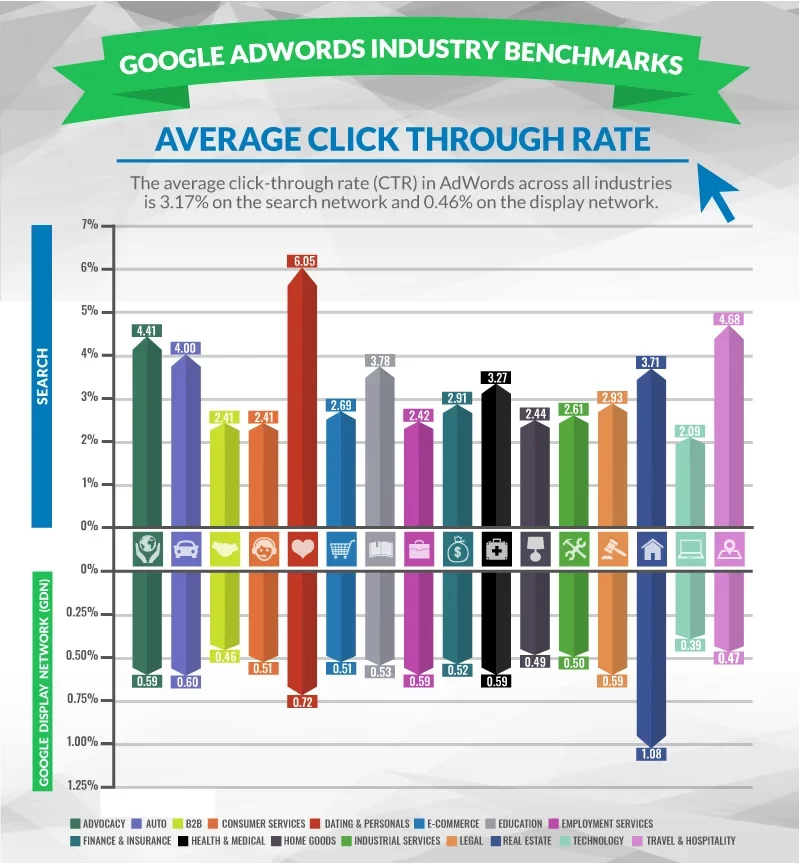
Source: WordStream
What Are Display Ads? (2026 Overview)
Display ads are a form of online advertising that uses visual formats — including banner images, responsive ads, video, native ads, and interactive rich media — to promote a brand across digital platforms. Unlike search ads that are triggered by user queries, display ads are served to audiences based on targeting parameters such as demographics, interests, browsing behaviour, and contextual relevance.
Display advertising is also commonly referred to as display marketing, and it is widely used for building brand awareness, product promotion, audience retargeting, and long-term brand positioning. Businesses that offer SEO services frequently use display ads alongside organic strategies to maximise visibility across the full marketing funnel.
According to Google, the Google Display Network alone reaches over 90% of internet users worldwide — making it one of the most expansive advertising ecosystems available to any marketer.
Display ads come in several formats, each suited to different campaign objectives:
- Banner ads – Static or animated image ads in standard IAB sizes (leaderboard, rectangle, skyscraper)
- Responsive display ads – Google automatically adjusts size, appearance, and format to fit available ad spaces
- Video ads – In-stream or out-stream video content on YouTube and across the display network
- Native ads – Ads that blend with the look and feel of the host website’s content
- Interstitial ads – Full-screen ads that appear between content pages, commonly on mobile apps
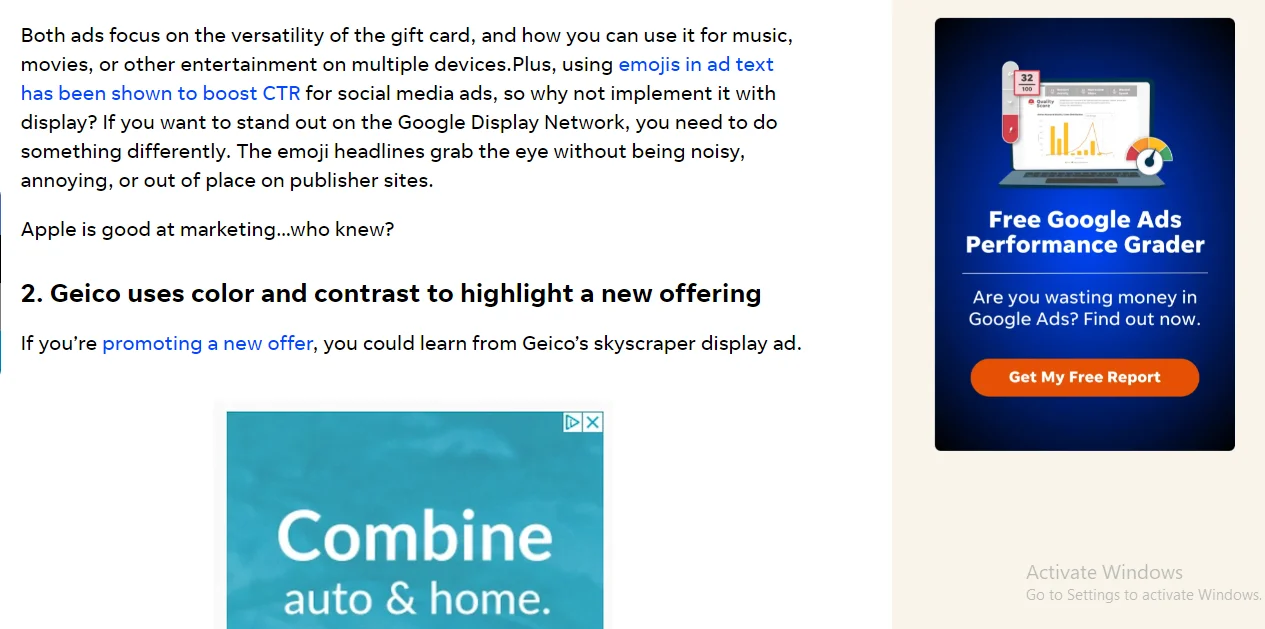
For example: If you search for “What is Google Display Network” and visit a blog on that topic, you are likely to see display ads from software companies or digital agencies — even though you never explicitly searched for those brands.
Source: WordStream
Display ads provide a broad reach because they can appear across thousands of websites, apps, and platforms simultaneously. This makes them particularly powerful for building brand familiarity among audiences who are not yet actively searching for your product — often called top-of-funnel or awareness-stage marketing.
A critical but often overlooked benefit of display ads is what SEO professionals call the “halo effect”: research shows that consistent display ad exposure increases branded search volume, which in turn improves the organic click-through rate of your search listings. Display ads and SEO are more connected than most advertisers realise.
Display ads can be priced on a cost-per-thousand-impressions (CPM) model for brand awareness campaigns, or a cost-per-click (CPC) model for direct response campaigns. Programmatic buying through demand-side platforms (DSPs) now allows advertisers to automate this process with real-time bidding across multiple networks simultaneously.
Uses of Display Ads
Display ads function like digital billboards that brands place across websites, apps, and platforms that have joined a display ad network. Publishers sell advertising space through these networks, and advertisers bid for placements through programmatic auctions or direct buys.
Platforms like the Google Display Network categorise websites by topic and audience type, allowing advertisers to reach relevant audiences at scale. Advertisers bid for placements through these networks, and the highest-quality bids — determined by both bid amount and ad relevance — earn the most prominent placements.
Remarketing is one of the most powerful applications of display advertising. By using tracking pixels, advertisers can retarget users who have previously visited their website with highly relevant ads, keeping the brand top-of-mind and recovering lost conversion opportunities.
The primary strengths of display ads include:
- Creative flexibility – Multiple ad sizes, formats, and creative styles allow brands to experiment and optimise
- Audience targeting precision – Target by interest, demographics, browsing behaviour, geography, and device type
- Retargeting capability – Re-engage users who visited your site but did not convert
- Brand awareness at scale – Reach millions of users across the web simultaneously
One known challenge with display ads is banner blindness — users who are deeply engaged with website content may instinctively ignore ads. Effective creative design, strategic placement, and frequency capping are essential to counteract this tendency and maintain ad effectiveness.
What Are Search Ads? (2026 Overview)
Search ads, also known as Search Engine Marketing (SEM) or pay-per-click (PPC) advertising, are text-based paid placements that appear on search engine results pages (SERPs) when users enter relevant queries. Google Ads is the dominant platform for search advertising, though Microsoft Advertising (Bing Ads) also commands a significant share of search ad inventory, particularly among professional and enterprise audiences.
For example: If you search for “best SEO service Delhi” on Google, the first few results marked “Sponsored” are paid search ads — placed there by businesses bidding on that specific keyword.

Search ads consist of three core components: Headline, Display URL, and Description text. Together, these elements must communicate the value proposition clearly enough to earn a click in the competitive SERP environment. Ads marked with “Sponsored” are immediately identifiable to users above the organic results.
Modern search ads have evolved significantly beyond simple text ads. Today’s search campaigns leverage:
- Responsive Search Ads (RSAs) – Google automatically tests multiple headline and description combinations to find the highest-performing variations
- Ad extensions – Sitelinks, callouts, structured snippets, call extensions, and location extensions expand the ad’s footprint and information density on the SERP
- Smart Bidding – Machine learning-powered bidding strategies (Target CPA, Target ROAS, Maximise Conversions) that optimise bids in real time
- Performance Max campaigns – Goal-based campaigns that run across all of Google’s channels, including Search, Display, YouTube, Gmail, and Maps
- RLSA (Remarketing Lists for Search Ads) – Adjusts bids for users on your remarketing list who are actively searching relevant keywords
A critical differentiator of search ads is intent targeting: users who trigger search ads have already demonstrated a specific need or interest through their query. This makes search advertising the most powerful tool for capturing high-intent demand at the bottom of the funnel — the stage closest to a purchase decision.
Search ads operate on a cost-per-click (CPC) model, meaning you pay only when a user clicks on your ad. Ad position and CPC are determined by a combination of bid amount and Quality Score — a metric that reflects ad relevance, expected CTR, and landing page experience.
Uses of Search Ads
In search advertising, advertisers build keyword lists aligned to their products or services and compete in real-time auctions for placement on relevant SERPs. The bidding process determines ad rank, but quality is equally important as bid amount — a highly relevant, well-structured ad with a strong Quality Score can outrank higher bids from less relevant competitors.
Google Ads operates on a pay-per-click model: you are only charged when a user actively clicks on your ad, not simply when it is displayed. This makes search advertising highly efficient for driving engaged, high-intent traffic to your website. Combined with well-optimised landing pages, search ads can deliver exceptional ROI even for businesses with limited budgets.
Key applications of search advertising include:
- Capturing users who are actively researching products or services in your category
- Driving immediate traffic to new product pages or promotional landing pages
- Competing for branded keyword searches to protect market position
- Targeting location-specific queries for local business visibility
- Promoting emergency or time-sensitive services (plumbing, locksmith, medical care)
Key Differences: Display Ads vs Search Ads
Understanding the structural differences between these two ad formats is essential for building an effective paid media strategy. The table below compares the most important dimensions of each ad type.
| Comparison Factor |
Display Ads |
Search Ads |
| Advertising Type |
Push advertising (proactive) |
Pull advertising (reactive) |
| User Intent |
Passive – user not actively searching |
Active – user has clear search intent |
| Ad Format |
Visual: images, video, rich media, native |
Text-based: headline, URL, description |
| Placement |
Websites, apps, YouTube, Gmail |
Search engine results pages (SERPs) |
| Average CTR |
0.46% across all industries |
3.17% across all industries |
| Average Conversion Rate |
0.57% |
4.40% |
| Average CPC |
~$0.59 |
~$2.41 |
| Average CPA |
~$75.51 |
~$48.96 |
| Pricing Model |
CPM (impressions) or CPC (clicks) |
CPC (pay-per-click) |
| Best For |
Brand awareness, retargeting, long sales cycles |
High-intent conversions, short sales cycles |
| Audience Targeting |
Demographics, interests, behaviour, context |
Keywords, location, device, audience lists |
| Reach |
90%+ of internet users worldwide (GDN) |
Targeted – only users searching your keywords |
Conversion Rate
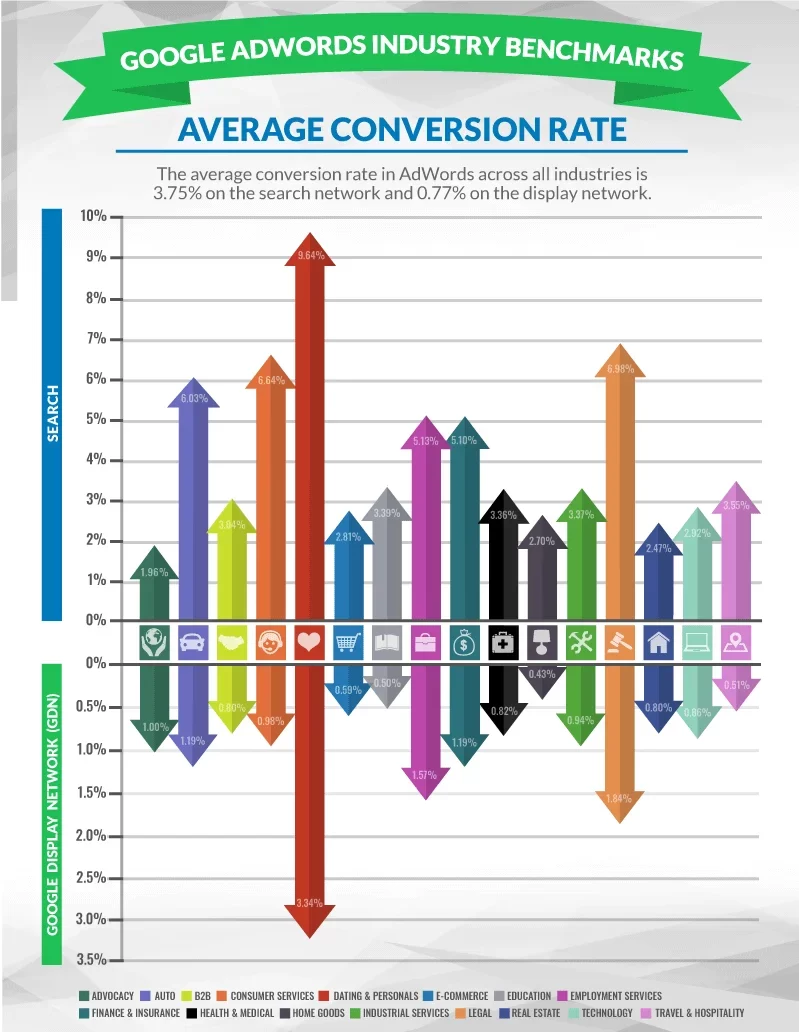
The average conversion rate across all industries is 0.57% for display campaigns and 4.40% for search campaigns. This significant difference reflects the fundamental intent gap between the two ad types. Search ads connect advertisers with users who have a defined, active intent to find information or make a purchase — naturally resulting in a much higher propensity to convert.
Display ads, by contrast, reach users who are in a passive discovery state, which means brand exposure is valuable, but immediate conversion is less likely. This does not make display ads less effective — it means they serve a different purpose in the customer journey.
Source: WordStream
Cost Per Click (CPC)
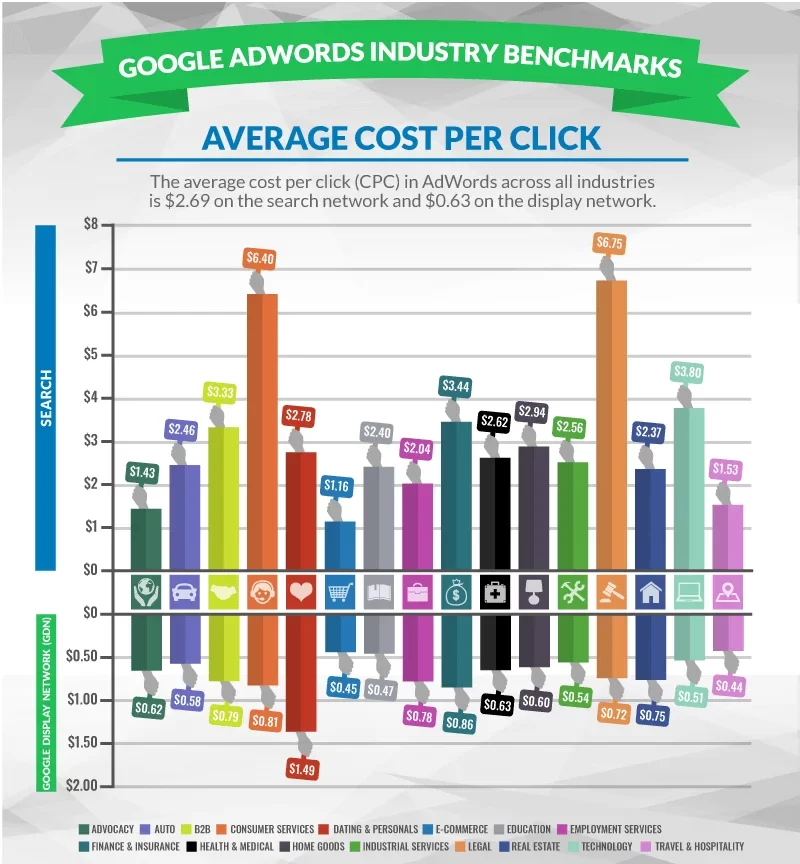
Display ads carry a significantly lower average cost per click than search ads. The average CPC for display ads is approximately $0.59, compared to around $2.41 for search ads.
The lower CPC of display ads makes them attractive for high-volume awareness campaigns, particularly when the goal is impressions and brand recall rather than direct conversions. However, the higher CPC of search ads is often justified by the superior conversion rate — a $2.41 click that converts at 4.4% may ultimately cost far less per acquisition than a $0.59 click converting at 0.57%.
CPC ranges also vary significantly by industry. Competitive sectors like legal services, finance, and healthcare often see search ad CPCs of $10–$50+, while display CPCs in those same sectors remain comparatively low — making display an attractive supplementary channel for budget efficiency.
 Source: WordStream
Cost Per Action (CPA)
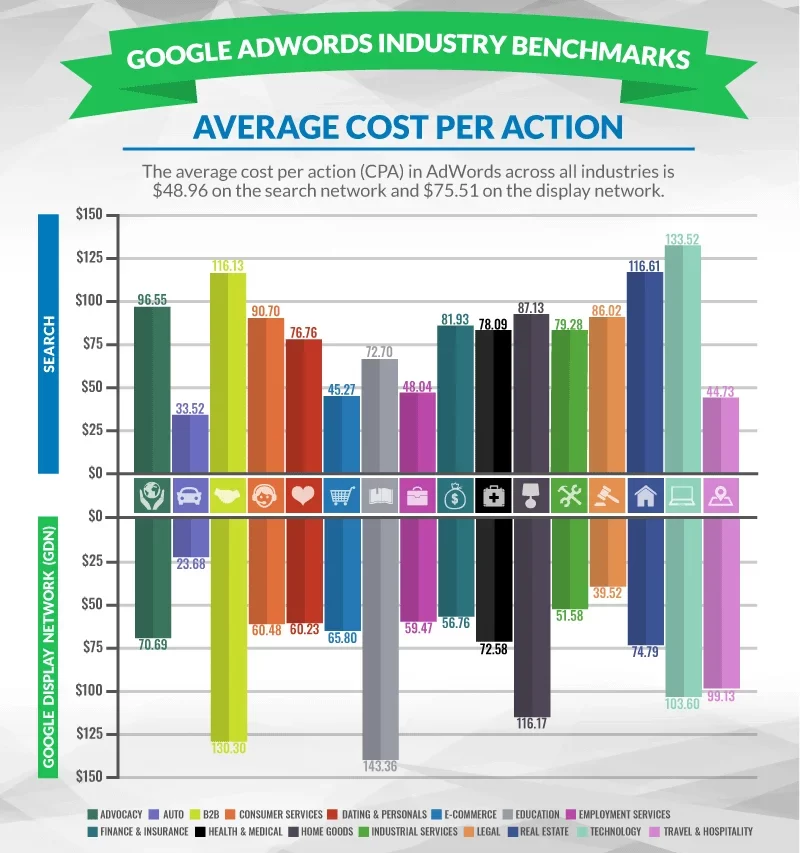
While search ads are more expensive on a cost-per-click basis, their higher conversion rate means the average CPA (cost per action or acquisition) is considerably lower. The average CPA in Google Ads across all industries is $48.96 for search campaigns and $75.51 for display campaigns.
This CPA gap makes search ads the more cost-efficient choice for direct response objectives. Display’s higher CPA is acceptable when the objective is brand building, audience priming, or retargeting — where the value extends beyond direct conversions to influencing long-term purchase behaviour.
Source: WordStream
Top Display Ad Networks in 2026
Choosing the right display advertising network is as important as the ad creative itself. Different networks offer different audience profiles, reach, pricing models, and targeting capabilities. Here is a breakdown of the top online display advertising networks available to advertisers in 2026.
| Network |
Global Reach |
Best For |
Pricing Model |
| Google Display Network (GDN) |
90%+ of internet users worldwide |
Broad reach, remarketing, responsive ads |
CPM / CPC / tCPA |
| Meta Audience Network |
3 billion+ users across Facebook & Instagram |
Social-interest targeting, eCommerce, B2C |
CPM / CPC / CPA |
| Amazon DSP |
300 million+ active Amazon shoppers |
eCommerce, retail brands, purchase-intent targeting |
CPM |
| Microsoft Audience Ads |
LinkedIn profile data + MSN/Bing ecosystem |
B2B marketers, professional audiences |
CPM / CPC |
| AdRoll |
1.2 billion+ digital profiles |
Cross-channel retargeting, SMBs |
CPM / CPC |
| Criteo |
700+ million daily active users |
Dynamic product retargeting, eCommerce |
CPC / CPA |
| Taboola |
500 million+ daily unique users |
Native content discovery, editorial sites, awareness |
CPC / CPM |
| Outbrain |
290,000+ premium publisher sites |
Content marketing, native advertising, brand storytelling |
CPC / CPM |
The right choice of display ad network depends on your target audience, industry vertical, budget, and campaign objective. Many sophisticated advertisers use two or more networks simultaneously to maximise reach, test audience responses, and balance performance across channels. For businesses running SEO packages alongside paid campaigns, aligning your display network targeting with your organic keyword strategy can amplify results significantly.
Advantages of Display Ads and When to Choose Display
High-Quality Visuals Drive Engagement
One of the most significant advantages display ads hold over search ads is their ability to incorporate rich visual formats — static images, animated GIFs, video, and interactive rich media. For industries where aesthetics drive purchasing decisions — home décor, fashion, travel, beauty, automotive — visual storytelling is far more persuasive than a text-based search listing.
Google’s ecosystem now makes video campaign creation accessible to all advertisers. Video display ads consistently achieve higher engagement rates than image-based formats because users are more likely to stop, watch, and remember video content. Dynamic Creative Optimisation (DCO) technology takes this further by automatically assembling personalised ad creatives from a library of assets based on audience signals.
Reaching Audiences at Every Stage of the Funnel
Display ads are uniquely capable of reaching users who are not yet in active buying mode. Many potential customers are in the discovery or consideration stages — they may have a problem but have not yet started researching solutions. Display advertising can introduce your brand to these audiences before they enter the search funnel, shaping their awareness and preference before they ever search for your keywords.
This is particularly valuable in competitive markets where search ads face high CPCs. By building brand familiarity through display, you increase the probability that a user will choose your brand when they do eventually search — and may even search for your brand by name, generating high-converting branded traffic.
Ideal for Long Sales Cycles
Display ads are the preferred choice when your product or service is not an impulse purchase. High-consideration categories — enterprise software, B2B services, real estate, automotive, luxury goods — involve extended research periods where customers need multiple touchpoints before committing. Display advertising, particularly through remarketing, allows brands to maintain presence throughout this extended journey.
To build a sustained brand presence across these longer cycles, the most effective display strategies combine:
- Cross-channel marketing – Displaying your ads across multiple devices and digital marketing channels for consistent exposure
- Omni-channel marketing – Creating a seamless, coordinated user experience across all channels relevant to the customer journey
- Retargeting – Serving tailored ads to users who have previously visited your website or engaged with your brand content
Precise Audience Targeting at Scale
Modern display advertising platforms offer sophisticated targeting options that go far beyond basic demographics. Advertisers can target by in-market audiences (users actively researching specific product categories), affinity audiences (users with demonstrated long-term interests), life events, custom intent audiences based on search behaviour, and contextual relevance of the web page being viewed.
Choose Display Ad Networks When:
- Your goal is building brand awareness and reaching a broad audience cost-efficiently
- Your creative assets are visually compelling — images, video, infographics, or rich media
- Your product has a long consideration or sales cycle (30+ days)
- You want to retarget website visitors who did not convert on their first visit
- Your budget allows for CPM-based campaigns focused on impression volume
Advantages of Search Ads and When to Choose Search
For businesses with smaller marketing budgets or those needing immediate, measurable results, search ads offer a level of precision and accountability that is difficult to match. Search advertising allows you to reach exactly the right person at exactly the right moment — when they are actively looking for what you offer.
Capture High-Intent Traffic and Drive Conversions
The defining advantage of search ads is intent alignment. A user typing “buy SEO services for small business” into Google is at the bottom of the funnel with a clear purchase intent. Search ads can intercept that user at the precise moment of decision, directing them to a targeted landing page optimised for conversion. This is why search ads consistently outperform display ads on direct conversion metrics. For businesses looking to complement paid search with organic growth, our SEO services help build sustainable long-term visibility alongside paid campaigns.
Keyword-Level Targeting for Qualified Leads
Search advertising offers multiple keyword match types — broad match, phrase match, and exact match — that give advertisers precise control over which search queries trigger their ads. Combined with a well-maintained negative keyword list, this prevents wasteful spend on irrelevant traffic and ensures your budget is focused entirely on users most likely to convert. Understanding and applying keyword match types strategically is a foundational skill for maximising click-through rate in search campaigns.
Fast Results with Measurable ROI
Unlike SEO, which builds rankings over months, search ads can deliver traffic within hours of campaign launch. This speed makes search advertising invaluable for new product launches, seasonal promotions, competitive conquesting, and any situation where immediate visibility is required. Every click, conversion, and cost can be tracked with precision, making ROI calculation straightforward and allowing rapid optimisation.
Perfect for Emergency and Immediate-Need Services
For service businesses where customers need immediate solutions — plumbers, locksmiths, electricians, emergency medical services, towing companies — search ads are the only viable paid advertising format. These searches happen on mobile devices with strong local intent, and the user needs a provider immediately. Ad extensions such as call extensions (allowing one-tap calling) and location extensions (showing your proximity) are critical for these high-urgency categories. This intent-driven advantage makes search ads a core recommendation in any Google Ads strategy for local businesses.
Budget Efficiency Through Precise Control
Search ads offer unmatched budget control. Advertisers can set daily spend caps, bid adjustments by device, time of day, and location, and use automated Smart Bidding strategies that optimise for specific target CPA or ROAS goals. This granularity means even small budgets can be deployed efficiently when campaigns are well-structured and negative keywords are actively managed.
Choose Search Ads When:
- You need to capture users with immediate, high purchase intent
- Your goal is generating quick, measurable leads or sales
- You are targeting specific, high-intent keywords relevant to your product or service
- You want a highly targeted approach to reach users at the bottom of the funnel
- Your product has a short consideration cycle and users typically convert on their first or second visit
How to Optimise Your Display Ad Campaigns for Better ROI
Running display ads is only the first step. Sustained performance requires ongoing optimisation. Here are seven proven tactics for maximising the effectiveness of your display advertising campaigns.
- Segment your audiences precisely: Avoid broad, untargeted reach by segmenting audiences into distinct groups — in-market buyers, remarketing lists, custom intent audiences, and lookalike audiences. Tailor your creative and messaging to each segment’s specific needs and stage in the funnel.
- Apply frequency capping: Overexposure kills display ad performance. Set impression frequency caps (typically 3–7 impressions per user per day) to prevent audience fatigue and banner blindness, which waste budget without generating conversions.
- A/B test creative elements continuously: Test multiple versions of headlines, images, CTAs, and colour schemes. Even small creative changes can dramatically shift CTR. Google’s responsive display ads automate much of this testing by combining multiple assets and learning which combinations perform best.
- Build robust retargeting funnels: Create audience lists based on specific pages visited, time spent on site, and actions taken. Serve different ad messages to users who viewed a product page versus those who added to cart but did not purchase. Personalised retargeting significantly reduces CPA.
- Use contextual targeting alongside audience targeting: Supplement audience targeting with contextual targeting — placing ads on pages with content that is semantically relevant to your product. This improves ad-to-content alignment and generally increases CTR.
- Monitor and improve viewability scores: An ad that is never seen cannot convert. Use Google’s Active View metrics to track viewability (percentage of ad impressions where at least 50% of the ad was visible for 1+ second) and exclude placements with consistently low viewability.
- Implement conversion tracking from day one: Without proper conversion tracking, display campaign optimisation is guesswork. Set up Google Ads conversion tracking and import Google Analytics goals to accurately measure CPA, ROAS, and campaign contribution to revenue.
Combining Display and Search Ads for Maximum ROI
The most effective digital advertising strategies do not treat display and search as competing choices — they treat them as complementary channels that, when coordinated, outperform either channel running in isolation.
Research published by the Harvard Business School found that display ads positively impact search conversion rates. When display and search ads are run together, they create a reinforcing dynamic: display builds the awareness and familiarity that makes users more likely to click on your search ad when they eventually search for your category — and more likely to convert once they do.
A proven integrated framework uses each channel for its natural strength:
- Top of funnel (Awareness): Use display ads to introduce your brand to cold audiences. Focus on CPM-based campaigns with visually compelling creative on the highest-reach networks (GDN, Meta Audience Network). Measure success by branded search lift and reach.
- Middle of funnel (Consideration): Use display remarketing to re-engage users who visited your site but did not convert. Serve educational content, case studies, testimonials, and product demonstrations. Use RLSA on search to bid more aggressively on users who have already shown interest.
- Bottom of funnel (Conversion): Focus search ad budget on high-intent, bottom-of-funnel keywords. Target users who are actively comparing solutions and ready to purchase. Use dedicated, high-converting landing pages aligned tightly to the search query. Learn how to optimise these pages by reading our guide on improving landing page conversion rates.
This full-funnel approach ensures your brand is present at every stage of the customer journey, maximising the probability of conversion and reducing overall cost per acquisition across both channels.
Display Ads vs Search Ads: Your Decision Guide
Not sure which ad type is right for your current campaign objective? Use this decision framework to guide your choice based on your specific business situation.
| Your Situation |
Choose Display Ads ✓ |
Choose Search Ads ✓ |
| Campaign Goal |
Brand awareness, product launch, retargeting |
Lead generation, direct sales, sign-ups |
| Sales Cycle |
Long (30+ days consideration period) |
Short (immediate decision or purchase) |
| Budget |
Larger budget; CPM reach campaigns |
Smaller budget; pay only when clicked |
| Product Type |
Visually-driven products (fashion, travel, home decor) |
Solution-based products (software, services, B2B) |
| Audience Awareness |
Brand is unknown; need to build familiarity |
Users are actively searching for your category |
| Primary KPI |
Impressions, brand recall, retargeting conversions |
Clicks, conversions, CPA, ROAS |
Frequently Asked Questions: Display Ads vs Search Ads
What is the difference between display ads and search ads?
Search ads appear on search engine results pages when users actively search for a keyword — this is called “pull” advertising. Display ads appear across websites, apps, and YouTube based on audience targeting parameters — this is “push” advertising. Search ads typically deliver higher conversion rates (around 4.4%) while display ads offer much broader reach, covering over 90% of internet users worldwide through networks like the Google Display Network.
Which is better: display ads or search ads?
Neither is universally better — the right choice depends on your specific business objectives. Search ads are best for capturing users with high buying intent and achieving direct conversions. Display ads are best for building brand awareness, running retargeting campaigns, and reaching audiences with longer consideration cycles. The strongest digital advertising strategies typically use both in a coordinated full-funnel approach.
What are the top display ad networks in 2026?
The leading online display advertising networks in 2026 include the Google Display Network (GDN), Meta Audience Network, Amazon DSP, Microsoft Audience Ads, AdRoll, Criteo, Taboola, and Outbrain. The choice of network should be driven by where your target audience spends time online and which network best supports your campaign’s targeting requirements and budget.
What is the average CPC for display ads vs search ads?
The average CPC for display ads is approximately $0.59, compared to approximately $2.41 for search ads. While search ads cost significantly more per click, they deliver a much higher conversion rate (4.4% vs 0.57% for display), which typically results in a lower average cost per acquisition for direct response campaigns.
What is the difference between paid search and display advertising?
Paid search (also known as SEM — Search Engine Marketing) targets users who are actively searching on Google or Bing using specific keywords. Display advertising targets users who are passively browsing websites, apps, and platforms based on their demographics, interests, or browsing behaviour. In simple terms: paid search captures existing demand, while display advertising creates new demand.
Is SEM the same as search ads?
SEM (Search Engine Marketing) is a broad umbrella term covering all forms of paid advertising on search engines, including search ads (PPC/pay-per-click), shopping ads, and local service ads. Search ads are one specific ad format within SEM. While all search ads are a component of SEM, SEM encompasses a wider range of paid search formats beyond text-based PPC ads.
Conclusion
Both display ad networks and search ads are powerful advertising tools that serve distinct and complementary roles in a comprehensive digital marketing strategy. The key is understanding their strengths and applying each format where it is most effective.
Use this summary to guide your final decision:
| Choose Display Ads If… |
Choose Search Ads If… |
| You want broad brand awareness at scale |
You want to capture users with clear purchase intent |
| Your product benefits from visual storytelling |
Your audience is actively searching for your solution |
| You have a long sales cycle (30+ days) |
You need fast, measurable results and conversions |
| You want to retarget past website visitors |
You offer emergency or immediate-need services |
| You want to build brand familiarity before search |
You have a limited budget and need cost-efficient leads |
When you connect your ads to well-optimised landing pages and align your creative messaging with your audience’s intent, both display and search ads can deliver exceptional results. The most successful advertisers view these two channels not as competing options, but as complementary tools that work together to build pipeline at every stage of the customer journey.
Your decision should ultimately be grounded in your advertising goals, target audience profile, sales cycle length, and available budget. Many businesses and brands use both types of ads simultaneously to create a balanced, full-funnel approach that maximises visibility, lead quality, and revenue. When it comes to building a winning digital strategy, combining paid advertising with strong organic foundations through professional SEO services delivers the most sustainable and scalable growth.