Your advertising headline has one job: stop the scroll and earn the click. It is the most-read element of any ad — online or offline. David Ogilvy, the father of modern advertising, famously noted that five times as many people read the headline as read the body copy — meaning roughly 80% of your ad’s success is decided before a reader ever reaches your first sentence.
Whether you’re writing a Google Ads headline, a Facebook ad, a landing page header, or an email subject line, the same truth applies: a weak headline wastes your entire ad budget, while a strong one can increase click-through rates by 30–50% without changing a single word of your body copy.
In this complete guide, you’ll learn how to write high-converting advertising headlines using proven formulas, psychological triggers, real-world examples, and a step-by-step framework used by top copywriters and performance marketers in 2026. From knowing your audience to A/B testing your best performers, every strategy is covered below.
An advertising headline is the first line of text in any advertisement — whether it appears in a Google Search Ad, a Facebook sponsored post, a landing page hero section, an email subject line, or a print campaign. Its sole purpose is to capture attention instantly and compel the reader to engage further with the ad content.
Unlike body copy, which explains and persuades, a headline must do something harder: it must earn the next two seconds of a reader’s attention in an environment flooded with competing messages. Research from Nielsen Norman Group shows that web users decide within 10–20 seconds whether to stay on a page — and the headline is almost always the deciding factor.
There are several common types of advertising headlines, each serving a different strategic purpose:
Headline Type
Purpose
Best Used In
Benefit Headline
Communicates the primary outcome the reader will gain
Landing pages, Google Ads, Facebook Ads
How-To Headline
Promises a practical, actionable solution
Blog ads, YouTube pre-rolls, email campaigns
Question Headline
Triggers curiosity by addressing a pain point as a question
Facebook Ads, display ads, landing pages
Number/List Headline
Sets clear expectations and adds specificity
All digital channels — universally effective
Social Proof Headline
Builds trust using testimonials or user counts
E-commerce, SaaS, service landing pages
Urgency/Scarcity Headline
Drives immediate action through FOMO
Promotional ads, retargeting campaigns
Curiosity/Cliffhanger Headline
Withholds just enough information to compel a click
Native ads, email subject lines, social posts
Know Your Audience Needs
The foundation of every high-converting advertising headline is a deep understanding of your target audience. Before writing a single word, you must know what they want, what keeps them up at night, and what language they use to describe their problem — because the best headlines speak in the reader’s own voice.
Start by analysing the search keywords your audience uses to find products or solutions like yours. These queries reveal not just what people want, but how urgently they want it and what language resonates with them. Look for recurring pain points, desired outcomes, and objections in customer reviews, forums, and social comments — these are your headline goldmines.
Consider the awareness level of your audience too. A customer searching “affordable running shoes” is already product-aware and price-sensitive — your headline should reflect that. Someone searching “why do my feet hurt when running” is problem-aware but not yet solution-aware — your headline needs to bridge that gap. Matching your headline to the reader’s awareness stage is one of the most under-used conversion techniques in digital advertising.
If your customers are searching for ‘affordable shoes’ or ‘footwear on sale’, your headline should reflect exactly that intent. Add terms that speak directly to their desire — ‘50% off’, ‘prices are down’, or even better: ‘Premium Running Shoes — Now 50% Off. Today Only.’
Be More Like a Relevant Solution
Once you understand your audience’s pain points, your next job is to position your headline as the answer. The most effective advertising headlines don’t just describe a product — they promise a transformation. Use the Pain-Agitate-Solution (PAS) copywriting formula to structure your thinking: identify the pain, make the reader feel it, then present your solution as the relief they’ve been looking for.
The Pain-Agitate-Solution (PAS) formula is one of the most trusted frameworks in direct-response copywriting. It works because it mirrors the reader’s internal monologue — the problem they’re experiencing, the frustration it causes, and the relief your solution provides. Applied to headline writing, PAS helps you craft copy that feels personally relevant rather than generic.
Method 1:Ask a question that addresses the customer’s common pain point or struggle. Make them feel seen — and curious about the answer.
For Example: “Struggling with weight loss? Not anymore!”
Method 2: Directly lead with the benefit or solution. Focus entirely on the positive outcome — what the reader gains — without dwelling on the problem. Clear, outcome-focused headlines consistently outperform vague ones in A/B tests.
For Example: “Double Your Productivity in Just 10 Minutes a Day.”
Method 3: Leverage social proof and testimonials. Show that real people have already solved the same problem using your product or service. Social proof reduces purchase risk and builds instant credibility — one of the most powerful psychological triggers in advertising.
For Example: “Join 10,000+ Satisfied Customers Who Lost Weight with Our Program!”
Method 4: Promise a clear transformation or outcome. Speak directly to the specific, desired end result your audience is seeking. Outcome-driven headlines outperform feature-focused ones because readers buy results, not products.
For Example: “Transform Your Skin in 7 Days with Our Natural Formula”
Method 5: Lead with your Unique Selling Proposition (USP). What makes your solution different from every competitor targeting the same keyword? Your USP should answer the reader’s implicit question: “Why you, and not everyone else?”
For Example: “Get Faster Results with Our Exclusive 3-Step Weight Loss Formula”
Add Numbers and Lists
Numbers are one of the most reliable tools in a copywriter’s arsenal — and the data backs this up. According to CoSchedule’s headline research, headlines containing numbers generate up to 36% more clicks than those without. Why? Because numbers signal specificity, credibility, and clear value in a single character.
Whether you’re writing a Google Ads headline, a landing page header, or a Facebook Ad, adding a precise figure transforms a vague claim into a believable promise. “Increase your profit” is forgettable. “Increase Your Profit by 23% in 30 Days” is credible, specific, and compelling — the reader can visualise exactly what they’re being offered.
Below, we have written heading samples with and without numbers. Compare both formats and see how specificity changes the impact:
Headings (without numbers)
Headings (with numbers)
“Increase Your Profit In a Month”
“Increase Your Profit by 23% in 30 Days”
“BizBoost: Trusted By Many Business Owners”
“BizBoost: Trusted By 20K Business Owners”
–
“Would an Extra $5K/Mo Change Your Life?”
“Increase Your Sales”
“Increase Your Sales by 50%.”
“Tips to Improve Your Health”
“5 Tips to Improve Your Health”
Pro tip: Use odd numbers where possible (5, 7, 9, 11) — studies consistently show they outperform even numbers in headline CTR, likely because they feel less “rounded up” and therefore more authentic. Also, spell out the benefit in the number — don’t just write “5 Tips”, write “5 Tips That Cut Your Ad Spend in Half.”
Use Strong Verbs and Power Words
Sell the emotion, not just the feature. This principle — sometimes called emotional selling — is at the heart of every headline that converts. Readers don’t buy products; they buy feelings: confidence, security, belonging, relief, excitement. The words you choose in your headline determine whether you trigger those feelings or leave the reader cold.
Power words are specific, emotionally charged terms proven to increase engagement and click-through rates. They work by activating psychological triggers — curiosity, trust, urgency, desire, or fear of missing out (FOMO) — that push a passive reader into an active clicker. When paired with strong action verbs (“Discover”, “Unlock”, “Transform”, “Claim”), they create headlines that feel impossible to ignore.
Examples of power words:
Free
New
Exclusive
Guaranteed
Proven
Transformative
Remarkable
Secret
Amazing
Discover
Uncover
And more
To use power words most effectively, match the emotional category to your campaign goal. Trust words (“Proven”, “Guaranteed”, “Certified”) work best for high-consideration purchases. Curiosity words (“Secret”, “Revealed”, “What Nobody Tells You”) work best for content-led ads. Urgency words (“Today Only”, “Ending Soon”, “Last Chance”) work best for promotional and retargeting campaigns. The following are high-converting titles built using the power words above:
“Discover the Secret to a Happier, Healthier You – Guaranteed!”
“Transform Your Life with This Remarkable New Method”
“Uncover the Amazing Benefits of Our Exclusive Wellness Program”
“Experience Proven Results with Our Free Trial Offer – Sign Up Now!”
“Get Exclusive Access to Proven Strategies for Financial Freedom”
“Discover the Power of Our Remarkable Skin Care Solution”
“Experience the Joy of Guaranteed Results – Try It Now!”
Create a Sense of Urgency and Scarcity
Power words activate emotion — but urgency and scarcity convert that emotion into immediate action. This is the psychology of FOMO (Fear of Missing Out) applied to advertising. When a reader believes that a deal, offer, or opportunity is genuinely time-limited or supply-limited, the mental cost of delaying a decision rises sharply. That psychological pressure is what separates a reader who thinks “I’ll come back to this later” from one who clicks right now.
One important caveat: urgency and scarcity only work when they are genuine. False scarcity (“Only 3 Left!” when you have 3,000 in stock) erodes brand trust and can increase bounce rates when readers land on a page that contradicts the headline. Use real deadlines, real inventory limits, and real limited-edition offers — and your urgency headlines will convert consistently. You have to use certain keywords, terms, and phrases in your ad headings to achieve this goal. For example, here is the list of common phrases we found:
Examples of terms/phrases to create a sense of urgency and scarcity:
Limited Time Offer
Only Today
Only 3 Left in Stock
Act Now
Last Chance
Don’t Miss Out
Ending Soon
Limited Availability
Order Now
Today Only
Only a Few Left
Flash Sale
Reserve Your Spot
One Day Only
Special Offer Ends Soon
Sale Ends Midnight
Limited Edition
Ending in 24 Hours
Using the above-mentioned terms/phrases, you can generate titles like:
“Last Chance! Get 50% Off Before It’s Gone.”
“Flash Sale Ending Soon – Don’t Miss Out!”
“Hurry, Limited Stock Available – Grab Yours Today!”
“Don’t Miss Out – Only 3 Left in Stock! Get Yours Today!”
“Exclusive Offer: 24-Hour Sale – Shop Before It’s Gone!”
“One Day Only: Buy One, Get One Free – Act Fast!”
10 Proven Headline Formulas That Convert (With Examples)
The most reliable way to write high-converting advertising headlines is to use tested, proven formulas — structural templates that have been refined through decades of direct-response advertising and millions of A/B tests. These aren’t shortcuts; they’re frameworks that encode the psychology of persuasion into a repeatable structure you can adapt for any product, audience, or platform.
Formula
Template
Example
Why It Works
1. How-To
How to [Achieve Desired Outcome] [Without Pain Point / In Timeframe]
“How to Double Your Ad CTR Without Increasing Your Budget”
Promises a practical solution. The “without” variation removes the reader’s biggest objection in the headline itself.
2. Number + Benefit
[Number] Ways/Tips/Strategies to [Achieve Outcome]
“7 Proven Strategies to Write Google Ads Headlines That Convert”
Numbers create specificity and set clear expectations. Readers know exactly what they’ll get.
3. Question
Are You [Experiencing Pain Point]? Here’s [Solution].
“Still Wasting Money on Ads That Don’t Convert? Read This.”
Speaks directly to a frustration. The reader feels understood, which earns the next click.
4. Social Proof
[Number]+ [People/Customers] [Achieved Outcome] with [Product/Method]
“Over 50,000 Marketers Use This Headline Formula to Boost CTR”
Reduces perceived risk. If others have succeeded, the reader is more confident to try.
5. Curiosity Gap
The [Surprising/Little-Known] [Thing] That [Outcome]
“The One Word That Increased This Ad’s CTR by 47%”
Withholds just enough information to make clicking feel irresistible. Works especially well in native and social ads.
6. Benefit + Feature
[Primary Benefit] — Powered by [Unique Feature/Method]
“Better Ad Results — Powered by AI-Driven Headline Testing”
Leads with what the reader cares about (outcome), then justifies it with the mechanism (feature).
7. Counterintuitive
Why [Common Belief] Is Wrong (And What to Do Instead)
“Why Shorter Headlines Don’t Always Convert Better — And What Does”
Challenges assumptions to trigger curiosity. Positions the brand as an authority with insider knowledge.
8. Urgency + Benefit
[Benefit] — But Only [Until Deadline / For Limited People]
“Get 40% Off Our Ad Copywriting Course — Offer Ends Tonight”
Combines desire (benefit) with urgency (deadline) for maximum conversion pressure.
9. Before–After–Bridge
Stop [Old Way]. Start [New Way]. [Outcome].
“Stop Guessing Your Headlines. Start Testing. Watch CTR Soar.”
Contrasts the reader’s current state with a better future. Creates movement — from problem to solution.
10. Case Study / Result
How [Person/Company] Achieved [Result] in [Timeframe]
“How This SaaS Brand Increased Ad Conversions by 63% in 30 Days”
Real-world proof is more persuasive than abstract claims. Specificity makes the result believable.
Writing High-Converting Headlines by Digital Marketing Channel
Different advertising platforms have different technical constraints, audience behaviours, and best practices for headlines. A headline formula that dominates on Google Search may fall flat on Facebook — and vice versa. Understanding platform-specific headline requirements is essential for running high-performing campaigns across digital marketing channels in 2026.
Channel
Character Limit
Primary Goal
Top Headline Strategy
Example
Google Search Ads (RSA)
30 chars per headline (up to 15 headlines)
Match search intent; earn click over competitors
Include the exact keyword + a benefit or CTA. Use Dynamic Keyword Insertion (DKI) for high-relevance variations. Headline 1 = keyword, Headline 2 = USP, Headline 3 = CTA.
“Advertising Headlines That Convert | Free Copy Audit — Book Now”
Facebook / Meta Ads
~40 chars recommended (truncates on mobile)
Stop the scroll; spark curiosity or desire
Lead with emotion or a bold claim. Questions and curiosity gaps outperform benefit-only headlines on social feeds. Avoid corporate language — conversational tone wins.
“Your ads aren’t converting. Here’s why.”
Landing Pages
No limit — but 6–12 words is proven optimal
Immediately confirm the visitor is in the right place
Clarity beats cleverness 9 times out of 10. State the core USP above the fold. Pair with a supporting subheadline that adds specificity. A/B test 2–3 variants.
“High-Converting Ad Headlines — Written by Expert Copywriters”
Email Subject Lines
41 chars on mobile preview
Earn the open in a crowded inbox
Personalisation + curiosity gap is the highest-converting combination. Numbers and questions both outperform statements. Avoid spam trigger words (“FREE!!!”, all caps).
“Your headline is losing you clicks (here’s the fix)”
Display / Banner Ads
25–35 chars typical
Create brand recall and re-engage past visitors
Ultra-short, bold benefit or provocative question. No room for nuance — one clear message only. High visual contrast amplifies headline impact.
“Better Ads. Higher CTR. Proven.”
Don’t Forget to Use AI to Write Headlines
Knowing every headline formula, power word, and psychological trigger is valuable — but applying them consistently across dozens of campaigns, ad sets, and A/B test variants is time-consuming and mentally exhausting. This is where AI-assisted headline writing tools can dramatically speed up your workflow without sacrificing quality.
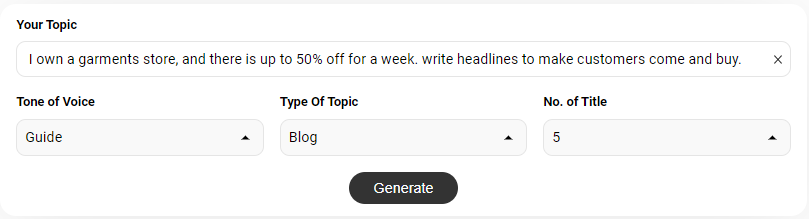
AI headline tools work best when used as a first-draft accelerator, not a replacement for strategic thinking. Feed the tool your target keyword, audience pain point, and desired outcome — then use the formulas and principles from this guide to evaluate, refine, and test the outputs. One such tool is Summarizer’sTitle Generator. These are the steps to write headlines with this AI-based tool:
Enter your topic or prompt into the text input box.
2. Select the tone of voice, type of topic, and number of titles you want to generate.
3. Click on the Generate button to get a list.
4. Wait 2 to 3 seconds and let the tool generate headlines for you.
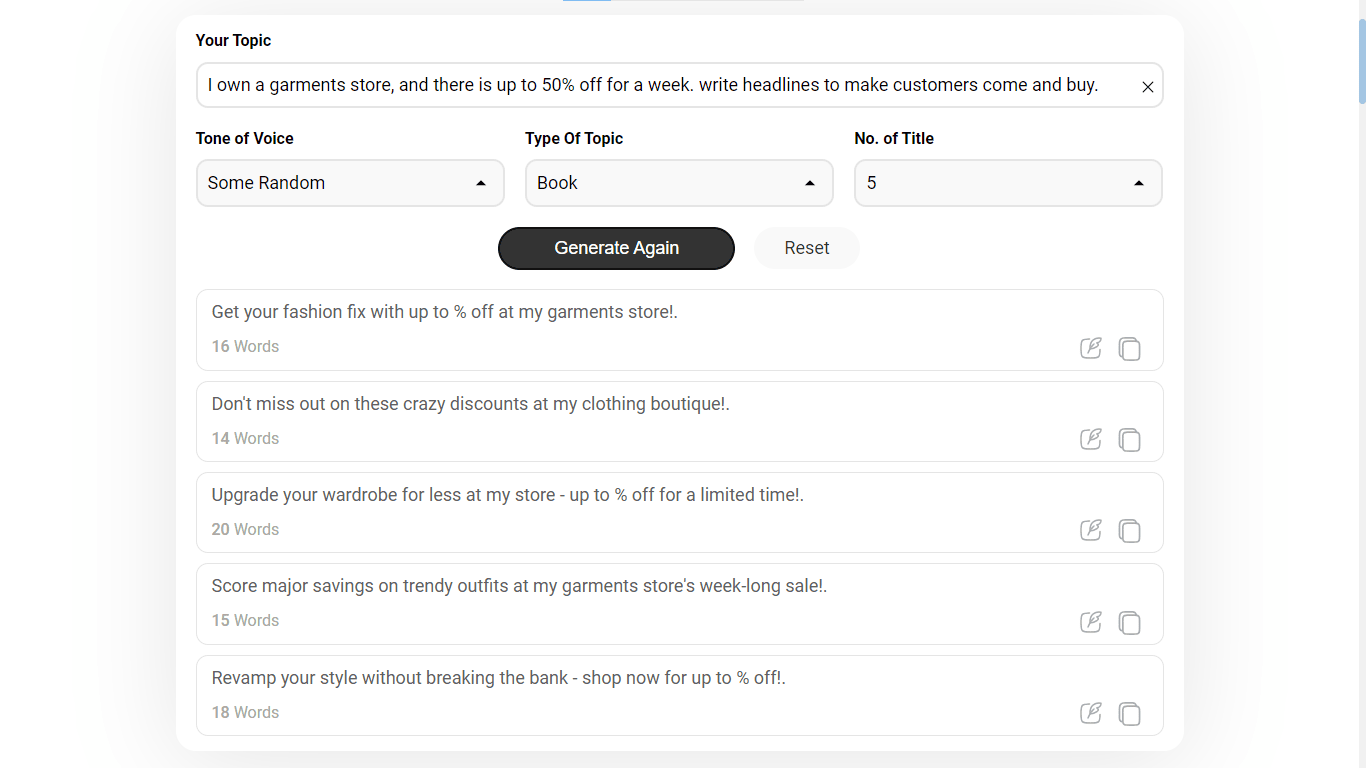
The resulting window looks like this:
Review all the headings generated by the tool. Pick one or two that best resonate with your targeted audience. In the end, work on them to improve further. In the end, choose and use the one that feels the best.
Common Advertising Headline Mistakes to Avoid
Even experienced marketers fall into predictable headline traps that silently kill conversion rates. Knowing what not to do is just as important as knowing the formulas — because a single avoidable mistake can undermine an otherwise strong ad campaign.
Mistake
Why It Kills Conversions
Fix It With
Being vague or generic (“Quality Service You Can Trust”)
Says nothing unique. Every competitor could say the same thing. Readers skip it instantly.
Replace with a specific benefit, number, or outcome: “24/7 Support — Average Response Time Under 2 Minutes”
Headline–landing page mismatch
Creates a trust gap. Visitors feel misled and bounce immediately, raising your cost-per-click and destroying Quality Score.
Ensure your headline promise is delivered word-for-word on your landing page hero section.
Keyword stuffing
Reads as unnatural and spammy. Damages Quality Score in Google Ads and triggers ad rejection on Meta.
Use your primary keyword once, naturally. Let semantic variants carry the rest.
Clever over clear
Wordplay that requires interpretation loses readers in milliseconds. Clarity converts; cleverness confuses.
If your headline takes more than 2 seconds to understand, rewrite it. Clarity wins 9/10 times.
False urgency or scarcity
Erodes brand trust when the reader discovers the “limited offer” is always available. Increases long-term bounce rates.
Only use urgency when it is genuinely real. Real deadlines convert better than manufactured ones anyway.
Ignoring mobile character limits
Headlines truncated on mobile lose context and impact. Over 60% of ad clicks now come from mobile devices.
Front-load your most important words. Lead with the benefit or keyword in the first 25–30 characters.
What We Learnt So Far?
Writing high-converting advertising headlines is part science, part psychology — and entirely learnable. Here is a rapid-fire summary of every strategy covered in this guide:
Start with your audience. Know their pain points, desired outcomes, and awareness level before writing a single word. The best headlines speak in the reader’s own language. Use the right headline type for your goal — benefit headlines for conversions, question headlines for engagement, social proof headlines for trust-building.
Apply proven formulas. The 10 headline formulas covered above — How-To, Number + Benefit, Question, Social Proof, Curiosity Gap, and more — are the structural backbone of every top-performing ad headline. Use numbers to make your headline stand out, like “Increase Your Profit by 23% in 30 Days”. Use strong action verbs and power words — “Discover”, “Proven”, “Guaranteed”, “Exclusive” — to activate emotion and drive clicks.
Create real urgency with phrases like “limited time offer” or “only a few left” — but only when it’s genuine. Keep your headlines short and clear, ideally 5–8 words for most platforms, and always front-load the benefit. Tailor your headline to the platform — Google Ads, Facebook, landing pages, and email all have different character limits and audience behaviours. And never skip A/B testing: even the best headline in the world can be beaten by a better one you haven’t written yet. If needed, use an AI title generator to accelerate your first drafts — then apply the principles from this guide to evaluate and refine them.
Rithik is a seasoned SEO professional with a wealth of experience in the digital marketing landscape. With an impressive track record of enhancing online visibility for businesses, Rithik has solidified his reputation as a dynamic SEO analyst dedicated to delivering remarkable results. He is not just a practitioner but also a contributor to the SEO community. He frequently shares his expertise through insightful SEO tips & innovative approaches.