Building quality backlinks is one of the most powerful things you can do for your website’s organic rankings — but in 2026, the rules of the game have fundamentally changed. Gone are the days when a spray-and-pray email blast could earn you links. Today, successful link building outreach is about building real, lasting relationships, creating genuinely valuable content, and leveraging AI-powered tools to work smarter.
According to recent industry data, 52% of digital marketers consider link building the toughest part of SEO — harder even than content creation. Yet websites with a strong backlink profile generate over 10,500 monthly visits, and 92.3% of the top 100 ranking websites have at least one backlink. The opportunity is enormous — if you approach outreach the right way.
In this comprehensive guide, you will learn proven tactics for effective link building outreach in 2026: how to find the right prospects, craft compelling outreach emails, use AI tools to scale your efforts, and build the kind of long-lasting industry relationships that generate backlinks for years to come.
What is Link Building Outreach?
Link building outreach is the strategic process of reaching out to website owners, bloggers, journalists, and influencers in your industry to earn high-quality backlinks to your site. It goes far beyond simply asking for a link — effective outreach is about offering genuine value, establishing trust, and building relationships that benefit both parties.
Modern link building outreach in 2026 involves four core components:
- Identifying Prospects: Finding websites, blogs, and online platforms in your niche that have the authority and relevance to provide meaningful backlinks — not just any site, but the right sites.
- Personalized Outreach: Crafting individualized messages that speak directly to the prospect’s content and audience — never generic templates or mass email blasts.
- Offering Value: Providing something genuinely useful in exchange — a data study, a guest article, a resource suggestion, or expert insights — rather than simply making a request.
- Building Long-Term Relationships: Treating every outreach touchpoint as the start of an ongoing professional relationship, not a one-off transaction.
What is Link Acquisition — and How is it Different from Link Building?
While the terms are often used interchangeably, link acquisition is the broader process of earning backlinks through any means — organic, outreach-driven, or earned through content quality. Link building outreach is the proactive, manual side of link acquisition, where you actively identify and pursue specific opportunities rather than waiting for links to come to you.
Link acquisition encompasses three categories:
- Manual outreach: Directly contacting websites, bloggers, and journalists to request or pitch for backlinks.
- Digital PR: Creating newsworthy content, data studies, or press releases that attract organic media coverage and links at scale.
- Link earning: Producing content so valuable — tools, original research, comprehensive guides — that other sites naturally reference and link to it over time.
For most businesses, the fastest route to ranking improvement combines all three: a foundation of high-quality linkable content, supported by targeted manual outreach, amplified through digital PR.
Understanding Link Building Fundamentals
Before diving into outreach tactics, it is essential to understand what makes a backlink valuable in 2026.
Backlinks
These are incoming links from other websites pointing to your site. Search engines treat them as votes of confidence — signals that your content is trustworthy, authoritative, and worth ranking. Not all backlinks carry equal weight; quality and relevance matter far more than quantity.
Anchor Text
Anchor text is the visible, clickable text within a hyperlink. Descriptive anchor text aligned with your target keywords positively influences rankings, though a natural mix of branded, generic, and keyword-rich anchors is essential for a healthy backlink profile.
Link Relevance
Links from websites that are topically aligned with your content carry significantly more SEO value than links from unrelated sites. A single backlink from a highly relevant industry publication can outperform dozens of links from off-topic domains.
Link Authority
High-authority, reputable websites pass more link equity than low-quality sources. Domain Authority (DA) and Domain Rating (DR) are commonly used metrics to gauge a site’s authority, though Google’s own signals are far more nuanced — factoring in traffic, engagement, and trustworthiness.
AI-Powered Link Building Outreach in 2026
Artificial intelligence has transformed how SEOs approach link building outreach. Where manual prospecting once took hours per campaign, AI tools now analyze thousands of potential link partners in minutes — identifying the most relevant opportunities, personalizing pitches at scale, and predicting which prospects are most likely to respond.
According to industry research, 65% of SEOs now use AI tools for automated prospecting and personalization in outreach, and 83% of link building platforms use AI for link quality assessment to filter out spammy or toxic sites.
Here is how AI is reshaping outreach in 2026:
- AI-driven prospecting: Tools like Pitchbox and Respona use machine learning to surface websites that naturally align with your niche — going far beyond simple keyword searches to analyze content relevance, audience overlap, and historical linking behavior.
- Personalization at scale: AI can analyze a prospect’s recent content and craft personalized outreach messages that reference specific articles, data points, or content gaps — dramatically improving response rates compared to generic templates.
- Predictive analytics: Advanced tools can forecast which link targets are most likely to generate ranking impact based on competitor backlink data, traffic trends, and topical authority signals.
- LLM optimization: As AI-generated search results (from tools like ChatGPT, Perplexity, and Google’s AI Overviews) become more prominent, backlinks from authoritative sites are increasingly critical for appearing in those AI-driven narratives — not just traditional search results.
The key insight: AI tools work best when combined with human judgment and relationship-building. Use AI to identify and prioritize prospects; use genuine, personalized communication to win the link.
Major Link Building Strategies for 2026
The Skyscraper Technique
Originally developed by Brian Dean of Backlinko, the Skyscraper Technique remains one of the most effective link acquisition strategies — when executed with precision.
The process works in three steps:
- Identify high-performing content in your niche that has already attracted many backlinks.
- Create a significantly improved, more comprehensive version of that content — adding updated data, better examples, richer visuals, and greater depth.
- Reach out to the sites linking to the original piece and inform them of your superior resource.
One case study by Ahrefs demonstrated the technique’s effectiveness: a targeted campaign sent to 515 prospects achieved a 17.55% reply rate and secured 36 editorial links from 32 unique websites. The key is quality: websites that already link to content like yours are pre-qualified prospects who have demonstrated a willingness to link out.
Note: In 2026, the Skyscraper Technique works best on statistics pages, ultimate guides, and data-driven resources — where freshness and comprehensiveness provide clear differentiation from the original.
Guest Posting Outreach
Guest posting — writing original articles for other websites in exchange for a backlink — remains a viable link building strategy in 2026, provided it is executed with strict quality standards. Google’s guidelines are clear: guest posts must be high-quality, relevant, and written for real human audiences, not thin content designed purely for link manipulation.
How to run effective guest posting outreach:
- Target websites with genuine organic traffic and editorial standards, not paid guest post farms.
- Research the publication’s content gaps using Ahrefs’ Competitive Analysis tool — pitch topics they need, not topics they already cover.
- In your pitch, demonstrate familiarity with the site’s audience and explain specifically how your article would add value to their readers.
- Provide double E-E-A-T-approved content: first-hand experience, genuine expertise, authoritative sourcing, and a trustworthy author bio.
Guest posting builds more than backlinks — it establishes long-term relationships with editors and publishers who become recurring contacts for future link opportunities.
Link Insertion (Niche Edit) Outreach
A link insertion — also called a niche edit — involves reaching out to site owners and asking them to add your backlink to an existing, already-indexed piece of content. This approach has gained significant traction because it offers a speed advantage over guest posting: since the host article is already indexed and ranking, the link equity flows to your site much faster.
How to identify link insertion opportunities:
- Use Ahrefs Content Explorer to find pages on relevant sites that rank for your target topics but don’t currently link to your resource.
- Look for content gaps — places where your page would genuinely add value as a reference or additional resource.
- Frame your pitch around the benefit to the publisher’s readers, not your desire for a backlink.
Broken Link Building
Broken link building involves finding dead or broken external links on authoritative websites and proposing your content as a relevant, working replacement. Website owners actively want to fix broken links because they harm user experience and SEO — making this one of the more receptive outreach approaches.
A five-step broken link building process:
- Use Ahrefs’ Site Explorer or the Check My Links Chrome extension to identify broken links on relevant websites in your niche.
- Verify that the broken link pointed to content similar to what you have (or can create).
- If you don’t have a matching resource, create one — the broken link has already told you what kind of content earns links in that space.
- Reach out to the webmaster, politely point out the broken link (positioning it as helpful, not self-serving), and suggest your page as a replacement.
- Follow up once after 5–7 days if you don’t hear back.
Identify Broken Links and Suggest Replacements
Beyond the formal Broken Link Building tactic, you should regularly audit your own link profile for lost or broken inbound links. Reclaiming those is even easier — the site owner already chose to link to you once.
Request Links for Unlinked Brand Mentions
When websites reference your brand name without linking to your website, that is an unlinked brand mention. Converting these into backlinks is one of the easiest outreach wins available because the publication already values your brand enough to mention it — adding a link is a small, low-friction request.
Use tools like Ahrefs Alerts, Google Alerts, or Brand24 to monitor unlinked mentions automatically. When you spot one, reach out with a brief, friendly message thanking the author and asking if they would be willing to add a link for their readers’ convenience.
Analyze Competitor Backlink Profiles
Your competitors’ backlink profiles are a goldmine of pre-qualified link opportunities. If a site has linked to your competitor, they are already receptive to linking to content in your space — which means your outreach has a significantly higher baseline probability of success.
Use Ahrefs or Semrush to:
- Identify your competitors’ top linked content types (guides, statistics, infographics, tools).
- Filter for sites that link to two or more competitors but not to you — these are your highest-priority targets.
- Look specifically for listicles and round-up articles where your brand could be included.
Use HARO and Its 2026 Alternatives
Help a Reporter Out (HARO) was for years the go-to platform for earning editorial backlinks by answering journalist queries. In 2026, HARO has undergone significant changes and become more crowded with both legitimate responses and spam. Smart outreach specialists now diversify across multiple journalist query platforms:
- Connectively (formerly HARO) — still the largest platform, worth monitoring for relevant queries.
- Qwoted — focuses on business, finance, and marketing queries from quality publications.
- Featured.com — expert contribution platform with strong editorial standards.
- ProfNet — PR Newswire’s expert network, used by major media outlets.
The key to success on any of these platforms: respond fast, provide specific and quotable expert insights, and always include your credentials to establish authority.
Get Attention Through Digital PR
Digital PR is where link building meets storytelling, and in 2026 it is one of the fastest-growing link acquisition channels. Unlike traditional cold outreach, Digital PR earns links at scale by creating content that journalists and publishers genuinely want to cover.
Effective Digital PR content in 2026 includes:
- Original data studies and surveys that generate unique statistics journalists can cite.
- Trend reports and industry analyses that position your brand as an authoritative voice.
- Newsworthy campaigns or stunts that tap into trending conversations.
- Expert commentary and thought leadership pieces tied to current events.
The critical shift from 2024 to 2026: generic press releases no longer earn meaningful coverage. You need a genuinely interesting story with original data and a clear relevance to your target publication’s audience.
Link Building for Local SEO
For businesses targeting specific geographic markets — including major metros like Chicago, New York, or regional markets in India and the UAE — local link building adds a powerful dimension to outreach.
Effective local link building tactics include:
- Earning links from local business directories, chambers of commerce, and industry associations in your target region.
- Partnering with local bloggers, news sites, and community organizations for coverage and resource links.
- Sponsoring local events, charities, or meetups that generate branded citation links.
- Pitching locally-focused data stories or research to regional media outlets.
- Building relationships with local influencers and micro-influencers in your niche.
Local backlinks from geographically relevant sites send strong signals to Google about your regional authority — particularly valuable for businesses targeting specific city or regional markets.
Establish Linkable Assets
Linkable assets are pieces of content so useful and unique that other websites naturally want to reference and link to them — often without you having to ask. Building a library of linkable assets reduces long-term outreach burden by generating organic, passive backlinks.
High-performing linkable assets in 2026 include:
- Original industry research, data studies, and annual reports.
- Free tools, calculators, or templates that solve a specific problem.
- Comprehensive “ultimate guides” that cover a topic with genuine depth (2,500+ words).
- Infographics that visualize complex data in a shareable format.
- Statistics pages that aggregate key data points journalists frequently need to cite.
- Expert roundups and thought leadership interviews that incentivize featured experts to share and link.
Applying Effective Outreach Strategies
Identify Relevant Websites and Influencers
Quality prospect research is what separates outreach campaigns that achieve 15–20% response rates from those that land in the spam folder. Spend time building a curated, selective prospect list based on relevance, authority, and realistic linking potential.
Your research for each high-value prospect should include:
- Reviewing their 5–10 most recent articles to understand their tone, depth, and editorial direction.
- Analyzing their most-linked content via Ahrefs to understand what type of resources they reference.
- Identifying the right contact — an editor or content manager who has direct control over the site’s content, not a generic info@ address.
- Looking for a specific angle: what would your content add to their readers that their existing content doesn’t already cover?
Industry data confirms that spending 10–15 minutes on thorough prospect research per high-value target dramatically improves response and conversion rates.
Craft Personalized Outreach Messages
Generic, template-driven outreach is immediately identifiable — and immediately ignored. The single biggest lever for improving outreach success is genuine, specific personalization that demonstrates you have actually read and valued the prospect’s work.
An effective outreach email in 2026 should:
- Reference a specific article, data point, or piece of content from the prospect’s site — not a generic compliment.
- Clearly state why your content would benefit their specific audience (not just why you want a link).
- Be concise — aim for 100–150 words maximum in the initial pitch.
- Have a clear, single call-to-action — don’t ask for multiple things at once.
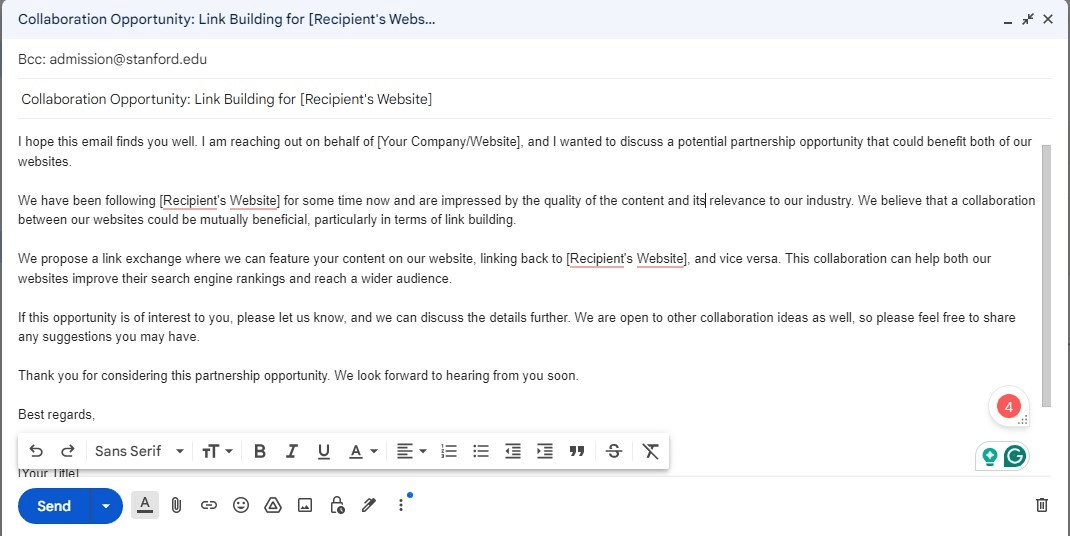
Link Building Outreach Email Templates (Ready to Use)
Here are three proven outreach email templates you can adapt for your campaigns:
Template 1 — Resource Link Suggestion
Subject: Quick resource suggestion for your [Topic] article
Hi [Name],
I came across your article on [specific topic] — really appreciated the depth you went into on [specific point they made].
I recently published a comprehensive guide on [your topic] that includes [specific value: original data / step-by-step process / updated 2026 stats] which I think your readers would find genuinely useful alongside your existing content.
Would you be open to taking a look? Happy to share the link if it seems like a good fit for your audience.
Thanks,
[Your name]
Template 2 — Broken Link Replacement
Subject: Broken link on your [page title] page
Hi [Name],
I was reading your [specific page] and noticed that the link to [description of broken link] appears to be returning a 404 error — thought it might be helpful to flag it.
I have a resource on [similar topic] that covers the same ground and might work as a replacement: [brief description of your resource].
Either way, hope the heads-up is useful!
[Your name]
Template 3 — Guest Post Pitch
Subject: Guest post idea for [their site]: [specific article title]
Hi [Name],
Love what you’re publishing on [their site] — especially your recent piece on [specific article].
I noticed you haven’t covered [specific content gap relevant to their audience]. I’d love to write an original, data-backed piece on [your proposed topic] for your readers.
I’m [your credentials / position] and have written for [credible publications you’ve contributed to]. Happy to share an outline or a few topic options if you’re interested.
[Your name]
Provide a Compelling Reason to Link
Every outreach message needs a clear answer to the prospect’s implicit question: “What’s in it for my readers?” Explain precisely what makes your content uniquely valuable — original data, comprehensive coverage, an updated resource, or expertise not available elsewhere. Emphasize the value to their audience first; your backlink is a byproduct, not the pitch.
Follow Up Strategically
The majority of outreach emails go unanswered on the first send — not because the prospect isn’t interested, but because inboxes are crowded and priorities shift. A single, polite follow-up sent 5–7 days after the initial email can increase response rates by 30–40% without coming across as pushy.
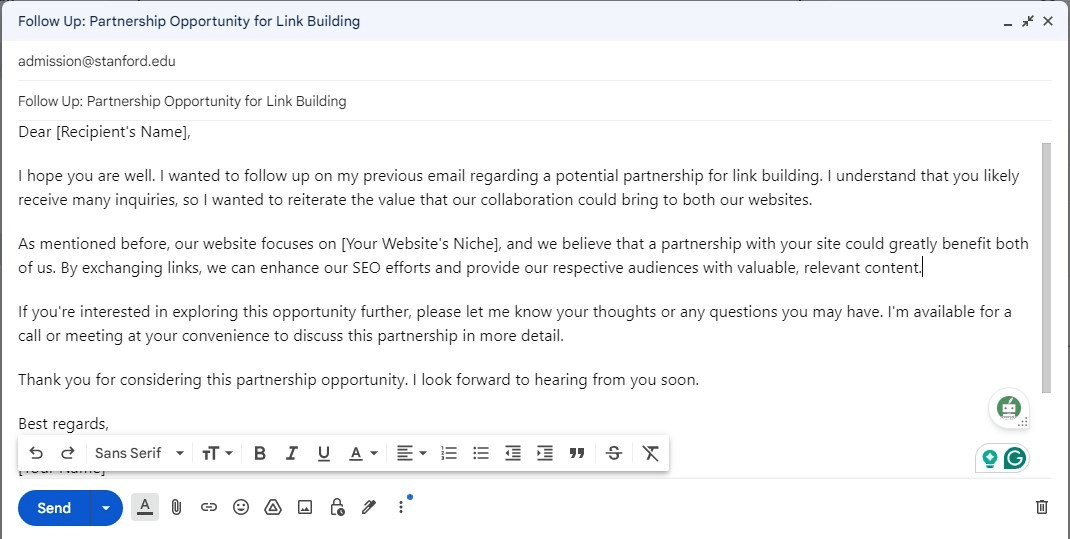
Keep follow-ups brief — just two or three sentences that reference your original email and restate the key value you offer. Never send more than two follow-ups per prospect; beyond that, you risk damaging the relationship before it begins.
Building Meaningful Connections Through Link Outreach
The most successful link builders in 2026 have shifted their mindset from “link acquisition” to “relationship cultivation.” The difference is fundamental: transactional outreach seeks a link; relationship-driven outreach seeks a long-term connection that generates multiple links, collaboration opportunities, and genuine industry authority over time.
Here is how to move from transactional to relational outreach:
Engage Before You Ask
LinkedIn has become the most effective platform for link building outreach in 2026, with 17.3% of SEOs using it as their primary outreach channel. Before sending a formal pitch, engage with a prospect’s content — comment thoughtfully on their posts, share their work, or reply to something they’ve shared. By the time you reach out with a link request, you’re no longer a cold stranger.
Focus on Adding Value First
Offer something before asking for anything: share a piece of data relevant to their work, point out a content opportunity in their niche, or congratulate them on a piece of coverage they’ve received. Givers earn links; askers get ignored.
Leverage Existing Relationships
Your existing professional network is your highest-converting outreach list. A warm introduction or mutual connection dramatically increases the probability of a positive response. Before cold outreach, always check whether any colleagues, clients, or industry contacts have existing relationships with your target prospects.
Nurture Long-Term Relationships
A prospect who has linked to you once is a future collaborator, co-author, or advocate — if you maintain the relationship. Stay in touch through social media, reference their work in your own content, and look for opportunities to provide ongoing value. These compounding relationships build a sustainable pipeline of backlink opportunities over years, not just campaigns.
Importance of Effective Link Building Outreach
Search Engine Optimization (SEO) Benefits
- Relevant and High-Quality Backlinks: Search engines use backlinks as a primary ranking signal for authority and relevance. High-quality links from reputable, topically aligned sites tell Google your content is trustworthy and deserving of prominent placement in search results.
- Improved Organic Traffic: Higher search engine rankings directly translate into increased organic traffic — and data shows that referral traffic from authoritative link sources typically exhibits 30–40% higher engagement metrics than cold search traffic, including lower bounce rates and longer session durations.
- Visibility in AI-Driven Search: With 73.2% of marketers now believing backlinks influence appearance in AI search results like ChatGPT and Google’s AI Overviews, earning links from authoritative sources is essential not just for traditional rankings but for AI-generated narrative visibility.
Brand Awareness and Credibility
- Increased Exposure: Links from influential websites in your industry introduce your brand to new, targeted audiences — people who are already interested in your space and more likely to convert into clients or customers.
- Established Industry Authority: When respected publications link to your content, it functions as a public endorsement of your expertise. Over time, this builds your brand’s reputation as a credible, trustworthy resource — a foundation that compounds in value as your backlink profile grows.
Competitive Advantage
- Outranking Competitors: In competitive niches, a strong and diverse backlink profile is often the decisive ranking factor that separates the first page from the second. Consistent, quality-focused outreach creates a compounding competitive moat that is extremely difficult for competitors to replicate quickly.
- Diversified Backlink Profile: A natural, diverse backlink profile — spanning different domains, content types, and anchor text patterns — is essential for maintaining long-term ranking stability, particularly through Google algorithm updates.
- Long-Term SEO Success: Links built through genuine relationships and high-quality content tend to persist far longer than those acquired through shortcuts — creating sustained organic growth rather than short-term spikes followed by penalties.
Top Effective Outreach Strategies in 2026
Personalized and Targeted Outreach
- Define Your Target Audience: Begin every campaign by defining precisely which types of sites, publications, and influencers are most likely to link to your content. A curated list of 50 highly relevant, thoroughly researched prospects will consistently outperform a bulk list of 500 generic contacts.
- Thorough Research and Preparation: Use tools like Ahrefs Content Explorer, BuzzSumo, and LinkedIn to research each prospect before outreach — understanding their content focus, audience, editorial style, and the types of resources they typically reference.
- Craft Personalized Pitches: Generic outreach is the single biggest reason link building campaigns fail. Your pitch should make each prospect feel that you reached out specifically to them — because you did.
Providing Value and Building Relationships
- Focus on Adding Value: The most successful outreach campaigns offer something tangible — a unique data point, a guest article, an expert quote, or a resource their readers will love. Position the value to their audience as the primary message; the link request as the secondary.
- Encourage Genuine Connections: Use LinkedIn, Twitter/X, and industry communities to engage authentically with prospects before and after outreach. Genuine digital presence amplifies your credibility and makes cold outreach feel less cold.
- Use Existing Relationships: Warm introductions consistently achieve the highest response rates of any outreach method. Always check your network for shared connections before approaching a new prospect cold.
Strategic Follow-Up and Nurturing
- Persistence and Timing: Send your initial email, wait 5–7 days, then send one concise follow-up. Research shows Tuesday through Thursday mornings generate the highest open and response rates for outreach emails.
- Nurture Existing Relationships: For prospects who have already engaged with you or linked to you in the past, continue nurturing those connections — engage with their content, share their work, and look for mutual collaboration opportunities beyond individual link requests.
- Analyze and Optimize: Track key outreach metrics — open rates, reply rates, link acquisition rates, and cost per acquired link — and use that data to continuously refine your targeting, messaging, and timing.
Top Link Building Outreach Best Practices
- Transparency and Authenticity: Be clear about who you are, what you’re offering, and what you’re asking for. Prospects can sense inauthenticity instantly, and any attempt at manipulation will permanently close the door on that relationship.
- Respect and Professionalism: Maintain a respectful, professional tone in every interaction — even when following up, even when rejected. The digital marketing world is small; how you treat people in an outreach email defines your professional reputation.
- Offer Mutual Benefit: The best outreach creates genuine win-win scenarios. Your link provides their readers with a valuable additional resource; their link improves your site’s authority. Frame every pitch around that mutual value.
- Avoid Black Hat Tactics: Link exchanges (“link to me and I’ll link to you”), paid link schemes, and private blog networks (PBNs) violate Google’s Webmaster Guidelines and risk severe penalties. In 2026, white-hat, relationship-driven outreach is both the safest and most effective long-term strategy.
- Relevant Tools & Templates: Streamline and scale your outreach with these proven tools:
Outreach Tools:
- BuzzStream — CRM and relationship tracking for link building campaigns
- Pitchbox — AI-powered outreach automation with personalized follow-up sequences
- Respona — all-in-one prospecting, contact finding, and email outreach platform
- Hunter.io — email finding and verification for prospect contact research
- Ahrefs — backlink analysis, competitor research, and content explorer for prospecting
- NinjaOutreach — influencer discovery and relationship management
Email Template Resources:
- Really Good Emails — inspiration from successful outreach campaigns
- Mailshake Template Library — proven outreach scripts and frameworks
- HubSpot Marketing Email Templates — professional email templates for various outreach goals
How to Plan and Run a Successful Link Outreach Campaign
Step 1: Set Clear Campaign Goals
Before launching any outreach campaign, define specific, measurable objectives. Are you targeting a certain number of backlinks in 90 days? Trying to improve rankings for specific keywords? Attempting to build relationships with publications in a new industry vertical? Your goals shape every decision that follows — from prospect selection to messaging to success metrics.
Step 2: Create High-Quality, Link-Worthy Content
Your outreach can only be as strong as the content you’re promoting. Before scaling your outreach, ensure your target page contains genuine, original value — data, expert insights, practical frameworks, or visual resources that other sites would genuinely want to reference. Investing in linkable content is the single highest-leverage activity in any link building program.
Step 3: Build a Targeted, Curated Prospect List
Research and build your prospect list based on topical relevance, audience alignment, domain authority, and realistic linking potential. Prioritize prospects who have linked to similar content in the past — they have demonstrated a willingness to link out in your space.
Step 4: Personalize Your Pitch and Choose Your Channels
Craft individualized outreach messages for each prospect. Choose your primary outreach channel — email, LinkedIn, or a combination — based on your prospect’s behavior and the nature of your relationship. LinkedIn works exceptionally well for first-touch relationship building; email for formal pitches and follow-ups.
Step 5: Execute, Follow Up, and Track Results
Launch your campaign, track all outreach in a CRM or spreadsheet (recording status, dates, responses, and outcomes), and follow up strategically. Monitor metrics weekly: open rates, reply rates, and link acquisition rates. Use this data to identify which messaging angles, prospect segments, and content types generate the best results.
Tracking and Following Up on Your Outreach Campaigns
Set Your Goals
Every campaign needs measurable objectives — number of backlinks acquired, improvement in keyword positions, increase in referral traffic, or growth in referring domains. Define your KPIs before launch so you can evaluate success objectively.
Choose Your Channels
Email remains the primary outreach channel for most link builders, but LinkedIn, Twitter/X, and even podcast outreach are increasingly effective — particularly for relationship-driven campaigns. Choose channels based on where your target prospects are most active and responsive.
Use Tracking Tools
Essential tracking tools for outreach campaigns in 2026:
- Google Search Console: Monitor impressions, clicks, and ranking position improvements for target keywords as your backlink profile grows.
- Google Analytics: Track referral traffic from new backlinks and analyze engagement metrics to understand link quality.
- Ahrefs or Semrush: Monitor your site’s total referring domain count, new and lost backlinks, and overall Domain Rating trends.
- BuzzStream or Pitchbox: Track outreach campaign metrics — open rates, reply rates, and link acquisition — in a centralized CRM.
Track Your Progress
Review campaign performance weekly or bi-weekly. Correlate link acquisition with ranking improvements — most sites see measurable ranking movements 4–8 weeks after earning quality backlinks, as search engines discover, crawl, and assign value to new links. Use this data to double down on what’s working and deprioritize what isn’t.
When to Hire a Link Building Outreach Agency
Effective link building outreach requires time, consistent effort, established publisher relationships, and deep knowledge of prospecting tools and outreach best practices. Many businesses reach a point where the internal bandwidth simply doesn’t exist to execute at the scale required to move the needle.
Hiring a specialist link building agency makes sense when:
- Your team lacks the time or expertise for consistent, high-quality outreach at scale.
- You’re in a highly competitive niche where outranking competitors requires a significant, sustained backlink acquisition effort.
- You need access to an established network of publisher relationships — something that takes years to build organically.
- You want to outsource the relationship-building process entirely and focus your internal resources on content creation and on-page optimization.
When evaluating agencies, prioritize those that use only white-hat, manual outreach methods, provide full transparency on link placement and quality, and can demonstrate measurable ranking and traffic improvements for past clients.
Frequently Asked Questions About Link Building Outreach
What is link building outreach?
Link building outreach is the process of proactively contacting website owners, bloggers, journalists, and influencers to earn high-quality backlinks to your site. It involves identifying relevant prospects, crafting personalized pitches, offering genuine value, and building lasting relationships within your industry.
How long does it take to see results from link building outreach?
Most sites begin to see measurable ranking improvements 4–8 weeks after earning quality backlinks, as Google discovers and indexes new links and recalculates authority signals. Significant organic traffic growth typically becomes visible over a 3–6 month consistent outreach effort, depending on niche competitiveness and the authority of sites linking to you.
How many outreach emails should I send per campaign?
Quality always outperforms quantity in link building outreach. A curated list of 50–100 highly researched, highly relevant prospects consistently outperforms a bulk list of 500 generic contacts. Industry benchmarks suggest a 5–15% positive response rate for well-executed personalized campaigns.
What makes a backlink high quality in 2026?
A high-quality backlink in 2026 comes from a site that is topically relevant to your content, has genuine organic traffic, maintains editorial standards, uses a dofollow link attribute, and is placed contextually within content — not in footers, sidebars, or link directories. Domain Rating and Domain Authority are useful proxy metrics, but Google’s actual quality signals are far more nuanced.
Is guest posting still effective for link building?
Yes — when executed with strict quality standards. Guest posts must be written for real human audiences, provide genuine value to the host site’s readers, and be published on sites with authentic editorial standards and real organic traffic. Paid guest posting at scale on low-quality sites risks Google penalties; strategic, quality-first guest posting on relevant publications remains a powerful link acquisition tactic.
What outreach tools are best for link building in 2026?
The most widely used and effective outreach tools in 2026 include Pitchbox (AI-powered automation and follow-up), Respona (all-in-one prospecting and outreach), Hunter.io (email finding and verification), BuzzStream (CRM and relationship tracking), and Ahrefs (prospecting, competitor backlink analysis, and content research). Most platforms offer free trials — testing two or three before committing to one is recommended.
What are HARO alternatives for link building in 2026?
With HARO rebranded as Connectively and facing increased competition and spam, top alternatives include Qwoted (business and finance queries), Featured.com (expert contribution platform), and ProfNet (used by major media outlets). Diversifying across multiple journalist query platforms maximizes your chances of earning high-authority editorial backlinks.
How do I measure the success of a link building outreach campaign?
Key metrics for evaluating outreach campaign performance include: number of referring domains acquired, improvement in target keyword rankings (tracked via Google Search Console and Ahrefs), referral traffic from new backlinks (Google Analytics), outreach response rate, and overall Domain Rating growth over time. Cost per acquired link — calculated by dividing total outreach time investment by links acquired — is also a useful efficiency metric.
Conclusion
Effective link-building outreach in 2026 is both a science and an art. The science lies in data-driven prospecting, meticulous tracking, and strategic use of AI-powered tools to identify the highest-value opportunities at scale. The art lies in the human side: crafting messages that resonate, building genuine relationships, and earning the trust and respect of your industry peers.
The most successful link builders consistently make the same choice: they prioritize genuine relationship-building over transactional link collection. By creating content that deserves to be linked to, reaching out with authentic, personalized messages, and nurturing the connections that result, you build a compounding asset — a backlink profile and an industry network that generates organic growth, referral traffic, and authority for years to come.
So use outreach as the foundation of partnerships rather than just link acquisition. Commit to the process, stay consistent, and those coveted backlinks — and the rankings they drive — will freely follow.