Recently updated: May 20th, 2026
Keyword research is the backbone of every successful SEO strategy. But the rules of the game have changed dramatically. In 2026, it is no longer enough to open Google Keyword Planner, pick the highest search volume terms, and sprinkle them across your content. Search engines — and the AI systems increasingly powering them — now evaluate intent, context, topical depth, and entity relevance alongside traditional keyword signals.
Whether you are a business owner trying to grow organic traffic, a content marketer building out a strategy, or an SEO professional looking to sharpen your approach, this guide covers everything you need to know about next-gen keyword research strategy: what it is, why it matters, how to do it properly, and how to adapt it for the AI-driven search landscape of 2026.
“For people to discover your website, you need to build pathways and big, flashing signs that lead them there. In digital marketing terms, this means you need links, links, and more links.”
— Luisito Batongbakal
What is Keyword Research?
Keyword research is the process of finding, evaluating, and selecting the search terms that your target audience uses so that you can create content that ranks higher in search engine result pages (SERPs), drives qualified organic traffic, and aligns with genuine user intent.
Keywords are the words and phrases that people type — or speak — into search engines when they are looking for information, products, services, or solutions to their problems. Every piece of content you create for SEO should be rooted in a thorough understanding of what your audience is actually searching for, with what intent, and how often.
For example, if you want to buy a jacket for a year-old kid, you might type the keyword “Jackets for one year child” into Google Search. That phrase is the keyword — and every business targeting young parents needs to know this is how their customers think and search.
If you conduct proper keyword research, it helps you:
- Better understand the language, needs, and pain points of your target audience.
- Build a content strategy that answers real questions and solves real problems.
- Drive relevant organic traffic and qualified leads to your website.
- Gain a competitive advantage by identifying keyword gaps your competitors have missed.
- Lay a strong foundation for visibility in both traditional search engines and AI-generated answers.
If you optimize your website without proper keyword research, you risk creating content around terms that nobody searches for — wasting months of effort. The best approach is to use proven keyword research tools to identify exactly what your target audience searches for, understand the monthly search volume (MSV), assess keyword difficulty, and map each keyword to the right type of content and page on your website.
Why Is Keyword Research Important in 2026?
Keyword research has always been foundational to SEO, but its importance in 2026 has grown even further — and its complexity has deepened. Here is why:
Google now processes over 8.5 billion searches per day. AI Overviews (Google’s AI-generated summaries at the top of search results) now appear for a significant share of informational queries — and they are fundamentally changing how users interact with search results. According to research by Ahrefs, AI Overviews now reduce clicks by up to 58% on affected queries, meaning many users get their answer without ever visiting a website.
This makes it more critical than ever that your keyword strategy focuses not just on ranking, but on winning featured placement, earning citations in AI-generated answers, and targeting queries where clicks still happen — such as transactional, commercial, and local intent searches.
In the inbound methodology, we don’t create content around what we want to tell people; we create content around what users want to search. This is the core philosophy that drives effective keyword research strategy.
Conducting keyword research provides us with many benefits:
Provides Insight Into Marketing Trends
Proper keyword research reveals what topics are rising in your industry, what questions your audience is asking right now, and where demand is shifting. This helps you stay ahead of competitors by creating content around emerging topics before they become saturated.
Drives Targeted Traffic Growth
When you identify and rank for the right keywords, you attract visitors who are genuinely interested in what you offer. This is the difference between traffic that converts and traffic that bounces immediately. Ranking for the right keyword with the right intent drives leads, sign-ups, and sales — not just vanity metrics.
Enables Smarter Customer Acquisition
When your content matches the exact moment a potential customer is actively searching for a solution you provide, you meet them where they are in the buyer journey. A well-structured keyword strategy maps content to each stage — awareness, consideration, and decision — creating a pipeline of organic leads that compounds over time.
Key Elements of Keyword Research
Before diving into the process, it is important to understand the fundamental metrics and concepts that make keyword research effective. These are the building blocks of any sound keyword research strategy:
Relevance
Search engines rank content based on how well it answers a user’s specific query. A keyword is only valuable if it is genuinely relevant to what your business offers and what your target audience is looking for. Irrelevant keywords — even high-volume ones — will generate traffic that bounces, hurting your rankings and wasting your resources.
Monthly Search Volume (MSV)
Volume is measured as MSV (monthly search volume), which tells you how many times a keyword is searched per month across all users globally or within a specific geography.
Using keyword research tools, you can see the MSV of a keyword worldwide or narrow it down to a specific city, country, or device type. Higher MSV means more potential traffic, but it also implies heavier competition. This is why a balanced keyword strategy targets a mix of high-volume head terms and lower-competition long-tail keywords.
Keyword Difficulty (KD)
Keyword difficulty (KD) is a score — typically on a scale of 0 to 100 — that indicates how hard it would be to rank on the first page of Google for a specific keyword based on the strength and authority of pages currently ranking for it. A new website should focus on low-KD keywords first to build authority, then gradually target more competitive terms as domain strength grows.
Search Intent
Search intent — also called user intent — is the underlying reason why a person types a specific query into a search engine. It is arguably the most critical element of keyword research in 2026. Google’s algorithms are now highly sophisticated at understanding and matching intent, which means your content must align perfectly with what users actually want when they type a given keyword.
There are four primary types of search intent:
- Informational — The user wants to learn something (e.g., “what is keyword research”)
- Navigational — The user wants to find a specific website or page (e.g., “Google Keyword Planner login”)
- Commercial — The user is researching before a purchase decision (e.g., “best keyword research tools 2026”)
- Transactional — The user is ready to buy or take action (e.g., “buy Ahrefs subscription”)
Cost Per Click (CPC)
While CPC is primarily a paid search metric, it is a valuable signal for organic keyword research too. A high CPC means advertisers are willing to pay significant money for that keyword — which indicates strong commercial intent and a potentially valuable audience. High CPC + high MSV keywords often represent the most strategically valuable targets for a business.
Understanding the Evolution of Keyword Research: From Keywords to Intent Signals
The way search engines evaluate and reward keywords has changed fundamentally over the past five years. To build a next-gen keyword research strategy, you need to understand this evolution and adapt accordingly.
User Intent and Context-First Search
Search intent, also called user intent, is now at the centre of how Google evaluates whether a piece of content deserves to rank for a given keyword. Modern keyword research is not about finding a high-volume phrase and inserting it into your content as many times as possible. It is about understanding the full context behind a query — what the user wants to know, what format they expect the answer in, and what action they are likely to take next.
For example: if people search “best leather jackets” on Google, it means they want to compare options before purchasing — not read a definition of leather jackets. This commercial intent signals that you should create a comparison-style article or a curated top-10 list, not a general blog post about leather jacket history.
By identifying the intent behind a keyword and matching your content format to that intent, you will rank higher, keep visitors on page longer, and drive more conversions.
Natural Language Processing (NLP) and Long-Tail Keywords
Natural language processing (NLP) is the branch of artificial intelligence that enables computers to understand, interpret, and generate human language. Google’s algorithms — particularly BERT and MUM — use NLP to understand the meaning and nuance behind search queries, not just the surface-level keywords.
This is why long-tail keywords — longer, more specific phrases of three to six words or more — have become increasingly powerful for SEO strategy. Long-tail keywords reflect how people naturally speak and search, especially with the rise of voice search. They typically have lower competition and higher conversion rates than short, broad head terms because they reflect users who are further along in their decision-making journey.
Instead of targeting “SEO,” a next-gen keyword strategy might target “how to improve keyword ranking for a small business website in 2026” — a specific, intent-rich, lower-competition phrase that captures a highly qualified audience. Utilize long-tail keywords to capture specific search intents and enhance content relevance across your entire site.
Entity-Based SEO and Semantic Search
Entity-based SEO is one of the most important evolutions in modern keyword strategy. Rather than focusing solely on keywords as individual strings of text, search engines now think in terms of entities — real-world concepts, people, places, organisations, and things — and the relationships between them.
Google’s Knowledge Graph connects billions of entities and uses these connections to understand the topical context of a web page. This means that for a piece of content to rank well in 2026, it must not only include the target keyword but also the semantic keywords, related entities, and contextual signals that a search engine expects to see in comprehensive, expert content on that topic.
Implementing structured data markup (schema.org) helps search engines understand the entities on your page and can directly improve how your content appears in search results — including earning rich snippets, FAQ boxes, and featured positions in AI Overviews.
Topical Authority and Keyword Clusters
In 2026, search engines reward websites that demonstrate genuine topical authority — comprehensive, in-depth coverage of a subject — over sites that simply try to rank for individual keywords in isolation. This is where the concept of keyword clustering and topic clusters becomes essential.
A keyword cluster groups semantically related keywords together under a central pillar topic. For example, a pillar page on “keyword research strategy” would be supported by cluster pages covering subtopics like “how to find long-tail keywords,” “keyword difficulty explained,” “best free keyword research tools,” and “how to check keyword ranking on Google.” This interconnected structure signals topical depth to search engines and helps your entire cluster rank better over time.
Next-Gen Keyword Research Strategies for 2026
- Use AI-powered keyword research tools (Semrush, Ahrefs, Surfer SEO) that offer intent classification, semantic clustering, and SERP analysis in one platform.
- Understand the four types of search intent for every keyword before creating content, and match your content format to what already ranks.
- Build topic clusters around pillar pages rather than targeting isolated keywords across unconnected posts.
- Identify entity gaps — named people, products, tools, and concepts that competitors mention but your content is missing.
- Optimize for voice search by including conversational, question-based long-tail keywords in your content (who, what, where, when, why, how).
- Target keywords that appear in Google’s People Also Ask (PAA) boxes — these are prime candidates for earning AI Overview citations.
- Monitor your keyword rankings through Google Search Console and third-party rank trackers, and update content regularly to maintain and improve positions.
- Incorporate AI-generated insights from tools like ChatGPT and Gemini for keyword ideation, but always validate with real search data from Google Keyword Planner or Ahrefs.
How to Do Keyword Research: A Step-by-Step Process
Now that you understand why keyword research matters and what the key concepts are, here is a practical, step-by-step guide to conducting keyword research the right way in 2026.
Step 1: Define Your Business Goals and Target Audience
Before opening any keyword tool, define what you want to achieve. Are you trying to generate leads, sell products, build brand awareness, or grow a subscription base? Who is your ideal customer — what are their job roles, pain points, questions, and buying triggers? This clarity ensures that every keyword you target is genuinely valuable for your business, not just popular in your industry.
Step 2: Make a List of Broad Seed Keywords Relevant to Your Topic
The first active step in keyword research is creating a spreadsheet of general topic categories — also called seed keywords — that relate to your business, products, or services. These are broad umbrella terms your audience would use to describe what you offer.
Try to identify 8 to 12 core topic categories to start with. Each of these will be expanded into a full list of more specific keyword phrases in the next step.
For example: A website that sells organic food products might define these seed topic categories:
- Organic diet
- Natural health
- Non-toxic ingredients
- Healthy cooking
Step 3: Expand Each Seed Topic Into Specific Keyword Phrases
With your seed topics defined, now research the specific keywords and phrases your target audience actually types into the search bar. Use Google Analytics or Google Search Console to see which queries are already bringing people to your website — this is real, confirmed data. Then, use keyword tools to discover related phrases you may be missing.
For each seed topic, aim to build a list of 10 to 30 more specific keyword phrases covering different angles of that topic — including informational queries, comparison queries, how-to queries, and transactional queries.
From the organic food product example, under “Organic Diet” you might expand to:
- Best organic foods for weight loss
- What is a certified organic diet
- Low carb organic meal plan
- Vegan organic diet for beginners
- Organic tea for digestion
Step 4: Find Related Search Terms and Semantic Keywords
Beyond the obvious phrases, there is a rich layer of related terms, semantic keywords, and entity-related phrases that your content should include to signal topical depth to search engines. There are several reliable ways to find these:
- Google Autocomplete — Type your seed keyword into Google and note the suggested completions. These are real queries that Google users are actively searching.
- People Also Ask (PAA) — The question boxes that appear in Google results are a direct window into what related information users want. Target these questions in your subheadings and FAQ sections.
- Related Searches — Scroll to the bottom of the Google results page for a cluster of related search phrases you may not have considered.
- Google Keyword Planner — Enter your keyword and explore the “Related keywords” tab for additional ideas with search volume data.
- AnswerThePublic — This tool visualizes the questions and prepositions associated with any keyword, ideal for building FAQ content and voice search optimization.
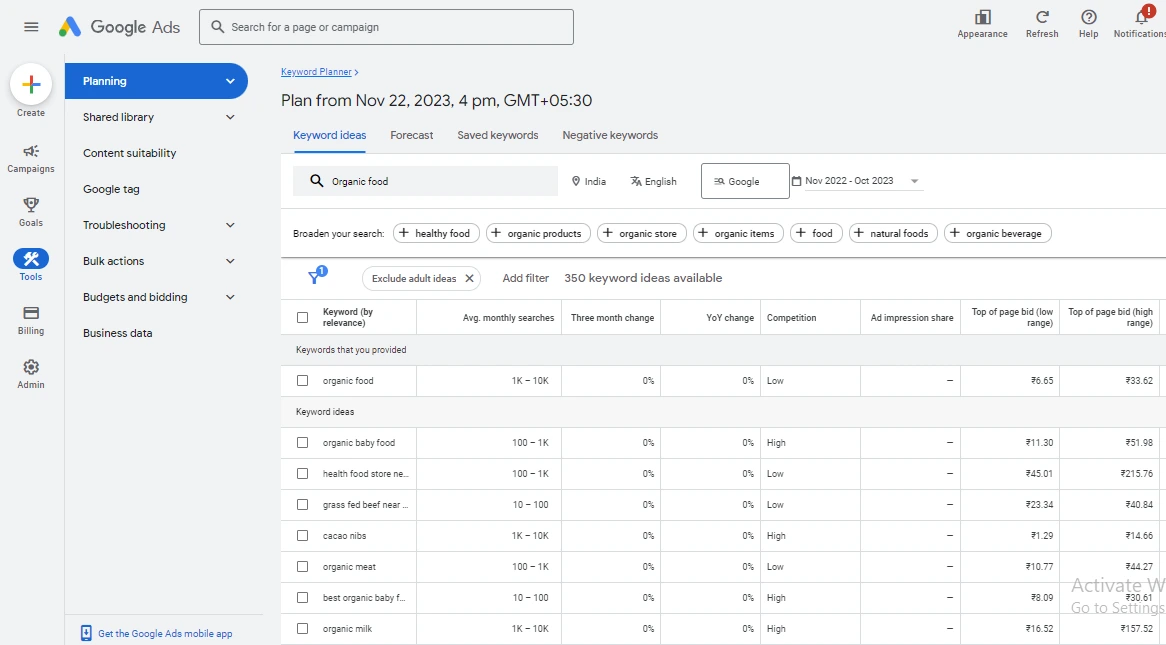
Step 5: Analyze Keyword Metrics — MSV, Difficulty, and CPC
To check the strength and strategic value of each keyword, use dedicated keyword analysis tools. Ahrefs, Semrush, Moz, and Google Keyword Planner are the most widely used and reliable options. Each provides the following key data points:
- Monthly Search Volume (MSV) — How many times the keyword is searched per month. This measures potential traffic opportunity. Higher MSV is not always better — balance it against difficulty and intent.
- Keyword Difficulty (KD) — A score representing how competitive it is to rank for the keyword. New or smaller websites should prioritize keywords with KD below 40.
- Cost Per Click (CPC) — What advertisers pay per click for the keyword in Google Ads. High CPC signals strong commercial value.
- SERP Features — Does this keyword trigger featured snippets, AI Overviews, PAA boxes, local packs, or image carousels? Understanding SERP features helps you format your content to win those placements.
Things to keep in mind when analysing keywords:
- Confirm that the keyword phrase matches the exact way people naturally search — not how you internally describe your own products or services.
- Prioritise keywords with the highest MSV that are still realistically within your website’s authority level to rank for.
- The best keywords to target have relatively high search volume but lower organic competition. These represent your fastest path to meaningful traffic.
- Always look at the actual SERP for each keyword — what types of pages are ranking (blog posts, product pages, comparison pages) tells you exactly what format your content needs to take.
Step 6: Assess Your Competitive Position
- Conduct a competitor keyword gap analysis using tools like Ahrefs or Semrush. Enter your domain alongside two or three competitors to see which keywords they rank for that you do not. These gaps represent immediate content opportunities.
- If your target keyword SERPs are dominated by high-authority established brands, look for long-tail variations of those keywords where competition is weaker. Ranking on page one for a lower-volume keyword is infinitely more valuable than ranking on page five for a high-volume term.
- Identify where competitors have thin, low-quality, or outdated content. If you can produce a significantly more comprehensive, current, and better-structured piece, you have a strong chance of outranking them — even with a smaller backlink profile.
Step 7: Map Keywords to the Right Content Type and Page
Keyword research is only half the job. Each keyword must be mapped to the right type of page on your website — matching the content format that search engines expect to see for that particular intent.
- Informational keywords → Blog posts, how-to guides, explainer articles, FAQ pages
- Commercial comparison keywords → Comparison articles, round-up lists, review posts
- Transactional keywords → Product pages, service pages, landing pages with a clear CTA
- Navigational keywords → Homepage, about page, specific product or service pages
Mapping keywords to pages also helps prevent keyword cannibalization — where multiple pages on your website compete against each other for the same keyword, splitting your ranking power and confusing search engines about which page to rank. Every primary keyword should have a single, clearly designated page optimized for it.
How to Improve Keyword Ranking on Google
Finding the right keywords is only the first step. To actually improve your keyword rankings on Google and sustain them over time, you need to execute the following practices consistently.
Target the Right Keywords for Your Website’s Current Authority
One of the most common keyword strategy mistakes is targeting high-difficulty keywords before your website has the domain authority to compete for them. Every marketer wants to rank on page one, but the path there is different for different websites. A new site should focus on building authority through low-competition long-tail keywords first, then systematically expand to higher-volume terms as rankings and backlinks grow.
Points to keep in mind while selecting keywords:
- Make a prioritized list of keywords ranked by a combination of MSV, KD, and business relevance — not just search volume alone.
- Identify the keywords that competitors with similar domain authority are ranking for. These are your most realistic near-term targets.
- Use Google Keyword Planner or Ahrefs to find keywords with relatively strong search volume and lower competition in your niche.
- Incorporate latent semantic indexing (LSI) keywords — semantically related phrases that support your primary keyword — throughout your content to signal topical depth.
- Review and refresh your keyword targeting every three to six months as search trends, algorithm updates, and competitive landscapes evolve.
Conduct Regular SERP Analysis
To outperform competitors consistently, you must regularly analyse the search engine result pages for your most important target keywords. SERP analysis reveals exactly what Google currently considers the best content for a given query — and therefore what you need to produce to compete.
When analysing SERPs for a target keyword, pay attention to:
- Title tags and meta descriptions — How do top-ranking pages frame the topic?
- Content format, structure, and length — Are the top results 500-word posts or 3,000-word comprehensive guides? Lists or long-form paragraphs?
- Keyword usage and semantic terms — What related terms appear frequently in top-ranking content?
- Domain authority — Are the top results dominated by major brands, or do smaller sites rank too?
- Core Web Vitals and page speed — Technical performance is a confirmed ranking factor.
- Mobile-friendliness — Google uses mobile-first indexing; all top-ranking pages must perform well on mobile devices.
- Backlink profile — How many and what quality of backlinks do top pages have?
- SERP features present — Is there a featured snippet, PAA section, local pack, or AI Overview? Can you optimise your content to win those placements?
Match Your Content Format to Search Intent
This is the single most important ranking factor that goes unaddressed by most keyword strategies. If your target keyword has informational intent and the top results are all “how-to” guides, publishing a product page for that keyword will never rank — regardless of how well it is optimized. Content format must match user intent precisely.
Steps to match content with search intent effectively:
- Classify each target keyword as informational, navigational, commercial, or transactional.
- Analyse the top 5 ranking results for your keyword and note their content format and structure.
- Create content that fulfils the user’s specific need for that intent type — answering the question completely, comparing options objectively, or making it easy to take action.
- Include the secondary questions users typically have around the topic — these often appear in PAA boxes and voice search queries.
Create Comprehensive, High-Quality Content
In 2026, content quality is evaluated more rigorously than ever by both search engine algorithms and AI systems that power Google’s AI Overviews and generative search results. High-quality content that earns rankings and AI citations shares several characteristics:
It is comprehensive — covering the topic deeply enough that a user doesn’t need to visit multiple other sites to get a complete answer. It demonstrates Experience, Expertise, Authoritativeness, and Trustworthiness (E-E-A-T) through original insights, accurate data, expert references, and a clear author identity. It is structured in a way that is easy to scan — with clear H2 and H3 headings, short paragraphs, bullet points where appropriate, and visual aids like tables and images where helpful.
About 90% of B2B marketers report using content marketing as part of their overall strategy — but the ones seeing the best results are those creating genuinely useful, intent-matched, deeply researched content, not just high volumes of generic posts.
Steps for creating high-quality keyword-targeted content:
- Research the topic thoroughly before writing — read top-ranking competitor content and identify the angles, questions, and depth they cover.
- Create content that is more comprehensive, more current, and more useful than what currently ranks.
- Make your content easily readable with clear structure, short paragraphs, and scannable headers.
- Include original data, expert perspectives, real examples, and actionable steps that generic content lacks.
- Link to authoritative external sources where relevant to build credibility and context.
- Update content regularly — fresh, accurate content outperforms outdated posts as search trends and information evolve.
Optimise On-Page SEO Elements
Even the best-researched content can underperform if on-page SEO fundamentals are neglected. On-page SEO ensures that both search engines and users can immediately understand what your page is about and why it is relevant for their query. Key on-page elements to optimise for every piece of keyword-targeted content include:
- Title tag (H1) — Include your primary keyword naturally near the beginning of the title. Keep it under 60 characters for optimal SERP display.
- Meta description — Write a compelling 150-to-160-character description that includes the primary keyword and a clear reason for the user to click.
- Header tags (H2, H3, H4) — Use headers to organise content logically, incorporate semantic keywords naturally into subheadings, and signal topical structure to crawlers.
- URL structure — Keep URLs short, clean, and keyword-rich (e.g., /keyword-research-strategy rather than /post?id=4760).
- Image alt text — Describe every image with accurate, keyword-relevant alt text for both accessibility and SEO.
- Internal linking — Link to related posts and pages on your website using relevant anchor text to distribute authority and guide users through your content ecosystem.
- Schema markup (structured data) — Add FAQ schema, Article schema, or HowTo schema where relevant to improve eligibility for rich results and AI Overview citations.
Keyword Research Tools: Free and Paid Options Compared
The right tools make keyword research faster, more accurate, and more strategic. Here is a practical overview of the most effective keyword research tools available in 2026:
| Tool |
Best For |
Key Features |
Price |
| Google Keyword Planner |
Real search volume data |
MSV, CPC, keyword ideas, geographic filters |
Free (requires Google Ads account) |
| Google Search Console |
Your own site’s keyword performance |
Impressions, clicks, CTR, position tracking |
Free |
| AnswerThePublic |
Question-based and long-tail keywords |
Visual keyword maps, PAA-style queries |
Free (limited) / Paid |
| Ubersuggest |
SMBs and beginners |
Keyword ideas, difficulty, content suggestions |
Free / $29–$99/month |
| Ahrefs |
Advanced competitor and backlink analysis |
Keyword explorer, site audit, rank tracking, content gap |
From $129/month |
| Semrush |
Enterprise-level keyword strategy |
Keyword magic tool, topic research, SERP analysis, position tracking |
From $139.95/month |
| Surfer SEO |
Content optimization and NLP keyword scoring |
Content editor, keyword clustering, SERP analyzer |
From $89/month |
| Wordtracker |
Niche keyword discovery |
Keyword suggestions, competition metrics |
Free (limited) / Paid |
For businesses just starting out, Google Keyword Planner and Google Search Console together provide a powerful free foundation. As your strategy matures, investing in a premium tool like Ahrefs or Semrush unlocks deeper competitor analysis, keyword clustering, and SERP feature tracking that significantly accelerates results.
Frequently Asked Questions About Keyword Research Strategy
What is keyword MSV and why does it matter?
MSV stands for Monthly Search Volume — the number of times a specific keyword is searched per month. It is one of the most important metrics in keyword research because it tells you the potential traffic opportunity a keyword represents. However, higher MSV also means more competition. A balanced keyword strategy combines high-MSV head terms with lower-MSV, lower-competition long-tail keywords for the most sustainable traffic growth.
How do I choose the right keywords for my website?
Start by defining your business goals and target audience. Then research keyword options using tools like Google Keyword Planner, Ahrefs, or Semrush. Evaluate each keyword based on MSV, keyword difficulty, commercial relevance, and search intent. Prioritize keywords where user intent matches the content you can credibly create, and where the competition level is achievable given your website’s current authority.
What are the best free keyword research tools?
The best free keyword research tools include Google Keyword Planner (for real MSV and CPC data), Google Search Console (for monitoring your own keyword performance), AnswerThePublic (for question-based and long-tail keyword ideas), and Google’s own autocomplete and related searches features. For most small businesses, these free tools provide enough data to build an effective initial keyword strategy.
What is keyword difficulty and how do I use it?
Keyword difficulty (KD) is a score between 0 and 100 that indicates how hard it will be to rank on the first page of Google for a specific keyword. A KD of 0–30 is generally considered low difficulty and achievable for most sites. KD of 31–60 is medium difficulty, and 61–100 is high difficulty, typically requiring significant domain authority and a strong backlink profile to compete. Use KD to prioritize which keywords to target based on your website’s current strength.
How often should I do keyword research?
Keyword research is not a one-time activity. Search trends evolve, competitors publish new content, and Google’s algorithm updates continuously reshape which content ranks. A practical cadence is a comprehensive keyword audit every six months, with quarterly reviews of your existing keyword rankings using Google Search Console to identify opportunities to update, expand, or consolidate existing content.
What is next-gen keyword research?
Next-gen keyword research goes beyond simply finding high-volume phrases. It incorporates search intent analysis, semantic keyword mapping, entity-based SEO, topic cluster architecture, AI-powered keyword discovery, voice search optimization, and generative engine optimization (GEO) — ensuring your content is not only found in traditional Google search results, but also cited in AI-generated answers from tools like Google’s AI Overview, ChatGPT, and Perplexity.
Wrap Up
Next-gen keyword research requires a comprehensive, multi-dimensional approach that goes far beyond traditional volume-and-difficulty metrics. In 2026, the most successful keyword strategies are built on a deep understanding of user intent, semantic relevance, topical authority, and the rapidly evolving role of AI in search discovery.
By combining advanced keyword research tools with intent-driven content creation, mobile optimization, structured data implementation, and AI-ready content architecture, businesses can effectively leverage Google’s ranking signals — and increasingly, the citation logic of AI-powered search systems.
Conducting thorough keyword research before creating any content is not just a best practice — it is the difference between building a website that compounds in organic traffic over time and one that simply exists on the internet without being found. Your keyword strategy is your content roadmap, your competitive intelligence system, and your connection to the audience that needs exactly what you offer.
Always remember that keyword research is the foundation, not the full strategy. Combine it with high-quality content creation, strong on-page SEO, consistent publishing, link building, and regular performance monitoring to build an SEO presence that generates real, measurable business results.