

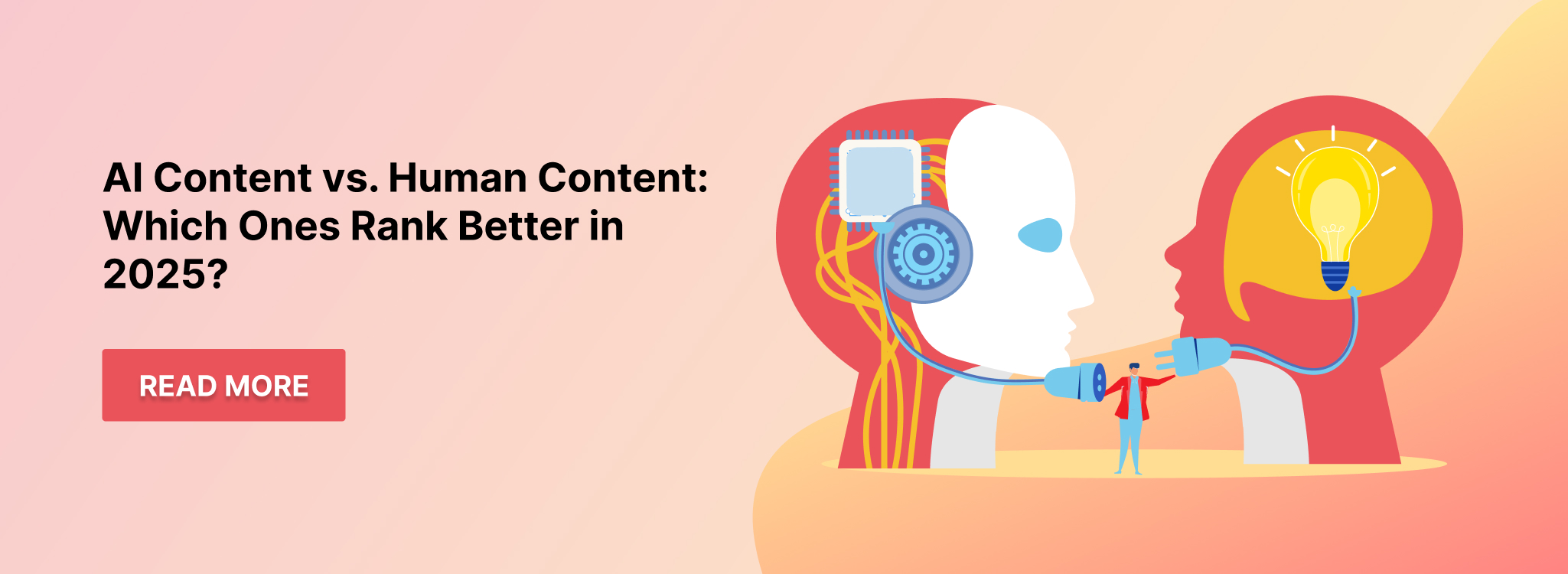
AI Content vs Human Content: Which Ranks on Google in 2026?
Recently updated: April 15th, 2026
AI content tools like ChatGPT, Claude, and Gemini have made it possible to publish at a scale that was unthinkable three years ago. But here’s what the traffic data actually shows: 80% of Google’s number-one-ranking pages are human-written, while purely AI-generated content lands in the top spot just 9% of the time — based on Semrush’s analysis of 42,000 blog posts.
That doesn’t mean AI content is dead. It means the rules have changed — and both sides of this debate are partly right.
This guide breaks down the latest ranking data, what the Google March 2026 core update changed, and the exact content strategy that actually wins — whether you’re writing with AI, without it, or somewhere in between.
⚡ Key Findings: AI Content vs Human Content in 2026
- 📊 Position #1: Human-written content is 8× more likely to rank first than pure AI content (Semrush, 2025)
- 🤖 Top-10 parity: 57% of AI content and 58% of human content reach Google’s top 10 — nearly equal
- 🔀 Hybrid wins: AI-assisted content edited by humans ranks 34% higher on average than unedited AI output (Writesonic, 2025)
- ⚠️ Penalty risk: Google’s August 2025 spam update + SpamBrain ramped up manual actions for scaled AI content — including full de-indexing
- 🔍 AI Overviews: 76% of AIO-cited URLs also rank in Google’s top 10 — structured, EEAT-backed content dominates both surfaces
- 📈 The real winner: Hybrid content with human oversight — scalable, rankable, and penalty-resistant
Google’s 2026 Landscape: AI Overviews, AI Mode, EEAT & GEO
To understand what actually ranks today, you need to understand what Google is showing users — because it isn’t just blue links anymore.
Google’s AI Overviews (previously called SGE) now appear in 25%–48% of all US searches, according to research by Conductor and BrightEdge. These AI-generated summaries pull from trusted sources before any organic result appears on screen. And in March 2026, Google’s core update doubled down on rewarding structured, expert-led content while penalising scaled AI output lacking real human value.
On top of that, Google AI Mode — a fully conversational search interface — is now available to US users and being rolled out globally. AI Mode doesn’t just summarise; it synthesises, compares, and recommends. Your content either gets cited or gets bypassed entirely.
This creates two parallel ranking surfaces your content must optimise for: traditional organic SERPs and AI Overview / AI Mode citations.
Optimising for both is what SEOs now call Generative Engine Optimization (GEO) — a discipline that sits alongside traditional SEO and is rapidly becoming non-optional.
EEAT Is Still the Filter That Matters Most
Google’s ranking systems in 2026 are more aligned with EEAT — Experience, Expertise, Authoritativeness, and Trustworthiness — than at any previous point. The March 2026 core update made this crystal clear: sites producing expert, human-led content gained visibility, while scaled AI content without proper editorial oversight dropped.
AI-generated content can meet EEAT standards, but not by default. The “Experience” signal — the first E added to the framework in 2022 — is now the primary differentiator. Google’s systems are increasingly capable of detecting whether content comes from someone who has actually done the thing they’re describing, versus an AI recombining information from other sources.
- Sites with real, documented experience (case studies, original data, first-person testing) consistently perform better in both SERPs and AI Overviews
- Pages with named authors, credentials, and editorial policies are more likely to be surfaced
- Thin AI content that looks mass-produced? Filtered out — sometimes de-indexed entirely under Google’s scaled content abuse policy
AI Overviews Prioritise Sources That Answer Clearly and Cite Credibly
Research analysing 15,847 AI Overview results across 63 industries identifies the top factor for AIO citation: semantic completeness (r=0.87 correlation). Content scoring above 8.5/10 on semantic completeness is 4.2× more likely to appear in an AI Overview. AI pulls from content that fully answers a query in a self-contained passage — optimally 134–167 words per passage.
To be AIO-eligible, your page needs to be:
- Crawlable and indexable with clear semantic structure
- Structured with clear H2/H3 headings, bullet points, and short answer-first paragraphs
- Supported by Article, FAQ, and BreadcrumbList schema markup
- Written in natural, question-matching language (“How does X work?” → answer it directly)
- Backed by verifiable citations from authoritative, Tier-1 sources
The practical implication: whether written by AI or by hand, your content must be structured for AI readability and backed by EEAT signals. That’s what ranks in SERPs — and that’s what gets cited in AI Overviews.
What 42,000 Blog Posts Reveal About AI vs Human Rankings
The most comprehensive study to date on AI versus human content ranking comes from Semrush, which analysed 42,000 blog pages tied to 20,000 keywords using GPTZero to classify content by origin. The findings are more nuanced than most headlines suggest.
Position #1 Is Still Overwhelmingly Human
Content classified as purely AI-generated appeared in the top spot just 9% of the time. Human-written content was there 80% of the time. That’s not a small gap — it’s an 8× advantage at the position that captures the majority of clicks.
But the picture shifts dramatically by the time you reach the top 10: 57% of AI articles and 58% of human articles appeared in Google’s top-10 results. Near parity. This tells us something important: AI content can get into the game, but it rarely wins it.
Pure AI Content Rarely Reaches the Top Three
Corroborating the Semrush data, Reboot Online’s multi-domain experiment found that pages written entirely by AI (with no human edits) made it to Google’s top 10 in 28% of test cases. But only 6% reached the top 3 — the positions that capture the bulk of organic clicks and CTR.
Google isn’t blocking AI content from ranking. But its systems clearly still reward depth, originality, and demonstrable expertise — qualities that human involvement tends to produce.
Hybrid Content Outperforms Both at Scale
Analysis of over 500 AI-assisted articles across multiple niches found that the highest-performing pages shared a common structure: AI-generated first draft, human revision for structure and tone, and manual on-page optimisation. These hybrid pieces ranked 34% higher on average than unedited AI content — and had lower bounce rates, signalling better user engagement.
Meanwhile, 64% of SEO teams already operate on a human-led, AI-assisted workflow — making it the dominant model in the industry. Another 87% of teams report keeping humans heavily involved in production and editing regardless of AI usage level.
In other words: the best-performing teams aren’t choosing between AI and human writing. They’re combining both — strategically.
Human-Written Content: Engagement, Trust & EEAT Advantages

AI wins on speed. But on trust, engagement depth, and EEAT signal strength, human content consistently outperforms — and in 2026, those signals are worth more in Google’s ranking systems than they’ve ever been.
Users Trust Content That Feels Personal, Not Programmatic
Recent behavioural studies show that audiences are 2.5× more likely to engage with content that tells a story, shows personal experience, or cites real case studies. AI-generated text is often grammatically correct but emotionally flat — and readers notice. When they sense generic, templated language, trust drops and bounce rates rise.
A blind-test study by Brandwell.ai put this directly to the test. Participants rated two versions of the same article — one human-written, one generated by GPT-4o. Most initially rated the AI version higher on clarity and flow. But when told which was which, 63% switched their preference to the human article — and 72% said they would trust the human-written version more for important decisions (finances, health, legal matters).
Perception shapes engagement. And engagement shapes rankings.
EEAT Favours Authorship, Identity & Authority
Google’s Search Quality Rater Guidelines make one thing clear: authorship matters. Human-written content naturally includes a named author with credentials, source links and references, and a distinctive point of view. These signal “realness” to both readers and search algorithms.
AI content — especially when published anonymously — misses these marks. It may satisfy technical SEO requirements, but it falls short on authenticity, which is now a direct ranking input under EEAT.
Better Engagement = Better Rankings
When human-first content resonates, the behavioural results are consistent: time on page increases, bounce rate drops, and internal click depth goes up. These signals tell Google’s systems that the content is useful — and when combined with EEAT and relevance signals, they drive stronger long-term rankings.
You don’t need every article to be a 3,000-word personal essay. But injecting human expertise — even if it’s just editing and enriching an AI draft — sends measurably stronger signals to both your audience and the algorithm.
Pitfalls of Pure AI Content: Spam, “AI Slop” & Scaled Abuse
The speed of AI content creation has created a serious problem: a flood of low-effort, high-volume articles that offer nothing new. Google has a policy term for this: scaled content abuse. And its enforcement is accelerating.
What Is “AI Slop” and Why Does Google Care?
“AI slop” describes auto-generated content that reads like filler — repetitive phrasing, generic advice with no original angle, keyword overuse without semantic variation, and no author attribution or credibility markers. It’s content no human would ever bookmark, share, or link to. And in 2026, Google’s SpamBrain detection system is significantly better at identifying it.
The August 2025 Spam Update Changed the Stakes
Google’s August 2025 spam update — which rolled out over 27 days — continued SpamBrain’s training on new AI content patterns. The consequences for sites caught in its scope weren’t just ranking drops. They included complete de-indexing of entire site sections and manual actions, particularly for affiliate-heavy AI content blogs.
Sites publishing hundreds of AI-written pages without human oversight are now flagged under Google’s site reputation abuse and spammy automated content policies. The pattern triggers aren’t specifically about AI — they’re about publishing velocity spikes, thin content at scale, and missing expertise signals. You can trigger all of these with bad human content too. But AI makes it easier to trigger them at volume.
You Can’t Mass-Produce Authority
No matter how many pages you generate, they won’t rank if they don’t add value. This is especially true in YMYL (Your Money, Your Life) categories — health, finance, legal, and educational content — where Google’s trust threshold is highest. If your content exists primarily to manipulate rankings rather than serve readers, Google’s systems will eventually identify it.
The lesson: using AI for scale is fine. Using it without editorial strategy is a liability.
Hybrid Models: Combining AI Speed with Human Oversight

The most effective content strategies in 2026 aren’t fully human or fully AI — they’re hybrid. That’s not a trend; it’s now the industry standard. As noted above, 64% of SEO teams already operate on this model.
Start with AI to Draft, Research, or Outline
AI tools are excellent at generating content briefs, drafting first-pass introductions and conclusions, summarising research or public data, and creating SEO-intent-aligned outlines. This cuts production time significantly and eliminates the blank-page problem. But it’s just the beginning.
Human Editing Is Where the Quality Happens
After the AI draft is done, humans step in to restructure content for clarity and tone, add expert insights or unique perspectives, inject personal anecdotes or real client examples, polish phrasing for voice and rhythm, and optimise headers, calls to action, and metadata. This phase is where most EEAT value gets built — and where the 34% ranking uplift comes from.
Review for AI “Tells” Before Publishing
Even with good prompts, AI falls into predictable habits. Before publishing, check for repetitive sentence structures, overuse of hedging phrases (“may help,” “could be useful”), hallucinated facts or uncited claims, and keyword stuffing or unnatural phrasing. These are the signals that both Google and readers detect. Editing them out is what separates high-quality hybrid content from expensive AI filler.
The Hybrid Advantage in Numbers
| Dimension | Pure AI | Pure Human | Hybrid (AI + Human) |
|---|---|---|---|
| Production Speed | ⚡ Fastest | 🐢 Slowest | ✅ Fast |
| Position #1 Probability | 9% (Semrush) | 80% (Semrush) | ~60–70% (est.) |
| EEAT Signal Strength | ❌ Weak | ✅ Strong | ✅ Strong (with author bio) |
| Penalty Risk | 🔴 High (at scale) | 🟢 Low | 🟢 Low (if edited well) |
| AI Overview Citation Potential | ❌ Low | ✅ High | ✅ High |
| Scalability | ✅ High | ❌ Limited | ✅ High |
| Cost Efficiency | ✅ Lowest | ❌ Highest | ✅ Balanced |
How to Get Cited in Google AI Overviews in 2026 (GEO Guide)

With AI Overviews now appearing in nearly half of all US searches and generating 35% more organic clicks for cited pages, being selected as a source is no longer a bonus — it’s increasingly a prerequisite for top-of-funnel visibility.
Here’s what the data tells us about how to get cited:
Write in Self-Contained Passage Units (134–167 Words)
Research on 15,847 AI Overview results found that 62% of cited content falls between 100–300 words per passage — the “semantic unit” AI systems extract confidently. Write each H3 subsection to fully answer its question without requiring the reader to click elsewhere.
Use Answer-First Structure
Lead each section with the direct answer, then expand with context and evidence. AI systems parse the first 1–2 sentences most heavily when selecting citation sources. If your section opens with background context instead of an answer, it’s less likely to be pulled.
Implement FAQ, Article, and BreadcrumbList Schema
Structured data shows a 73% higher AIO selection rate for properly marked-up content compared to unmarked pages. At minimum, implement FAQ JSON-LD for your Q&A section and Article schema with author, dateModified, and publisher fields.
Cite Verifiable, Authoritative Sources
Google’s AI fact-checks content in real time against authoritative databases. Content with recent stats, peer-reviewed sources, and Tier-1 citations gets 89% higher AIO selection probability. Link to original studies, not aggregator summaries.
Build Entity Density
Content with 15+ connected named entities (studies, organisations, tools, concepts) shows 4.8× higher AIO selection probability. Include specific entity names — study authors, algorithm names, policy terms — rather than generic descriptions.
Track Your AI Share of Voice
Traditional rank tracking doesn’t capture AIO presence. Start monitoring how often your brand appears in AI Overviews for target queries — this is rapidly becoming the visibility KPI that matters most in 2026. Tools like Semrush and SE Ranking now include AIO tracking in their SERP feature reports.
The ChatGPT Angle: How to Leverage AI Tools in 2026 SEO

Not all AI tools are equal, and not all approaches to AI content are built for ranking. If you’re using ChatGPT or similar tools in your content workflow, here’s how to get results without triggering Google’s red flags.
Use Prompts That Mimic Real Search Queries
Instead of asking ChatGPT for “a blog post about time management,” try: “Write a blog outline that directly answers the query: ‘How to manage time effectively as a remote worker in 2026?’ Focus on actionable tactics with specific examples.” Aligning your prompt to search intent improves both the draft quality and the content’s relevance to real user queries.
Avoid Generic Language: Train for Specificity
ChatGPT gravitates toward safe, general phrasing. When reviewing drafts, find and replace vague adjectives (“great,” “useful,” “important”), redundant openers (“in today’s fast-paced world”), and empty filler (“content is king”). Replace them with specific use cases, data points, and clear, actionable language.
Pair ChatGPT Output with Schema and Internal Linking
ChatGPT generates text. It won’t add product or FAQ schema, link to your cornerstone pages, or optimise headers for featured snippets. Think of it as a writing assistant with no knowledge of your site architecture or KPIs. The strategic layer is always yours.
Note on ChatGPT as a Search Platform
Beyond content creation, ChatGPT is now also a search destination. ChatGPT processes over 1 billion queries daily, and 43.2% of pages ranking #1 on Google are also cited by ChatGPT. Optimising your content for Google’s AI Overviews and for ChatGPT search citations are now intertwined objectives.
Never Hit Publish on Raw AI Output
This needs repeating: never publish unreviewed AI content. Review it, restructure it, run it through fact-checking tools, and shape it to reflect your brand voice and Google’s EEAT expectations. Used well, AI is a powerful accelerant. Used carelessly, it’s a ranking liability.
Reader Preference & Bias: Human vs AI Awareness
Can readers tell the difference between AI and human content — and does it affect how they engage? The data says yes, but with an important twist.
People Judge Quality First, Then Source
In Brandwell.ai’s blind test, most participants initially rated the AI-written version higher on clarity and flow. But when they learned which article was AI-generated, 63% switched their preference to the human article. And crucially, 72% said they would trust the human-written version more for consequential decisions involving money, health, or legal matters.
Perception matters. And it matters most where stakes are highest.
Disclosure Impacts Trust, Especially in YMYL Content
In niches like finance, healthcare, legal, and education, users want to know who wrote the content and why they should trust it. Even if AI generates the bulk of a draft, failing to provide author bios, editorial disclaimers, or source links significantly lowers trust and engagement — both of which feed back into Google’s quality signals.
Readers may not mind AI helping. They want humans checking. Make that visible.
AI Detection Tools Are Changing Reader Expectations
With tools like GPTZero and Originality.ai widely used, both editors and readers have become more sceptical of generic-sounding content. Publications are increasingly adding “AI-assisted” or “human-reviewed” labels. Transparency doesn’t hurt — it builds the long-term trust that drives return visits, backlinks, and durable rankings.
Practical SEO Guide: Content Strategy for 2026
Here’s your actionable 2026 content playbook — built around what actually ranks, what gets cited in AI Overviews, and what avoids penalties.
1. Start with Real Search Intent — Including PAA and AIO Queries
Don’t just target keywords. Target questions. Use tools like AlsoAsked, Google’s “People Also Ask,” and Google’s own AI Overviews to see what questions are being surfaced. Structure each article to directly answer those questions in full — with answer-first paragraph structure that AI can extract and cite.
2. Use AI for Drafting, Humans for Finishing
- Use AI to build structure or generate the first draft
- Inject human expertise, first-person insights, or original client data
- Edit heavily for tone, specificity, and genuine value
- Optimise for EEAT, search intent, readability, and AI Overview eligibility
3. Inject EEAT Signals at Every Level
- Add author bios with credentials and a real name — this is the single biggest gap on most AI-assisted content sites
- Link to trusted, Tier-1 sources (original studies, official Google documentation, peer-reviewed content)
- Include first-hand insights: client results, original testing, proprietary data
- Avoid vague, surface-level commentary — it reads as low-effort to both readers and algorithms
4. Optimise for AI Summarisation and Indexable Passages
Write in structured 134–167-word passage units per H3 section. Use clear headings, answer-first paragraphs, bullet lists for scannability, and FAQ schema. Implement Article + FAQ + BreadcrumbList schema markup. If your content sounds like something an AI could quote directly to answer a question, you’re building for the right format.
5. Optimise for AI Mode and GEO — Not Just Traditional SERPs
Track AI Overview appearances alongside organic rankings. Monitor brand mentions in ChatGPT and Perplexity responses. Build entity signals: consistent business information across directories, brand mentions in third-party publications, and a complete Google Knowledge Graph presence. These are the signals that determine your AI Share of Voice — the new visibility metric that matters in 2026.
6. Use UTM Tracking to Measure AI Referral Traffic
Want to know if ChatGPT or other AI tools are referring visitors? Check your analytics for traffic tagged with utm_source=chatgpt.com and utm_medium=referral. Set up custom segments in GA4 or Looker Studio to compare AI-referred visitor behaviour against traditional organic search visitors.
Verdict: Which Ranks Better in 2026?
AI Content Wins on Speed, Scale, and Cost
- Fast and consistent — allows teams to publish more with fewer resources
- Effective for drafting FAQs, metadata, outlines, and long-tail content
- Useful for supporting SEO refreshes of older, underperforming posts
But on its own? It rarely dominates. Especially not for competitive queries or high-trust niches where human involvement is both expected and rewarded.
Human Content Wins on Depth, Trust, and Engagement
When rankings depend on EEAT signals, user engagement, and demonstrable expertise — which they increasingly do — human-written or heavily-edited content performs better. Humans win in thought leadership, product reviews, case studies, health and financial content, and editorial content with genuine brand voice.
The Real Winner: Hybrid Content with Human Oversight
The data across every major 2025–2026 study points to the same conclusion: hybrid content — AI for speed and structure, humans for insight, editing, and EEAT compliance — consistently outperforms both pure approaches.
It’s scalable. It’s rankable. It’s penalty-resistant. And it’s what 64% of leading SEO teams are already doing.
Don’t pick sides. Pick strategy.
Future Outlook: SEO Beyond 2026

We’re not just watching a shift — we’re watching a convergence. Search, AI, and content are becoming architecturally inseparable. Here’s what’s already reshaping the landscape and what you need to prepare for.
AI Overviews Are the New Above the Fold
AI Overviews already reach 1.5 billion users monthly across 200+ countries. Organic CTR drops 61% when an AI Overview appears for your target query — but cited pages earn 35% more organic clicks than competitors not cited. The stakes of AIO optimisation are growing by the quarter.
AI Mode Is Becoming the Default Search Interface
Google announced at I/O 2025 that AI Mode represents the future of search. In AI Mode sessions, 75% of users never leave the pane — meaning traditional click-through traffic is being replaced by in-session influence. Your content either informs AI Mode’s synthesis or it’s invisible to that interaction entirely.
Gartner Projects 25% of Organic Traffic Shifts to AI by End of 2026
This isn’t a distant forecast — it’s already underway. B2B technology, health, and education sectors are experiencing the sharpest transitions. Brands adapting early report growth exceeding pre-AIO traffic levels. Those waiting are ceding ground that becomes progressively harder to reclaim.
Voice + Agent-Based Search Will Reshape Query Patterns
AI agents, voice tools, and smart assistants are driving longer, more conversational, more specific queries. Your content needs to match natural speech patterns, be structured for easy summarisation, and include clear author signals and trust indicators — not just keyword-matching text.
Your Edge Is Still Human Judgment
As AI content gets smarter and more widespread, your competitive advantage won’t be more automation — it’ll be better decisions. The brands winning in this environment are auditing what content to create and why, using AI to accelerate rather than replace, and publishing with deliberate purpose rather than volume. That’s the strategy that survives algorithm shifts, AIO expansion, and whatever comes next.
Conclusion & Takeaway
The verdict in 2026 is clear — but it’s not a simple winner-takes-all answer.
Human-written content holds an 8× advantage at position #1. AI content reaches the top 10 at nearly the same rate as human content. And hybrid content — AI speed plus human judgment — consistently outperforms both. The March 2026 core update confirmed what the data has been showing all year: Google rewards structured expertise, penalises scaled mediocrity, and is increasingly using AI itself to evaluate whether your content deserves to rank.
If you’re still publishing keyword-stuffed, unedited AI output and hoping for the best, you’re not just falling behind in rankings — you’re building a penalty risk. But if you treat AI as the accelerant it is, layer in human expertise, structure everything for both SERP ranking and AI Overview citation, and make your authorship visible and credible, you have a genuinely powerful advantage.
This is the new SEO — where content is written for both search and AI, structure matters as much as substance, and speed without strategy is a liability rather than an asset. The brands that master this balance will own their rankings — not just in 2026, but long after.
Frequently Asked Questions
-
Can AI-generated content rank in Google in 2026?
Yes. Google does not automatically penalise AI-written content. However, it evaluates quality, relevance, and EEAT (Experience, Expertise, Authoritativeness, Trustworthiness). Purely AI-generated content ranks in the top spot only 9% of the time versus 80% for human-written content (Semrush, 2025). AI content edited by humans performs significantly better and can rank competitively in the top 10.
-
Does Google prefer human-written content over AI?
Google prefers helpful, expertly authored content — regardless of how it was produced. In practice, human-written or heavily human-edited content dominates the top positions, particularly for competitive and high-trust queries. Google’s March 2026 core update reinforced this: expert-led, structured content gained visibility while scaled AI content without editorial oversight dropped.
-
What is “AI slop” and how does it affect rankings?
“AI slop” refers to low-effort, mass-produced AI content that offers little original value — repetitive phrasing, generic advice, no author attribution. Google’s SpamBrain detection system and August 2025 spam update actively target this pattern. Sites publishing AI slop at scale risk de-indexing of entire content sections, sitewide ranking drops, and manual actions — not just lower positions.
-
Is hybrid content better than fully AI or fully human content?
Yes, consistently. Hybrid content — AI-assisted drafts with substantive human editing, EEAT signals, and on-page optimisation — ranks 34% higher on average than unedited AI content (Writesonic analysis, 2025). It’s the model used by 64% of leading SEO teams and represents the best balance of speed, quality, and penalty resistance.
-
How do I get my content cited in Google AI Overviews?
Structure your content in self-contained, answer-first passages of 134–167 words per H3 section. Implement FAQ and Article schema markup. Cite authoritative, verifiable sources. Build entity density (15+ named entities per page). Ensure your content demonstrates EEAT through named authorship, credentials, and original data. Pages with these signals have 4.2× higher AIO citation probability.
-
What is Generative Engine Optimization (GEO)?
GEO is the practice of optimising content to be cited or summarised by AI-powered search engines — including Google AI Overviews, AI Mode, ChatGPT Search, and Perplexity. It extends traditional SEO by focusing on structured answer format, semantic completeness, entity clarity, and real-time fact-verifiability. In 2026, GEO is increasingly essential alongside traditional SERP optimisation.
-
How do I track AI-generated traffic to my site?
Use UTM parameters to track referrals. For ChatGPT traffic, look for utm_source=chatgpt.com and utm_medium=referral in Google Analytics or GA4. For AI Overview tracking, use Semrush or SE Ranking’s AIO features — Google Search Console includes some AIO data but doesn’t fully separate it from traditional organic clicks. Also track your “AI Share of Voice” — how often your brand appears in AI-generated answers for target queries.
-
Should I disclose that I’m using AI to write content?
Transparency is increasingly important, particularly in regulated industries. You don’t need to flag every sentence, but adding named author bylines, editorial oversight notes, and source citations reinforces trust — even where AI helped in the drafting phase. Studies show 72% of users trust human-reviewed content more for important decisions. Making your editorial process visible is a trust signal, not a weakness.
-
Can small businesses benefit from AI-generated content?
Absolutely. AI helps small teams scale their output efficiently — from drafting long-form articles to generating FAQ content, meta descriptions, and outlines. The key is pairing AI speed with human expertise and SEO best practices. Quality and EEAT signals — not content volume — drive rankings in 2026.
-
Will AI content hurt my rankings after the March 2026 core update?
Not inherently. Google’s March 2026 core update targeted low-EEAT signals, scaled content abuse, and content that exists primarily to rank rather than help users. AI content that demonstrates genuine expertise, carries named authorship, cites credible sources, and is structured for user value is not penalised. The risk is AI content published at volume without expert oversight — that’s what the update targeted.
Related posts:
 Search Product Discovery with ChatGPT: A Complete Guide
 AIO vs GEO vs AEO vs LLMO: The Complete Guide to AI Search Optimization in 2026
 Link Building for AI Search 2026: Backlinks & AI Overviews, ChatGPT, Perplexity Guide
 How to Optimize for Google SGE and AI Overviews in 2026: The Complete Strategy Guide
 Voice Search SEO: 7 Tips to Rank Your Business for Siri, Alexa & Google Assistant
 SEO for Cleaning Companies: The Complete 2026 Guide to Rankings, Leads & AI Search
 How to Use ChatGPT for Automated SEO Audits in 2026: The Complete Guide
 How to Build AI-Powered SEO Workflows with Screaming Frog & Python (2026 Guide)
