Have you ever tried searching for something while driving, cooking, or walking — and found yourself reaching for your voice instead of a keyboard? You are not alone. Voice search has moved from novelty to necessity, fundamentally changing how people interact with search engines — and how businesses must approach SEO.
By 2026, an estimated 8.4 billion voice assistants are in active use worldwide, and over 50% of U.S. consumers use voice search daily. Voice queries are now being processed by Google Assistant, Siri, Alexa, and Cortana — and increasingly by AI-powered platforms like ChatGPT and Perplexity. If your website is not optimized for voice search, you are invisible to a rapidly growing share of your audience.
In this comprehensive guide, we walk you through everything you need to know about voice search SEO — from what it is and why it matters, to 8 proven strategies that will help your website rank in voice search results in 2026 and beyond. Whether you are a startup or an established brand, these strategies are actionable, data-backed, and built for the way search is evolving right now.
What Is Voice Search SEO? (Definition + Why It Matters in 2026)
Voice search SEO — also called voice search optimization or voice engine optimization — is the practice of structuring your website content, technical infrastructure, and metadata so that voice assistants can easily find, understand, and read out your content in response to spoken queries.
Unlike traditional SEO, which targets keywords typed into a search bar, voice search optimization is built around natural language, conversational queries, and user intent. It includes the optimization of your content, location data, and brand information to increase your chances of appearing in voice search results — which typically return only one top answer.
How Voice Search Differs from Traditional Text Search
The fundamental difference between typed and spoken searches lies in how people naturally express themselves. When typing, users tend to input short, fragmented keywords — for example: best SEO company India. When speaking, the same user would ask: “What is the best SEO company in India for small businesses?”
Voice queries average 29 words in length, are typically phrased as questions, and carry strong intent signals. They are also disproportionately local — over 55% of consumers use voice search to find local businesses, making local SEO a non-negotiable part of any voice strategy.
Voice Search Statistics You Cannot Ignore in 2026
The growth of voice search is not a prediction — it is a measurable reality. Here are the key data points shaping voice search SEO strategy in 2026:
- 8.4 billion voice assistants are currently in use globally (Statista, 2026)
- 50% of U.S. consumers engage with voice search daily
- 55%+ of consumers use voice search to find local businesses (Synup, 2025)
- Voice commerce is projected to reach $80 billion in 2026
- Voice search accounts for approximately 30% of all web browsing sessions
- Over 1 billion people use voice search every month globally
- Voice queries are 3x more likely to trigger a local search result than text queries
These numbers make one thing clear: voice search is not a future trend. It is the present reality, and businesses that do not adapt will be left behind.
Why Businesses Must Prioritize Voice Search Optimization
With voice search usage at an all-time high and Google’s mobile-first indexing already the default ranking mechanism, businesses of all sizes — from local startups to global brands — need to adapt to a voice-first digital landscape.
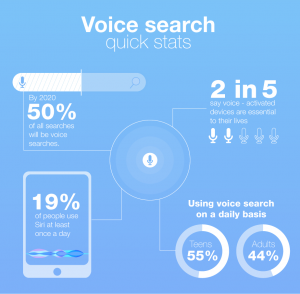
As Jenny Halasz, a recognized speaker and SEO consultant, points out: “While voice search is certainly the future of how we will do most searches, there’s not really too much you can do to optimize for it that is different than regular SEO optimization. Because Google’s goal will always be to return the best result based on the person, location, and history, it’s hard to guess exactly what the right answer for a query will be.”
This expert observation rings true — but there are specific, high-impact actions that clearly separate voice-ready websites from those that are not. The good news is that most voice SEO improvements also strengthen your overall SEO performance.
The Rise of Smart Speakers and AI Voice Assistants
Smart speakers, AI-integrated phones, in-car voice assistants, and smart TVs have made voice search accessible in virtually every context. Platforms like Google Assistant, Amazon Alexa, Apple Siri, and Microsoft Cortana now handle billions of queries monthly — and each platform sources its answers differently. Google Assistant pulls heavily from featured snippets and Google Business Profile data. Alexa draws from Bing and its own Skills database. Siri relies on Apple Maps, Yelp, and local data sources.
Understanding how each assistant retrieves data helps businesses structure content that works across all major voice platforms.
How Google’s Mobile-First Indexing Connects to Voice Search
Google’s mobile-first indexing means that the mobile version of your site is what Google uses for ranking and indexing decisions. Since the vast majority of voice searches happen on mobile devices, a slow, unresponsive, or poorly structured mobile site directly undermines your ability to rank in voice search results. Mobile optimization is not just a UX consideration — it is a core technical pillar of voice SEO.
8 Proven Voice Search SEO Strategies to Rank in 2026
Voice and text searches return different results. Traditional SEO tactics alone will not be enough — here are the eight most impactful voice search optimization strategies that top SEO services providers implement for their clients today.
1. Win Featured Snippets (Position Zero)
The single most important goal in voice search SEO is to earn the featured snippet — also known as Position Zero. When a voice assistant answers a spoken query, it almost always reads aloud the content from the featured snippet. There is effectively only one result in a voice search, making Position Zero the only position that matters.

Featured snippets appear at the top of Google SERPs in an answer box, and up to 30% of 1.4 million tested Google queries contain them. To earn a featured snippet:
- Identify questions your target audience asks related to your business or industry
- Provide a direct, concise answer (40–60 words) immediately below the question heading
- Use structured formats: bullet lists, numbered steps, or short definition paragraphs
- Target long-tail, question-based keywords that trigger snippet boxes
- Ensure your page is already ranking in the top 10 for the target keyword
For a deeper dive into earning and retaining featured snippets, explore our detailed featured snippets guide.
2. Optimize for Conversational, Long-Tail Keywords
People use full, natural-language sentences when conducting voice searches. They ask questions instead of typing short, choppy keywords. A typed query like “SEO company India” becomes “What is the best SEO company in India for a small business?” when spoken aloud.
To optimize for this behavior:
- Research question-based keywords using tools like AnswerThePublic, AlsoAsked, and Google’s People Also Ask section
- Focus on who, what, where, when, why, and how query starters
- Use long-tail keywords (3+ words) — they have lower competition and match the conversational tone of voice queries
- Write content in a natural, readable tone at an 8th–9th grade reading level — voice assistants prefer content that sounds natural when read aloud
- Incorporate question phrases as H2 and H3 subheadings throughout your content
Long-tail keywords benefit both voice search performance and traditional SEO — they help your content reach the right audience with higher purchase intent.
3. Align Content with User Search Intent
Voice searches carry strong user intent signals — people asking voice queries typically want an immediate, definitive answer. Google’s Hummingbird and BERT algorithms are specifically designed to understand the contextual intent behind spoken queries, not just the keywords themselves.
To align your content with search intent:
- Informational intent: Provide clear, accurate answers to “what is” and “how to” questions
- Navigational intent: Ensure your Google Business Profile, contact pages, and location data are complete and accurate
- Transactional intent: Optimize product and service pages for commercial voice queries (e.g., “Where can I get SEO services near me?”
- Structure each page to answer one core question thoroughly before branching into related subtopics
Matching your content to user intent is the foundation of both traditional and voice search SEO success.
4. Implement Schema Markup for Voice Search
Schema markup is structured data added to your HTML that helps search engines and voice assistants understand your content with greater precision. Implementing the right schema types is one of the most technically powerful steps you can take for voice search optimization.
The most important schema types for voice SEO include:
- FAQPage schema: Directly feeds question-and-answer content to voice assistants
- HowTo schema: Ideal for instructional, step-by-step content frequently requested via voice
- LocalBusiness schema: Essential for local voice searches — includes address, hours, contact info, and geo-coordinates
- Article and BlogPosting schema: Establishes E-E-A-T signals and content authority
- Product and Review schema: Captures transactional voice commerce queries
Pages with rich schema markup are significantly more likely to appear as rich results and featured snippets, increasing both click-through rates and voice search selection rates.
5. Boost Page Speed and Core Web Vitals
Speed is non-negotiable for voice search. Studies consistently show that most users abandon a page that takes longer than 3 seconds to load — and voice search users expect near-instant responses. Slow pages simply do not rank in voice results.
Google’s Core Web Vitals are the technical benchmarks your site must meet:
- LCP (Largest Contentful Paint): Should be under 2.5 seconds
- FID (First Input Delay): Should be under 100 milliseconds
- CLS (Cumulative Layout Shift): Should score below 0.1
Use Google PageSpeed Insights to audit your current performance. Improvement actions include compressing images, enabling browser caching, using a Content Delivery Network (CDN), minimizing JavaScript and CSS, and switching to a faster hosting provider. Our technical SEO checklist covers these steps in depth.
6. Optimize for Local SEO and Google Business Profile
Local SEO and voice search are inseparably linked. Over 55% of consumers use voice search specifically to find local businesses — asking questions like “Where is the nearest digital marketing agency?” or “What SEO company is open near me?” Voice assistants like Google Assistant and Siri pull local answers primarily from Google Business Profile (GBP) listings and verified local citation data.
To maximize your local voice search visibility:
- Claim and fully optimize your Google Business Profile — include accurate NAP (Name, Address, Phone), business hours, service categories, photos, and regular posts
- Incorporate “near me” keyword variations naturally in your title tags, meta descriptions, and on-page content
- Build consistent local citations across directories: Google, Bing Places, Apple Maps, Yelp, and industry-specific directories
- Implement LocalBusiness schema markup on your contact and location pages
- Encourage and respond to customer reviews — voice assistants factor review signals into local result selection
- Create location-specific landing pages with locally relevant content and FAQs
Our local SEO services and local SEO techniques are designed specifically to help businesses capture this high-intent local voice search traffic. Explore our local SEO packages to find the right plan for your business.
7. Build a Mobile-First, Voice-Ready Website
The overwhelming majority of voice searches happen on mobile devices. Since Google’s mobile-first indexing uses your mobile site as the primary basis for ranking decisions, a mobile-optimized website is a prerequisite — not an optional enhancement.
A voice-ready, mobile-first website must:
- Use responsive design that adapts seamlessly to all screen sizes
- Load in under 3 seconds on mobile connections
- Feature simple, thumb-friendly navigation and large tap targets
- Serve content in a logical, structured hierarchy that NLP engines can parse easily
- Be secured with HTTPS — SSL certification is a confirmed ranking signal and a trust indicator for voice assistants
- Avoid intrusive interstitials or pop-ups that block content on mobile
8. Leverage AEO and GEO for AI-Powered Voice Assistants
The voice search landscape in 2026 extends beyond traditional search engines. AI-powered assistants like ChatGPT, Perplexity, and Claude are becoming alternative discovery channels — and optimizing for them requires strategies beyond conventional SEO.
Answer Engine Optimization (AEO) focuses on structuring content so that AI engines and voice assistants select it as the definitive answer to a query. Generative Engine Optimization (GEO) prepares your content to be cited and referenced by large language models (LLMs) in their generated responses.
To win with AEO and GEO:
- Write content with a clear, authoritative, and direct answer at the very top of each page or section
- Build a consistent E-E-A-T profile (Experience, Expertise, Authoritativeness, Trustworthiness) — include author credentials, cite sources, and earn quality backlinks
- Structure content with logical semantic hierarchies that NLP systems can navigate easily
- Build brand citations across authoritative external sources — the more your brand is referenced, the more AI engines trust and surface your content
- Use structured data to make content explicitly machine-readable
Voice assistants want to quote the best answer, not just the first one. By establishing your brand as the most credible, clearly structured, and verified source on a topic, you become the default voice users hear.
On-Page SEO Checklist for Voice Search Optimization
Use this checklist to audit and optimize any page on your website for voice search in 2026:
- ☑ Title tag includes the primary keyword and is under 60 characters
- ☑ Meta description answers a likely voice query in 150–160 characters
- ☑ H1 contains the primary keyword in a question or conversational format
- ☑ H2/H3 subheadings mirror real question-based searches (who, what, where, when, why, how)
- ☑ Featured snippet target: a 40–60 word direct answer appears below at least one heading
- ☑ Long-tail, conversational keywords are integrated naturally throughout the content
- ☑ Schema markup implemented: FAQPage, HowTo, LocalBusiness, and/or Article
- ☑ Page speed is under 3 seconds; Core Web Vitals pass Google’s threshold
- ☑ Mobile-responsive design with thumb-friendly navigation
- ☑ Google Business Profile is complete and verified (for local businesses)
- ☑ NAP consistency (Name, Address, Phone) across all local citations
- ☑ HTTPS is enabled across the entire domain
- ☑ Internal links connect to relevant service pages and related blog posts
- ☑ FAQ section with at least 5–6 questions formatted for FAQPage schema
- ☑ Image alt text is descriptive and contextually relevant
- ☑ Content word count meets or exceeds 2,000 words for competitive topics
Frequently Asked Questions About Voice Search SEO
What is voice search optimization?
Voice search optimization is the process of structuring your website content, technical setup, and metadata so that voice assistants such as Google Assistant, Siri, and Alexa can find, understand, and read out your content in response to spoken queries. It involves optimizing for conversational language, featured snippets, local SEO signals, schema markup, and mobile performance.
How does voice search affect SEO?
Voice search affects SEO by shifting the focus from short-tail keywords to long-tail, conversational, question-based queries. It elevates the importance of featured snippets (position zero), local SEO, page speed, mobile optimization, and structured data. Websites not optimized for voice search are effectively invisible to the growing number of users who search by speaking.
How do I optimize my website for voice search?
To optimize your website for voice search, focus on eight core areas: winning featured snippets, targeting conversational long-tail keywords, matching user search intent, implementing schema markup, improving page speed and Core Web Vitals, strengthening local SEO through Google Business Profile, ensuring mobile-first design, and building your authority for AI-driven platforms through AEO and GEO strategies.
What schema markup is best for voice search?
The most effective schema types for voice search optimization are FAQPage schema (for question-and-answer content), HowTo schema (for step-by-step instructional content), LocalBusiness schema (for local SEO voice queries), and Article or BlogPosting schema (for building content authority). Implementing these increases your chances of being selected as a featured snippet or rich result.
How important is local SEO for voice search?
Local SEO is critically important for voice search. More than 55% of consumers use voice search to find local businesses, and voice queries are three times more likely to trigger local results than text searches. Optimizing your Google Business Profile, ensuring NAP consistency across directories, and using LocalBusiness schema markup are essential steps for capturing local voice search traffic.
What is the difference between AEO and traditional SEO for voice search?
Traditional SEO focuses on ranking web pages in search engine result pages (SERPs) through keywords, backlinks, and on-page optimization. Answer Engine Optimization (AEO) goes a step further — it structures content specifically to be selected and read aloud by voice assistants and AI-powered search tools like ChatGPT and Perplexity. AEO prioritizes direct, authoritative answers, semantic clarity, structured data, and E-E-A-T signals.
Start Optimizing for Voice Search Today
Voice search is no longer a future consideration — it is the present reality reshaping how people find businesses, make decisions, and purchase products. Whether you are a local service provider or a global brand, optimizing for voice search gives you a decisive competitive advantage in 2026.
The businesses that earn featured snippets, optimize for conversational queries, maintain fast and mobile-friendly websites, and build authoritative local presences will be the ones voice assistants recommend — again and again.
Those who have already incorporated voice search optimization into their SEO strategy are already improving content visibility and attracting more qualified traffic than those who have not. If you want to tap into the enormous opportunity that voice search offers, start with these strategies today. Investing in SEO packages that include voice search optimization can certainly boost the results of your SEO efforts and position your business for long-term growth.
Ready to dominate voice search? Explore our comprehensive SEO services and discover how Media Search Group’s AI-driven strategies can help your business get found — by voice, by text, and by the AI assistants shaping the future of search.