Recently updated: May 20th, 2026
43% of all ecommerce traffic comes from organic Google search — yet most online stores are invisible in search results, handing customers to competitors every single day.
Do you have an online store that is not generating enough sales? The most common reason is not the product, the price, or even the website design. It is discoverability. Your store simply is not ranking where your customers are looking.
The numbers make the opportunity clear. The total value of ecommerce sales grew from $1.3 trillion in 2014 to $5.7 trillion in 2022. According to Statista, retail ecommerce sales will reach $8 trillion by 2026. That is an enormous market — and search engines are the primary gateway into it.
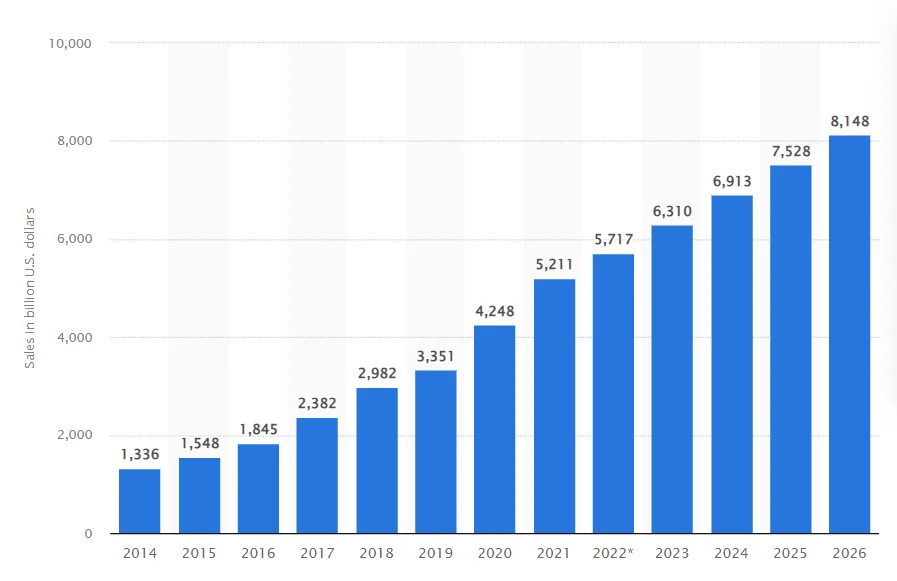
Source: Statista
According to FirstPageSage, two-thirds of all clicks on Google Search go to the top 3 organic results. The first organic result receives 19 times more clicks than the top paid search result. If your store sits on page 2, 3, or beyond, your potential customers are simply not finding you.
So, what affects the ranking of your ecommerce store? And how do you rank your website on page 1 of Google in 2026?
In this guide, you will discover the 10 most important ecommerce SEO ranking factors in 2026 — from technical foundations and on-page optimisation to E-E-A-T signals, schema markup, and AI-powered search. We have also included a free 2026 ecommerce SEO checklist you can implement immediately.
Table of Contents
- What Is Ecommerce SEO?
- Why Is Ecommerce SEO Important?
- Ecommerce SEO vs. Regular SEO: Key Differences
- The 10 Most Important Ecommerce SEO Ranking Factors in 2026
- Optimising for AI Search, GEO, and Answer Engines in 2026
- 2026 Ecommerce SEO Checklist
- Frequently Asked Questions
What Is Ecommerce SEO?
Ecommerce SEO (Search Engine Optimisation) refers to the practice of optimising an online store to improve its visibility in search engine result pages (SERPs). The primary goal is to generate consistent organic traffic and drive more sales — without paying for every click.
This approach is far more cost-effective than bidding on expensive paid advertising keywords. More importantly, organic traffic converts at an average rate of 2.8% for ecommerce websites — outperforming both social media and email as a channel.
However, SEO for an ecommerce website is far more than adding targeted keywords and building links. In 2026, it encompasses technical infrastructure, content depth, E-E-A-T signals, structured data, and even optimisation for AI-generated search results. You also need a strong understanding of search engine algorithms and how they evolve.
Why Is Ecommerce SEO Important?
Ecommerce SEO is the cornerstone of sustainable online retail growth. To compete effectively in an increasingly crowded digital marketplace, you need to attract the right audience, establish a strong online presence, and convert organic traffic into revenue.
Key reasons ecommerce SEO matters in 2026:
- Ecommerce SEO increases the visibility of your web pages so that customers can discover your store when searching for products you sell.
- Higher rankings lead to increased organic traffic — which is more cost-effective and sustainable than paid advertising.
- Targeting the right keywords increases conversions by connecting shoppers with exactly what they are looking for at the right moment in their buying journey.
- SEO optimisation improves your website’s structure, content, and design — which enhances the overall user experience and reduces bounce rates.
- Consistently high rankings build brand authority and customer trust, making shoppers more likely to choose you over an unfamiliar competitor.
- Unlike paid ads that stop the moment your budget runs out, SEO delivers compounding returns — traffic and rankings that grow over time.
Ecommerce SEO vs. Regular SEO: Key Differences
While both disciplines share the same foundational principles, ecommerce SEO and regular (informational) SEO differ significantly in focus and complexity.
| Factor |
Ecommerce SEO |
Regular / Informational SEO |
| Primary Goal |
Drive product sales and revenue |
Drive traffic, leads, and brand awareness |
| Keyword Intent Focus |
Transactional and commercial intent |
Informational and navigational intent |
| Key Page Types |
Product pages, category pages, collections |
Blog posts, landing pages, service pages |
| Structured Data |
Product, Review, Offer, Breadcrumb, FAQ schema |
Article, FAQ, HowTo, Organisation schema |
| Technical Complexity |
Very high — thousands of URLs, faceted navigation, duplicate content risks |
Moderate — fewer pages, simpler architecture |
| Conversion Metric |
Revenue, average order value (AOV), ROAS |
Leads, subscriptions, content engagement |
| Seasonal Strategy |
Critical — must plan for Black Friday, Q4, and product launches |
Less critical unless industry is seasonal |
The 10 Most Important Ecommerce SEO Ranking Factors in 2026
Google considers over 200 ranking signals when deciding which pages deserve top positions. For ecommerce websites, the following 10 factors have the greatest impact on your ability to rank on page 1 and convert that traffic into revenue.
1. Keyword Research and Search Intent Mapping
Keywords are the foundation of ecommerce SEO — but in 2026, keyword strategy goes far beyond finding high-volume search terms. The most important skill is matching your content to searcher intent: understanding exactly what a person wants to find, see, or buy when they type a query into Google.
If you have an online store, the first step is to research relevant keywords using tools such as Google Keyword Planner, Ahrefs, or SEMrush. Then map each keyword to the correct page type based on its intent.
There are four types of search intent to understand:
- Informational intent — The searcher wants to learn. Example: “What are the best headphones for running?” — target this with blog posts and buying guides.
- Commercial investigation intent — The searcher is comparing options before buying. Example: “Sony vs Bose noise-cancelling headphones” — target this with comparison pages and category pages.
- Transactional intent — The searcher is ready to buy. Example: “buy Sony WH-1000XM5 online” — target this with optimised product pages.
- Navigational intent — The searcher is looking for a specific brand or website. Example: “Sony headphones official store” — target this with your homepage and branded landing pages.
Long-tail keywords — longer, more specific phrases — are particularly valuable for ecommerce. They have lower competition, higher purchase intent, and convert at 2.5 times the rate of broader terms. For example, “wireless noise-cancelling headphones under £100” will convert far better than simply targeting “headphones.”
Pro tip for 2026: Use Google Search Console to monitor which queries are generating impressions but few clicks. These “striking distance” keywords — typically ranking in positions 5–20 — represent your fastest path to Page 1 with targeted content improvements.
2. Technical SEO: The Foundation of Ecommerce Rankings
If you own an online store, a technically sound website is non-negotiable. Technical SEO ensures that search engines can efficiently find, crawl, index, and understand every page of your store — and that users enjoy a fast, stable, and secure experience when they arrive.
Securing a website and optimising site structure are core ecommerce SEO ranking factors. An ecommerce website with thousands of product pages is particularly vulnerable to technical issues that can suppress rankings across the entire domain.
Step-by-step technical SEO foundations for ecommerce:
- Conduct a regular technical SEO audit using tools like Screaming Frog or Google Search Console to identify and fix crawl errors, broken links, and redirect chains.
- Build a logical, flat site architecture where every product page is reachable within 3 clicks from the homepage. This helps both users and search engine crawlers navigate your store efficiently.
- Secure your website with HTTPS — Google treats HTTPS as a direct ranking signal and displays a “Not Secure” warning on HTTP sites, which damages customer trust.
- Create and submit an XML sitemap in Google Search Console so Google knows which pages to crawl and index.
- Configure your robots.txt file correctly to prevent search engines from crawling duplicate or low-value pages (such as faceted navigation URLs or internal search results pages).
- Implement canonical tags on product pages to resolve duplicate content issues — a common problem on ecommerce sites where the same product appears under multiple category URLs.
- Fix errors: 3xx (redirects), 4xx (not found), and 5xx (server errors) — these directly harm your crawl budget and user experience.
Technical issues that are most damaging to ecommerce rankings:
- Duplicate product descriptions (especially from manufacturer copy)
- Orphaned pages with no internal links pointing to them
- Slow page load times, particularly on mobile
- Unoptimised faceted navigation generating thousands of duplicate URLs
- Missing or incorrect canonical tags
Core Web Vitals for Ecommerce (LCP, INP, CLS)
Since Google’s Page Experience update, Core Web Vitals have been a confirmed ranking factor — and they are especially critical for ecommerce sites where slow pages directly cost you sales.
Core Web Vitals consist of three metrics:
- Largest Contentful Paint (LCP) — measures how quickly the main content of a page loads. Target: under 2.5 seconds. For ecommerce, this is usually your hero product image or category banner.
- Interaction to Next Paint (INP) — measures how quickly your page responds to user interactions such as taps and clicks. Target: under 200 milliseconds. Crucial for add-to-cart and checkout buttons.
- Cumulative Layout Shift (CLS) — measures visual stability; how much the page layout shifts unexpectedly as it loads. Target: under 0.1. Unexpected layout shifts frustrate shoppers and can cause accidental taps on the wrong element.
Use Google PageSpeed Insights and Google Search Console’s Core Web Vitals report to identify which pages fail these thresholds and prioritise fixes accordingly.
Schema Markup and Structured Data for Online Stores
Schema markup (structured data) is one of the most underutilised technical SEO advantages available to ecommerce businesses in 2026. It is code you add to your pages — typically in JSON-LD format — that tells Google exactly what your content represents, enabling rich results in search.
The impact is significant. Pages with schema markup achieve 20–40% higher click-through rates. Rich results achieve 82% higher CTR compared to standard search listings. Product schema specifically delivers 4.2× higher Google Shopping visibility.
The most important schema types for ecommerce:
- Product schema — displays price, availability, and product details directly in search results.
- Review / AggregateRating schema — shows star ratings in SERPs, dramatically improving CTR.
- BreadcrumbList schema — displays your site navigation path in search results, helping users understand your site structure.
- FAQPage schema — triggers FAQ rich snippets that occupy significantly more SERP real estate.
- Offer schema — highlights promotional prices, discounts, and sale periods.
You can implement schema via plugins like Rank Math or Yoast SEO, or by adding JSON-LD code directly to your page templates.
Mobile-First Indexing and Mobile UX
Google now uses mobile-first indexing as its primary crawl method — meaning it evaluates the mobile version of your site to determine rankings, even for desktop searches. With more than 50% of all online shopping now happening on mobile devices, this is both a technical and commercial priority.
Mobile optimisation checklist for ecommerce:
- Use a responsive design that adapts seamlessly to all screen sizes
- Ensure product images load at the correct resolution on mobile without causing CLS
- Make all tap targets (buttons, links, add-to-cart) at least 48×48px
- Simplify navigation menus for thumb-friendly use
- Ensure the checkout process is frictionless on small screens
- Test your site using Google’s Mobile-Friendly Test tool
3. Unique, Authoritative, and In-Depth Content
Having original and unique content is one of the most powerful ranking factors for ecommerce websites. In 2026, Google’s Helpful Content System actively rewards content that demonstrates genuine expertise and real-world experience, and penalises thin, generic, or AI-generated-for-rankings content.
According to a study by Oberlo, 96% of marketing decision-makers say content marketing has been effective for their brands. For ecommerce, content serves a dual purpose: it helps customers make informed purchase decisions and signals topical authority to search engines.
Content strategy essentials for ecommerce SEO in 2026:
- Product page content — Write original, detailed product descriptions (aim for 300+ words on key products). Avoid using manufacturer copy verbatim — duplicate content across thousands of product pages is a major ranking suppressor. Include features, benefits, use cases, FAQs, and customer review highlights.
- Category page content — Add 200–400 words of unique, keyword-rich introductory content to your category pages. This is often the highest-value content investment for ecommerce SEO.
- Buying guides and comparison content — Create evergreen resources that help customers choose between products. These attract links, rank for commercial intent queries, and build trust.
- Blog content for informational queries — Target upper-funnel queries that your potential customers search before they are ready to buy. This builds topical authority and creates multiple entry points to your store.
- Commercial intent keywords — Identify which products your potential customers are most actively searching for and ensure your product and category pages are fully optimised for those terms.
Topical authority — the practice of building comprehensive content clusters around your core product categories — is increasingly important for ecommerce rankings in 2026. Rather than publishing isolated pages, create a hub-and-spoke content model where a pillar page covers a broad topic, supported by detailed articles covering every subtopic.
4. On-Page SEO: Title Tags, Meta Descriptions, and URLs
After securing your technical foundation and creating authoritative content, the next critical ranking factors for ecommerce SEO are your on-page elements. These come under the category of on-page SEO and directly influence both search rankings and click-through rates from the SERP.
By correctly optimising these elements across every product and category page, you significantly improve your store’s visibility and the likelihood that searchers choose your result over a competitor’s.
On-page SEO optimisation for ecommerce:
- Title tags — Include your primary keyword near the start of the title tag. For product pages, use the format: [Product Name] | [Key Benefit or Feature] | [Brand]. Keep titles between 50–65 characters. For category pages, include the keyword and a modifier such as “Buy”, “Shop”, or “Best”.
- Meta descriptions — Write unique meta descriptions for every key page. Include the primary keyword, a specific benefit or unique selling point, and a call to action. Keep between 140–160 characters. Strong meta descriptions improve CTR even without directly affecting rankings.
- URLs — Use short, descriptive, keyword-rich URLs. Separate words with hyphens, use lowercase, and avoid stop words. Example: /running-shoes/mens-waterproof/ is far better than /category?id=4821&filter=mens.
- H1 tags — Each page must have exactly one H1 tag containing the primary keyword. For product pages, this is typically the product name. For category pages, it is the category name plus a modifier.
- Image alt text — Write descriptive alt text for every product image using the format: [primary keyword] + [description]. Example: “men’s waterproof trail running shoes in grey”. This improves accessibility and gives your images a chance to rank in Google Image Search.
- Long-tail keywords in product descriptions — Naturally incorporate long-tail variations throughout your product and category content. Use semantic variations rather than exact-match repetition.
5. E-E-A-T Signals: Experience, Expertise, Authoritativeness, and Trustworthiness
E-E-A-T — which stands for Experience, Expertise, Authoritativeness, and Trustworthiness — is Google’s framework for evaluating content quality and is a critical ranking factor for ecommerce websites in 2026. It is defined in Google’s Search Quality Rater Guidelines and directly influences how Google’s algorithms assess the credibility of your store and its content.
What each component means for ecommerce:
- Experience — Does your content demonstrate first-hand experience with the products you sell? This can be shown through real customer reviews, user-generated content, staff product recommendations, and authentic product photography.
- Expertise — Is the content written or reviewed by someone with genuine knowledge in the field? For an electronics store, this means product descriptions written by technical specialists. For a health supplement store, it means content reviewed by qualified practitioners.
- Authoritativeness — Is your brand recognised as an authority by other credible sources? This is established through editorial backlinks, media mentions, industry awards, and citations from expert publications.
- Trustworthiness — Does your website give users every reason to trust it? This includes: visible trust badges (SSL, secure payment logos), clear return and refund policies, accessible contact information, and a physical business address.
Practical E-E-A-T improvements for ecommerce websites:
- Add detailed author bios to all blog content, including credentials and areas of expertise
- Display verified customer reviews prominently on product pages (with Review schema markup)
- Show trust signals: payment security badges, SSL certification, industry accreditations
- Create a detailed “About Us” page with real team members, company history, and mission
- Cite authoritative external sources when making claims in your blog content
- Keep content up to date — showing a “Last Updated: March 2026” date signals recency
6. Link Building and Backlink Authority
Backlinks remain one of Google’s strongest ranking signals. For ecommerce, high-quality links from relevant, authoritative websites signal to Google that your store is a credible and trusted resource — directly improving rankings for competitive product and category keywords.
The emphasis in 2026 is firmly on quality over quantity. A handful of editorial links from respected industry publications will outperform hundreds of low-quality directory submissions. Focus on earning links that are genuinely hard to replicate.
Effective link building strategies for ecommerce:
- Identify expired or outdated competitor resources. Create updated, better versions of that content, then contact website owners who linked to the original and suggest your improved resource as a replacement.
- Find relevant social media groups, communities, and industry events. Engage authentically, identify events or collaborations where your products add value, and build relationships that lead to natural mentions and links.
- Send your products to relevant bloggers, journalists, and content creators. Stay connected, send thank-you notes after coverage, and look for opportunities for ongoing collaboration and future mentions.
- Use the product feedback technique: identify roundup articles and “best of” lists in your niche, reach out with your products, and request inclusion if the product genuinely fits their criteria. This is a direct way to earn links to specific product pages.
- Create link-worthy assets — original research, comprehensive buying guides, and data-driven infographics — that attract editorial links naturally over time.
- Pursue digital PR — pitch product stories, founder stories, or unique data to journalists and industry publications.
7. Page Speed and Core Web Vitals
Page speed is both a confirmed Google ranking factor and a direct driver of ecommerce revenue. Research shows that a 1-second delay in page load time can reduce conversions by up to 7%. For ecommerce, every second of load time costs you sales.
According to available data, 19% of customers will abandon a page that takes longer than two to three seconds to load. Online shoppers’ ideal website speed is two seconds or less — and faster is always better. You can check your current speed using Google PageSpeed Insights (free) or GTmetrix.
Common causes of slow ecommerce page speed:
- Uncompressed, oversized product images
- Excessive third-party scripts (live chat, tracking pixels, review widgets)
- Unoptimised JavaScript and CSS files
- Lack of browser caching or a Content Delivery Network (CDN)
- Slow server response times (Time to First Byte — TTFB)
Steps to improve ecommerce page speed:
- Compress and convert product images to modern formats (WebP) without sacrificing quality
- Implement lazy loading for images below the fold
- Minify CSS, JavaScript, and HTML files
- Use a CDN to serve assets from servers geographically close to your customers
- Reduce or defer third-party scripts that are not critical to the initial page load
- Use server-side caching and upgrade your hosting plan if TTFB is above 600ms
- Limit the use of unnecessary redirects
Core Web Vitals metrics — LCP, INP, and CLS — are directly tied to page speed performance. See Section 2: Technical SEO for the specific thresholds and how to measure them.
8. User Experience (UX) and Engagement Signals
User experience is a crucial ranking factor for ecommerce websites. Google’s algorithms increasingly use engagement signals — such as time on page, bounce rate, and click-through rate — as proxy signals for content quality and relevance.
Great UX is not only about making your website look visually appealing. It encompasses everything from navigation clarity, information architecture, and page speed to checkout friction, accessibility, and mobile usability. The goal is to make it as easy as possible for a customer to find, evaluate, and purchase a product.
UX improvements that directly impact ecommerce SEO and conversion:
- Shorten site load time — every second saved increases both rankings and conversion rates
- Improve interactivity — ensure product pages load fully before users begin scrolling or interacting
- Eliminate intrusive ads and pop-ups — particularly on mobile, intrusive interstitials are a negative ranking signal per Google’s guidelines
- Build clear calls to action (CTAs) — every product page should make the next step (Add to Cart, View Details, Compare) unmistakably clear
- Simplify navigation — ensure any product is reachable within three clicks; use breadcrumbs so users always know where they are
- Add a site search function — shoppers who use site search convert at 1.8× the rate of those who browse
- Reduce shopping cart abandonment — a frictionless checkout with multiple payment options, guest checkout, and transparent pricing directly reduces abandonment rates
9. Optimised Category and Product Pages
Category pages and product pages are the commercial heart of your ecommerce store — and they are the pages that directly generate traffic and sales from high-intent search queries. Optimising these pages is one of the highest-return activities in ecommerce SEO.
Category pages divide your store into logical product groupings, helping both customers and search engines navigate your inventory. An optimised category page should include:
- A keyword-rich H1 tag (e.g., “Men’s Waterproof Trail Running Shoes”)
- 200–400 words of unique, helpful introductory content above or below the product grid
- Keyword-optimised meta title and description
- Breadcrumb navigation with BreadcrumbList schema markup
- Internal links to related subcategories and top-selling products
- Properly structured subcategory pages — for example, if you sell laptops, your subcategories might be “Touchscreen Laptops,” “Gaming Laptops,” and “Ultra-thin Business Laptops”
Product pages must be optimised for transactional intent — shoppers who land here are often ready to buy. Key optimisation elements include:
- A unique, descriptive product title as the H1
- Original product descriptions of 300+ words (never copy manufacturer text verbatim)
- High-quality product images with keyword-rich alt text
- Clear pricing, availability, and delivery information — ideally marked up with Product + Offer schema
- Customer reviews displayed prominently, with AggregateRating schema
- A “Related Products” section with internal links to keep shoppers engaged
- An FAQ section addressing common pre-purchase questions
In terms of page design, both category and product pages work best with a highly structured, visually clean interface that prioritises the product above all else.
10. Site Architecture and Internal Linking
Site architecture — how your pages are structured and connected — is a foundational ecommerce SEO ranking factor that is frequently overlooked. A well-designed information architecture helps search engine crawlers discover and index every page efficiently, and helps PageRank flow from authoritative pages to key product and category pages.
Research shows that 86% of ecommerce brands lack optimised internal links — even 41% of high-visibility ecommerce sites have poor internal linking structures. This represents a significant competitive opportunity.
Best practices for ecommerce site architecture and internal linking:
- Use a flat site architecture: Homepage → Category → Subcategory → Product. Every product should be reachable in 3 clicks or fewer from the homepage.
- Implement a hub-and-spoke internal linking model: link from authoritative blog posts and pillar pages to category and product pages using keyword-rich anchor text.
- Add breadcrumb navigation to every product and category page — this helps both users and search engines understand your site hierarchy.
- Link to your highest-value category pages from your homepage and primary navigation.
- Create a comprehensive HTML sitemap in addition to your XML sitemap to ensure all pages are discoverable.
- Use descriptive anchor text for all internal links — avoid generic phrases like “click here” or “read more.” Instead use contextual, keyword-rich anchors like “shop men’s waterproof running shoes.”
- Identify and fix orphaned pages — product or category pages with no internal links pointing to them receive no PageRank and are rarely crawled.
Optimising for AI Search, GEO, and Answer Engines in 2026
One of the most significant shifts in search behaviour in 2026 is the rise of AI-powered search results. Google’s AI Overviews, ChatGPT Search, Perplexity, and other AI-driven answer engines are changing how consumers discover products and make purchasing decisions.
The data is striking: AI Overviews now appear for 16% of ecommerce searches. For queries that trigger an AI Overview, organic click-through rate has dropped by 61% compared to traditional search results. Zero-click searches now account for 69% of all queries.
This means ecommerce brands must now optimise for three overlapping discovery channels:
- SEO (Search Engine Optimisation) — ranking in traditional Google and Bing organic results
- GEO (Generative Engine Optimisation) — ensuring your content is cited and surfaced in AI-generated search answers
- AEO (Answer Engine Optimisation) — structuring content so voice assistants and AI chatbots can extract and deliver direct answers to user queries
How to optimise for AI-powered search as an ecommerce brand:
- Answer questions directly and clearly — AI systems prefer content that provides a concise, authoritative answer before expanding into detail. Use the “inverted pyramid” writing style.
- Use structured data comprehensively — AI systems rely heavily on schema markup to understand and categorise your content. Product, Review, FAQ, and Offer schemas are especially important.
- Cite authoritative sources and real data — content that references credible data points is significantly more likely to be included in AI-generated answers.
- Create comprehensive FAQ content — FAQ sections with clear question-and-answer formatting are among the most commonly surfaced content in AI Overviews.
- Build brand authority signals — AI systems favour brands that are widely cited, reviewed, and referenced across the web. Digital PR, review generation, and consistent NAP (Name, Address, Phone) data all contribute.
- Focus on long-tail, conversational queries — voice search and AI queries tend to be longer and more conversational than typed search. Optimise your FAQ and blog content for natural language questions.
2026 Ecommerce SEO Checklist (Quick Reference)
Use this checklist to audit your ecommerce store’s SEO health and identify your highest-priority optimisation opportunities.
| ✓ |
Task |
Category |
Priority |
Expected Impact |
| ☐ |
Rewrite meta titles to include primary keyword + year + power word |
Meta Tags |
Critical |
Higher CTR from SERP |
| ☐ |
Write unique meta descriptions for all key pages (140–160 chars) |
Meta Tags |
Critical |
Improved click-through rate |
| ☐ |
Add Product schema (price, availability, reviews) to all product pages |
Schema Markup |
Critical |
Rich snippets — 20–40% higher CTR |
| ☐ |
Add FAQPage schema to all FAQ sections |
Schema Markup |
Critical |
FAQ rich snippets in SERP |
| ☐ |
Run Core Web Vitals audit via Google Search Console |
Technical SEO |
Critical |
Page experience ranking boost |
| ☐ |
Ensure all product images have keyword-rich alt text |
On-Page SEO |
High |
Image search traffic + accessibility |
| ☐ |
Write original 300+ word descriptions for top 50 product pages |
Content |
High |
Ranking for product keywords |
| ☐ |
Add 200–400 words of unique content to all category pages |
Content |
High |
Category page rankings |
| ☐ |
Add an author bio with credentials to all blog content |
E-E-A-T |
High |
E-E-A-T and trust signals |
| ☐ |
Display verified customer reviews on product pages with Review schema |
E-E-A-T |
High |
Star ratings in SERP + trust |
| ☐ |
Compress all product images and implement WebP format |
Page Speed |
High |
LCP improvement + conversions |
| ☐ |
Add 5–8 strategic internal links from blog posts to category pages |
Internal Linking |
High |
PageRank flow + crawl efficiency |
| ☐ |
Set up and verify Google Search Console + submit XML sitemap |
Technical SEO |
Critical |
Faster indexing + issue alerts |
| ☐ |
Test all key pages on Google’s Mobile-Friendly Test tool |
Mobile SEO |
High |
Mobile-first indexing compliance |
| ☐ |
Create 3 high-quality buying guides targeting commercial intent keywords |
Content Strategy |
Medium |
Topical authority + backlinks |
| ☐ |
Add BreadcrumbList schema to all category and product pages |
Schema Markup |
Medium |
Breadcrumb display in SERP |
| ☐ |
Audit and fix all canonical tags across the site |
Technical SEO |
High |
Eliminate duplicate content issues |
| ☐ |
Implement a review generation strategy (post-purchase email sequence) |
E-E-A-T / UGC |
High |
Social proof + review schema CTR |
| ☐ |
Add clear trust badges (SSL, payment logos, return policy) across the store |
Trustworthiness |
Medium |
E-E-A-T trust signals |
| ☐ |
Optimise for AI search: add FAQ sections, cite data, use clear formatting |
GEO / AEO |
High |
AI Overview citation + visibility |
Frequently Asked Questions About Ecommerce SEO Ranking Factors
What are the most important ecommerce SEO ranking factors in 2026?
The most important ecommerce SEO ranking factors in 2026 include keyword research and search intent mapping, technical SEO (Core Web Vitals, schema markup, mobile-first indexing), on-page optimisation of product and category pages, E-E-A-T signals, content depth and topical authority, quality backlinks, page speed, user experience, site architecture and internal linking, and optimisation for AI-powered search (GEO and AEO).
How long does ecommerce SEO take to show results?
Most ecommerce stores begin to see measurable ranking improvements within 3 to 6 months of consistent SEO effort. Highly competitive keywords may take 6 to 12 months. Quick wins like meta tag rewrites and schema markup implementation can improve click-through rates within weeks of re-indexing. SEO is a long-term investment — the results compound and grow over time, unlike paid advertising.
What is E-E-A-T and why does it matter for ecommerce SEO?
E-E-A-T stands for Experience, Expertise, Authoritativeness, and Trustworthiness. It is Google’s framework for evaluating the quality and credibility of web content. For ecommerce, strong E-E-A-T signals include detailed author bios on blog content, expert product descriptions, verified customer reviews, trust badges, and citations from authoritative sources. Improving your E-E-A-T is one of the highest-impact long-term SEO strategies available.
What is schema markup and how does it help ecommerce SEO?
Schema markup (structured data) is code you add to your pages to help Google understand your content and display enriched results in search. For ecommerce, Product schema shows prices, ratings, and availability directly in the SERP. Pages with schema markup achieve 20–40% higher click-through rates. Rich results achieve 82% higher CTR compared to standard search listings. Product schema specifically delivers 4.2× higher Google Shopping visibility.
What are Core Web Vitals and how do they affect ecommerce rankings?
Core Web Vitals are Google’s page experience metrics: Largest Contentful Paint (LCP) measures loading speed, Interaction to Next Paint (INP) measures responsiveness, and Cumulative Layout Shift (CLS) measures visual stability. Pages that meet Google’s thresholds (LCP under 2.5 seconds, INP under 200ms, CLS under 0.1) benefit from Google’s Page Experience ranking boost. You can check your scores in Google Search Console under the Core Web Vitals report.
How is ecommerce SEO different from regular SEO?
Ecommerce SEO focuses on optimising product pages, category pages, and the shopping experience for transactional and commercial intent keywords. Regular SEO typically targets informational content and lead generation. Ecommerce SEO also requires Product schema, shopping feed optimisation, management of large numbers of URLs and faceted navigation, duplicate content resolution, and seasonal demand planning — all of which are rarely relevant for standard content websites.
What is GEO and why does it matter for ecommerce in 2026?
GEO stands for Generative Engine Optimisation — the practice of optimising your content to be cited in AI-generated search answers from tools like Google AI Overviews, ChatGPT, and Perplexity. In 2026, AI Overviews appear for 16% of ecommerce searches. Brands that structure content clearly, cite authoritative data, and use comprehensive schema markup are significantly more likely to be surfaced in AI-generated answers.
How many backlinks does an ecommerce website need to rank?
There is no fixed number. What matters is the quality and relevance of backlinks, not volume alone. A handful of high-authority links from relevant industry publications will outperform hundreds of low-quality directory links. Focus on digital PR, product review outreach, buying guide creation, and earning editorial mentions from authoritative sites in your niche. Use tools like Ahrefs or SEMrush to analyse the backlink profiles of your top-ranking competitors and set realistic targets.
Conclusion
Ecommerce SEO in 2026 is more comprehensive — and more rewarding — than ever before. The brands that rank at the top of Google are not just adding keywords to product pages. They are building technically excellent stores, creating genuinely helpful and authoritative content, earning quality backlinks, and now optimising for the AI-powered search landscape that is reshaping how customers discover products.
The good news is that most ecommerce stores have significant untapped potential. Whether it is adding schema markup to unlock rich snippets, expanding thin product descriptions, fixing Core Web Vitals, or building a content strategy around your core product categories — every improvement compounds over time.
Always remember that SEO is an ongoing process. Search engine algorithms evolve constantly, and the competitive landscape shifts with every major Google update. Continually analyse your competitors’ performance, track your keyword rankings in Google Search Console, and make data-driven decisions about where to focus your effort next. This includes content updates, keyword ranking analysis, and monitoring Core Web Vitals and engagement signals on a regular basis.
By improving search engine visibility, ecommerce businesses can attract more organic traffic, reach their target audience, and ultimately increase sales and revenue. Track your website performance regularly and stay updated with the evolving standards of search in 2026 and beyond.
I hope this guide gives you deep, actionable insight into ecommerce SEO and the ranking factors that matter most right now.