Updated: March 2026 — The ecommerce website development cost in India ranges from ₹50,000 for a basic online store to ₹25 lakh or more for enterprise-grade platforms. With India’s ecommerce market projected to surpass $160 billion by 2028 and over 850 million Indians now online, launching a professional online store is no longer optional — it’s a business necessity.
Ecommerce businesses are flourishing in every sector with a huge consumer base. People now prefer online stores for their shopping needs because of the variety and choices they offer. It is influencing individual sellers and businesses to bring their offline stores online to target customers who are actively shopping digitally. Having an e-commerce website is more than relevant today — but building one involves careful planning and budgeting. Many sellers and businesses always wonder about the cost for eCommerce website development and how it is going to work. In this complete guide, we answer that question in full detail.
Ecommerce is one of the best ways to grow your business on the internet and increase profitability. But in order to build and run one successfully, you will need an eCommerce website development partner on your side. Before getting an estimate from developers, you should assess your requirements and understand the eCommerce website development price in India so you can plan your budget smartly.
What Is the Ecommerce Website Development Cost in India in 2026?
The ecommerce website development cost in India is not fixed — it depends on your platform choice, design complexity, number of products, features required, and the type of development team you hire. Here is a quick overview of what businesses across different stages can expect to invest:
Business Type
Features
Platform
Approx. Cost (INR)
Timeline
Startup / Small Store
Up to 50 products, basic checkout, 1 payment gateway
2,000+ products, multi-vendor, ERP, API integrations, AI features
Magento Enterprise / Custom Stack
₹12,00,000 – ₹25,00,000+
16–24 weeks
These ranges are based on current market rates across Indian development agencies and freelancers as of 2026. Actual costs may vary based on your city, agency reputation, and specific feature scope.
Your Ecommerce Business Plan
As not all online stores are the same, eCommerce website development cost depends on many factors and varies from one store to another. While you are developing an e-commerce business plan to find out where to start, how to start, and what to consider for your online store, you should determine your goal, factors, and elements you will need during the website development process.
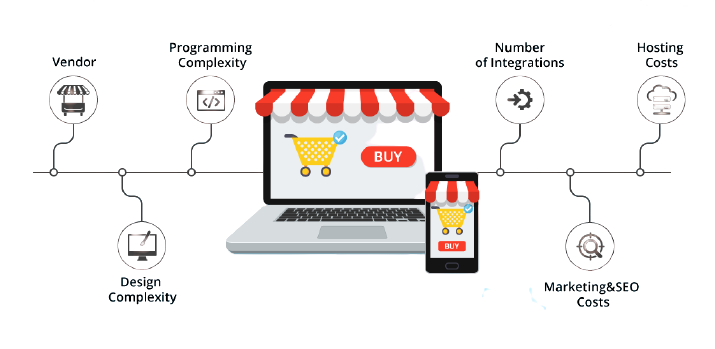
Factors That Influence Cost for Ecommerce Website Development
In your eCommerce business plan, you should include the following factors and elements to decide on your eCommerce website development cost:
Your goals and deliverables
Domain name and hosting
Website design and pages
Ecommerce functionality
SEO for website
Content Management System (CMS)
Database integration
Security
Promotional activities and live chat
Website maintenance
These are some common factors and elements that every eCommerce website needs to consider and integrate to serve its consumers better. With lesser functionality, minimum pages, and a smaller catalog, it will be more affordable to manage your online store than a website with a huge catalog and more functionality. Let’s discuss these things in detail.
Your Goals and Deliverables
Before you figure out your eCommerce website development cost and process, you need to determine your goals, what exactly you want to deliver, how you want to offer it, how you will manage your catalog, and what your expectations from your resources are.
To start with your eCommerce development plan, answer the following questions based on your business requirements:
What kind of eCommerce store do you want to build? Do you want to dropship, sell your own products, or build an affiliate marketplace?
What are your shipping options and delivery model?
How large is your product catalog? Do you sell products with multiple variants?
What payment options and checkout processes do you need?
What kind of user interface and data management will you need?
How do you want to promote, market, and deliver your services?
What are your future growth goals?
What is your eCommerce web development budget?
Answers to these questions will define your e-commerce business model and what kinds of elements and functionality you will need to start with.
Domain Name and Hosting
Domain name and hosting are the basic cost components of any website. To build a successful online store brand, you will need a catchy, memorable, and easily pronounced domain name. Domain registration in India typically costs ₹500 to ₹2,000 per year depending on the extension (.com, .in, .store) and registrar.
Hosting costs vary significantly based on the scale of your ecommerce operation. Here are your main options:
Shared Hosting (₹2,000–₹8,000/year): Suitable for small businesses with a limited product catalog and basic ecommerce functionality.
VPS Hosting (₹5,000–₹20,000/year): Ideal for growing ecommerce stores that need better performance, speed, and reliability.
Dedicated Server (₹20,000–₹80,000+/year): For large-scale ecommerce businesses with high traffic and complex databases. Some eCommerce projects also need multiple dedicated servers in India to manage multiple databases for smooth functionality.
Cloud Hosting — AWS / Google Cloud / DigitalOcean (₹10,000–₹50,000+/year): Best for scalable, high-availability ecommerce platforms that need to handle traffic spikes.
Website Design and Pages
To run a successful online store, you will need a responsive, mobile-first design and an intuitive user interface. In India, over 70% of ecommerce traffic comes from mobile devices, which makes mobile-first design a non-negotiable requirement in 2026 — not just for user experience, but also because Google uses mobile-first indexing for all websites.
Design cost in India depends on whether you choose a template or a fully custom UI/UX:
Pre-built / Template Design: ₹10,000 – ₹30,000 — fast to launch, limited brand customisation
Fully Custom UI/UX Design: ₹80,000 – ₹3,00,000+ — bespoke design built from scratch for maximum conversions
The number of web pages will also decide your development cost. Every ecommerce site needs static pages (About Us, Contact, Terms, Privacy Policy), along with product pages, category pages, and a checkout page. The more product listings you have, the more pages you will need.
Ecommerce Functionality
As you are building an eCommerce website, you will need the core functionalities of an online store: shopping cart software, customer registration, payment gateway integration, and a smooth checkout process. You can pick from various options based on your requirements and how you want to manage different stages of the shopping journey.
Additional features that impact the cost to develop an ecommerce website in India include:
Product catalog management with sorting, filters, and multi-variant support
Inventory management system for real-time stock tracking
Order management system for processing, tracking, and fulfillment
Wishlist, product comparison, and review features
AI-powered product recommendations for personalised shopping experiences
Multi-vendor marketplace functionality for platform-style businesses
Each additional feature adds to your development cost, but the right set of features directly drives conversion rate optimisation and long-term revenue growth.
SEO for Website
To build a loyal customer base, you first need to bring users to your website — and that starts with visibility on Google. If your listings don’t appear on the first page of search engine results, you are missing out on the majority of potential customers who shop through organic search.
SEO should be factored into your ecommerce website development budget from day one. Initial SEO setup — including technical SEO, on-page optimisation, and keyword research — can cost ₹10,000 to ₹30,000 as a one-time setup, while ongoing monthly SEO packages typically range from ₹5,000 to ₹30,000/month depending on competition and scope.
Content Management System (CMS)
You will need an administrative panel to manage your catalog, orders, users, and content without touching the website’s code. The CMS you choose will heavily influence your overall ecommerce website price in India. Popular options include:
WooCommerce — Free plugin, best for WordPress-based stores, widely used by Indian SMBs
Magento (Adobe Commerce) — Powerful and scalable, best for large catalogs and enterprise use
Shopify — Hosted SaaS platform, easy to manage, with monthly subscription costs
OpenCart — Lightweight and affordable, popular for budget-conscious Indian businesses
Drupal Commerce — Flexible but requires technical expertise
The kinds of functionality you need will decide which CMS program will best fit your business model. It is the foundation of any eCommerce website development and you should be very careful while picking the right one.
Database Integration
Database integration is mandatory for eCommerce websites to store and manage information about products, orders, and customers in a systematic manner. A well-structured database supports real-time inventory updates, order tracking, and personalised user experiences.
You can create multiple databases to manage customer preferences, product data, and order management separately. Third-party integrations with tools like Zoho CRM, Unicommerce, Shiprocket, and Delhivery for logistics can add ₹10,000 to ₹80,000 to your project depending on complexity. This could cost a bit more upfront, but will be very helpful in the long run for automating your operations.
Security
As you collect and store user information, payment details, and sensitive data on an eCommerce website, security is non-negotiable. Key security costs to account for include:
SSL Certificate: Free (Let’s Encrypt) to ₹5,000/year for premium certificates. The SSL (Secure Sockets Layer) guarantees your site is secured against hacker attacks and builds buyer trust.
Payment Card Industry (PCI-DSS) Compliance: Required if you store card data; adds development and audit costs
GST Compliance Integration: Indian ecommerce stores must be GST-compliant; integration adds ₹5,000–₹20,000
Data Privacy / IT Act Compliance: Mandatory for Indian businesses handling user data
Promotional Activities and Live Chat
To run a successful eCommerce business, you need to engage customers with offers, deals, and real-time support. Features like discount coupons, referral programs, pop-up offers, and suggestion feeds improve your conversion rate. A live chat feature allows visitors to get instant answers, directly reducing cart abandonment. These features are optional but can significantly accelerate growth — and each adds ₹3,000 to ₹20,000 to your development cost depending on the tool used.
Website Maintenance
Website maintenance is an ongoing cost that many businesses underestimate. It covers bug fixes, security patches, plugin/extension updates, performance monitoring, and implementation of new features over time. Without regular maintenance, even a well-built ecommerce website can become slow, vulnerable, or broken.
In India, ecommerce website maintenance typically costs 15–20% of the original development budget annually. For a ₹1 lakh website, expect to budget ₹15,000–₹20,000 per year. Enterprise platforms with dedicated support can cost ₹50,000–₹2,00,000/year.
Platform-Wise Ecommerce Website Development Cost in India
Your choice of platform is one of the biggest drivers of the cost to build an ecommerce website in India. Here is a detailed breakdown of costs by platform:
Shopify Website Development Cost in India
Shopify is a fully hosted SaaS ecommerce platform that is ideal for businesses that want a fast launch with minimal technical overhead. In India, Shopify is popular for D2C brands and growing product businesses.
Shopify Plan
Development Cost (INR)
Monthly Subscription
Best For
Basic Shopify Setup
₹30,000 – ₹50,000
~₹1,994/month
Startups, small stores
Shopify (Advanced)
₹50,000 – ₹2,00,000
~₹7,447/month
Growing brands
Shopify Plus (Enterprise)
₹2,50,000+
Custom pricing
High-volume, enterprise
Additional costs: Premium Shopify themes (₹10,000–₹25,000), apps and plugins (₹500–₹10,000/month each), and custom integrations (₹20,000–₹1,00,000).
WooCommerce Website Development Cost in India
WooCommerce is a free, open-source plugin for WordPress. It is the most popular ecommerce solution globally and particularly cost-effective for Indian SMBs already using WordPress.
Component
Cost (INR)
WooCommerce Plugin
Free
Web Hosting (annual)
₹3,000 – ₹20,000/year
Premium Theme
₹3,000 – ₹15,000
Development (basic setup)
₹25,000 – ₹80,000
Development (custom features)
₹80,000 – ₹1,50,000
Plugins and Extensions
₹2,000 – ₹30,000
Total Estimated Range
₹33,000 – ₹2,15,000
Magento Website Development Cost in India
Magento (now Adobe Commerce) is the platform of choice for large ecommerce businesses with complex product catalogs, multi-store setups, and advanced B2B requirements. It offers unmatched flexibility but requires experienced developers.
Magento Version
Development Cost (INR)
Best For
Magento Open Source
₹1,00,000 – ₹7,50,000
Mid to large businesses
Adobe Commerce (Cloud)
₹5,00,000 – ₹25,00,000+
Enterprise, multi-store
Magento development in India is primarily based in Tier 1 cities like Bangalore, Mumbai, and Delhi, where experienced Magento developers charge ₹800–₹2,500 per hour.
Custom Ecommerce Website Development Cost in India
Custom-built ecommerce websites offer maximum flexibility and are ideal for unique business models that no off-the-shelf platform can accommodate. They are built using technology stacks like React, Node.js, Laravel, Django, or similar frameworks.
Complexity Level
Cost (INR)
Timeline
Simple Custom Ecommerce
₹1,50,000 – ₹3,00,000
8–12 weeks
Advanced Custom Ecommerce
₹4,00,000 – ₹10,00,000
12–20 weeks
Enterprise Custom Platform
₹10,00,000 – ₹25,00,000+
20–36 weeks
Payment Gateway Integration Costs in India
No ecommerce website is complete without a payment gateway. In India, the most popular options are Razorpay, PayU, CCAvenue, and Instamojo. Here is what you can expect to pay:
Payment Gateway
Setup Fee
Transaction Fee
Best For
Razorpay
Free
2% per transaction
Startups and SMBs
PayU
Free – ₹5,000
1.99% – 2.5%
Mid-size businesses
CCAvenue
₹3,000 – ₹10,000
2% – 3%
Established businesses
Instamojo
Free
2% + ₹3 flat
Solo sellers, D2C
Stripe (International)
Free
2.9% + ₹16
International payments
Payment gateway integration typically adds ₹5,000 to ₹25,000 to your development cost depending on the platform and number of gateways integrated.
Freelancer vs Agency vs In-House: Which Is Best for Your Budget?
The type of development team you choose will significantly affect your overall ecommerce website development price in India. Here is a side-by-side comparison to help you decide:
Developer Type
Cost Range (INR)
Pros
Cons
Best For
DIY (Shopify / Wix)
₹15,000 – ₹50,000
Lowest cost, fast setup
Limited customisation, ongoing platform fees
Bootstrapped startups
Freelancer
₹15,000 – ₹80,000
Affordable, flexible
No team support, reliability risk
Simple, well-defined projects
Web Development Agency
₹50,000 – ₹5,00,000+
Full team, project management, post-launch support
Higher cost
Growth-focused businesses
In-House Team
₹5,00,000+/year
Full control, ongoing development
High salary overhead, recruitment effort
Large enterprises
For most Indian SMBs looking to build a scalable, professional ecommerce store, partnering with a web development agency in India offers the best balance of cost, quality, and long-term support.
Hidden and Ongoing Costs of Running an Ecommerce Website in India
Many businesses underestimate the true cost of ecommerce website ownership by focusing only on the initial development fee. Here are the hidden and recurring costs you must budget for:
Annual domain renewal: ₹500 – ₹2,000/year
Web hosting: ₹3,000 – ₹50,000/year depending on traffic and server type
SSL certificate renewal: Free – ₹5,000/year
Plugin / app subscriptions: ₹500 – ₹10,000/month per tool
Payment gateway transaction fees: 1% – 3% on every sale
Website maintenance retainer: 15–20% of original development cost annually
SEO services: ₹5,000 – ₹30,000/month
Digital marketing and paid ads: Variable — typically 10–20% of revenue target
A realistic annual cost of owning and running an ecommerce website in India — including hosting, maintenance, SEO, and payment fees — typically ranges from ₹50,000 to ₹5,00,000+ depending on your store’s scale.
How Long Does It Take to Build an Ecommerce Website in India?
Tips to Reduce Ecommerce Website Development Cost Without Compromising Quality
Start with an MVP: Launch with core features only. Add advanced functionality in phases after validating demand.
Choose open-source platforms: WooCommerce and Magento Open Source are free to download — you pay for hosting and development only.
Use premium pre-built themes: A quality theme at ₹3,000–₹15,000 can dramatically reduce design and development time.
Work with Tier 2 city agencies: Development agencies in cities like Jaipur, Ahmedabad, Lucknow, and Indore offer the same quality at 20–40% lower rates than Delhi or Mumbai.
Avoid scope creep: Define your complete feature list before signing a contract. Mid-project changes are the biggest budget killers.
Use free integrations first: Start with free payment gateways (Razorpay, Instamojo) and free shipping plugins before investing in paid tools.
Leverage existing plugins: Use WooCommerce or Shopify plugins instead of building custom features unless absolutely necessary.
Negotiate a maintenance package upfront: Bundling development + maintenance in one contract often yields a 10–15% cost saving.
Is Investing in Ecommerce Website Development Worth It in India?
Absolutely. India’s ecommerce market is projected to reach $160 billion by 2028, driven by growing internet penetration, rising disposable incomes, and the explosive growth of D2C (Direct-to-Consumer) brands expected to hit USD 66.4 billion by 2025. Businesses that invest in a well-built ecommerce platform today are positioning themselves to capture a rapidly expanding consumer base.
The cost of not having a robust ecommerce presence — lost sales, poor brand perception, missed organic traffic — far exceeds the upfront investment in development. Whether you are a local retailer, a manufacturer looking to go direct-to-consumer, or a startup building a marketplace, the ROI of a professionally built ecommerce website in India is clear and measurable.
Frequently Asked Questions About Ecommerce Website Development Cost in India
How much does an ecommerce website cost in India?
The ecommerce website development cost in India ranges from ₹50,000 for a basic store to ₹25 lakh or more for enterprise-grade platforms. The exact price depends on platform choice, design complexity, number of products, and features like payment gateway integration and mobile optimisation.
What is the cheapest way to build an ecommerce website in India?
The most affordable option is a DIY setup using WooCommerce or a basic Shopify plan, starting at ₹15,000–₹50,000. These platforms offer free or low-cost themes, built-in shopping carts, and payment gateway plugins, making them ideal for startups testing ecommerce for the first time.
How much does Shopify cost in India?
A basic Shopify setup in India costs between ₹30,000 and ₹50,000 for development, plus a monthly subscription starting at approximately ₹1,994/month. Advanced Shopify plans range from ₹50,000–₹2 lakh in development, while Shopify Plus for enterprise clients starts at ₹2.5 lakh+ in setup costs.
How long does it take to build an ecommerce website in India?
A basic ecommerce website takes 2–4 weeks to build. A mid-scale platform with custom design and integrations takes 6–10 weeks. Enterprise-level ecommerce websites with ERP integrations and advanced features can take 16–24 weeks from planning to launch.
Is it better to hire a freelancer or an agency for ecommerce development in India?
Freelancers charge ₹15,000–₹80,000 and suit simple, well-defined builds. Agencies charge ₹50,000–₹5 lakh+ but offer project management, design, development, and post-launch support under one roof. For businesses expecting growth and ongoing support, an agency is the better long-term investment.
What are the hidden costs of ecommerce website development in India?
Hidden ecommerce costs include annual hosting (₹3,000–₹50,000), SSL renewal (₹0–₹5,000), payment gateway fees (1–3% per transaction), plugin subscriptions (₹500–₹10,000/month), SEO services (₹5,000–₹30,000/month), and website maintenance (15–20% of dev cost annually).
Which platform is best for ecommerce website development in India?
The best platform depends on your budget and scale. Shopify suits beginners and growing brands (₹30K–₹2L setup). WooCommerce is ideal for WordPress users and SMBs (₹25K–₹1.5L). Magento suits large enterprises (₹1L–₹7.5L). Custom development offers maximum flexibility for unique business models (₹1.5L–₹10L+).
Can I build an ecommerce website in India for under ₹50,000?
Yes. A basic ecommerce website with 10–50 products, a standard template, one payment gateway, and shared hosting can be built in India for ₹20,000–₹50,000. Using WooCommerce with a ₹5,000 theme and basic developer support makes this achievable for startups and small businesses.
At Conclusion
These are some common factors and elements that decide the eCommerce website development price in India. Depending on your business model, the complexity of your website design, number of web pages, eCommerce functionality, database structure, platform choice, and development team, the cost for eCommerce website development in India can range from ₹50,000 to ₹25 lakh or more.
Building an eCommerce website from scratch can be more costly than using pre-made templates from popular platforms like Shopify or WooCommerce. Your website development partner can help you find the best designs and platforms for your online store based on your budget and goals.
At Media Search Group, we have a team of qualified and experienced web development experts who can help you design and develop a stunning eCommerce website within your budget. We can also help you with your SEO implementation that is an important part of website development as discussed above. Our SEO services include customized SEO packages to ensure your website ranks higher in search results and reaches potential customers. If you want to start an eCommerce website, you can contact us for the cost estimation and further discussion.
Meet Ratan Singh, a dedicated professional blogger and unwavering technology enthusiast. His journey in the world of content writing commenced over seven years ago. With a fervent passion for the latest advancements in technology, gadgets, mobile phones, apps, and social media, Ratan has emerged as a go-to source for all things tech and digital marketing. His analysis of the social media landscape unravels the latest trends and strategies, making him a valuable resource for digital marketers.