ChatGPT is no longer just an experiment for e-commerce — it is a proven growth engine. A 12-month analysis by Visibility Labs covering 94 seven- and eight-figure e-commerce brands found that traffic referred by ChatGPT converted at 1.81% versus 1.39% for non-branded organic search — a 31% advantage. Similarweb’s 2025 Global Ecommerce Report puts the gap even wider, estimating ChatGPT referral conversion at 11.4% compared to 5.3% for organic search. Meanwhile, ChatGPT visits to e-commerce stores grew 1,079% in a single year, from January to December 2025.
The reason behind these numbers is straightforward: by the time a shopper clicks through from ChatGPT, they have already described their needs, received tailored recommendations, and built confidence in a product — all inside the chat window. They arrive at your store ready to buy, not just browse.
In this guide, we cover every proven way e-commerce businesses can use ChatGPT to optimize sales in 2026 — from writing product descriptions and automating customer service, to capturing the new wave of ChatGPT Shopping and Agentic Commerce. Whether you run a Shopify store or a custom-built platform, this is your complete roadmap.
The Rise of ChatGPT and AI for E-Commerce:
ChatGPT is leading the integration of conversational AI into the e-commerce landscape. What started as a general-purpose chatbot in November 2022 has evolved into a full commerce layer — capable of recommending products, generating copy, analyzing data, and, as of 2025, enabling shoppers to complete purchases without ever leaving the chat window. Let’s explore the capabilities and applications of this transformative technology as it stands today.
Brief background on ChatGPT and its capabilities
ChatGPT was launched in November 2022 by OpenAI as a conversational AI system powered by generative pre-training. Its most advanced model, GPT-4o, supports text, image, and voice input in the same conversation and is available to all users — including those on free plans. It utilizes a complex machine-learning technique called transformer networks to analyze and understand natural language prompts. Key capabilities include:
- Natural language processing to comprehend nuances, context, and intent in text
- Accessing real-time web data to provide accurate and up-to-date responses
- Generating coherent, high-quality text — from product descriptions to full email campaigns — tailored to specific prompts
- Conversing contextually while maintaining logical consistency across long interactions
- Producing, summarizing, and analyzing structured data, spreadsheets, and business reports
Benefits of AI like ChatGPT for e-commerce businesses
With its advanced natural language capabilities, ChatGPT can provide e-commerce businesses with a wide range of benefits to enhance operations, marketing, and the customer experience. According to a McKinsey study, businesses that incorporate AI into their customer service and marketing strategies report up to a 20% increase in customer satisfaction. An MIT study found that ChatGPT reduces the time it takes to write a document by 50% while doubling productivity. Specifically, integrating conversational AI like ChatGPT enables online retailers to:
- Personalized engagement — Chatbots can provide tailored recommendations and conversations by processing customer data. This creates a customized shopping experience that mirrors in-store assistance.
- 24/7 customer support — The AI can instantly answer product queries without frustration, improving customer satisfaction around the clock. Gartner predicts AI will handle 80% of routine customer support by 2029.
- Appealing content generation — ChatGPT can create SEO-optimized product descriptions, email copy, ad headlines, and other text in a brand’s voice — at scale and in minutes.
- Data analysis — By processing sales data, ChatGPT can identify trends, forecast demand, and generate reports to inform faster, smarter business decisions.
- Higher revenue per session — ChatGPT-referred visitors generate 10.3% more revenue per session than non-branded organic search visitors, according to Visibility Labs’ 2025 analysis.
Current applications and use cases in e-commerce
ChatGPT is now being utilized across virtually every layer of e-commerce operations. Over 700 million people use ChatGPT every week, and a growing share of them are using it to find, evaluate, and purchase products. Key current applications include:
- Automated customer service agents — instant query resolution, returns handling, and product recommendations
- Product description generation — bulk-writing SEO-optimized, conversion-focused copy for entire catalogs
- ChatGPT Shopping — AI-powered product carousels surfacing your products to high-intent buyers directly in chat
- Inventory management — using demand data to optimize stock levels and reduce waste
- Email and ad copy — generating optimized campaign content across channels in minutes
- Agentic Commerce — AI agents that can research, recommend, and now complete purchases on behalf of users
As the technology progresses, ChatGPT and AI will continue to unlock even more impactful applications, transforming how customers discover and buy products online.
10 Proven Ways to Use ChatGPT for Ecommerce in 2026:
Here is a breakdown of the most impactful ways to put ChatGPT to work in your online store today — with ready-to-use prompt examples for each.
1. Using ChatGPT for customer service automation
Automating customer service with AI-powered chatbots is one of the most popular and highest-ROI applications of ChatGPT in e-commerce. By implementing a conversational support agent, businesses can provide instant, personalized help to shoppers 24/7 — without adding headcount. Chatfuel reports that AI-powered customer service tools reduce response times by 76% and can boost sales by up to 80%.
- Intelligent ChatGPT-powered chatbots can fully understand customer questions and provide accurate answers without human assistance — handling order status checks, return requests, shipping queries, and product comparisons.
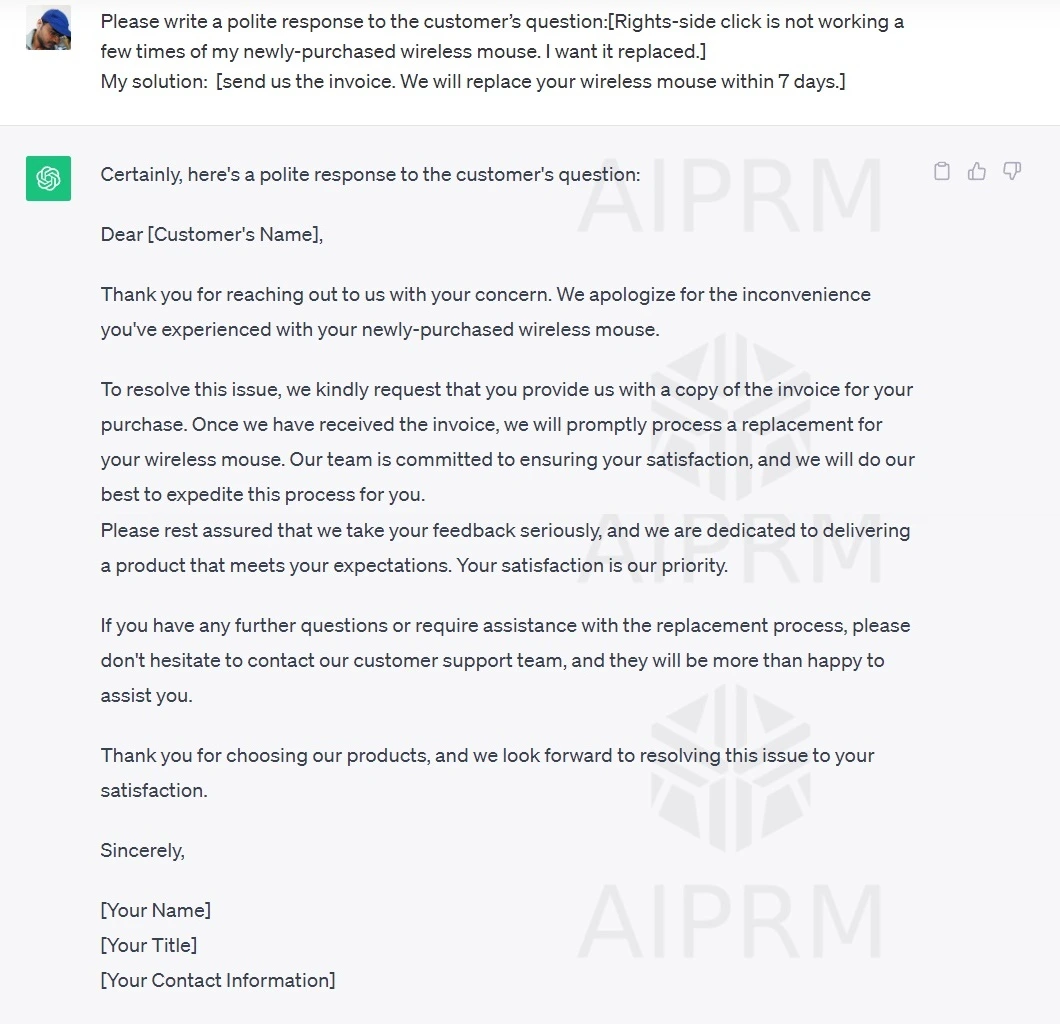
- Customers get quick resolutions without waiting on hold or exchanging multiple emails — improving satisfaction and reducing cart abandonment.
- Around-the-clock availability reduces operational costs while improving the experience for shoppers in different time zones.
- ChatGPT supports over 59 languages, enabling global brands to provide localized, culturally accurate support without a multilingual team.
📋 Ready-to-use customer service prompt:
Act as a customer support specialist for [your store name]. A customer has sent the following message: “[customer message].” Respond in a professional, empathetic, and solution-oriented tone. Address their concern directly, provide a clear resolution, and reassure them of our commitment to their satisfaction. Keep the response under 150 words.
2. Providing 24/7 instant answers to customer queries
ChatGPT allows e-commerce businesses to instantly resolve all types of common customer queries at any time of day. Specifically:
- Chatbots can be trained on your product catalog, FAQs, and policies so they answer questions about orders, shipping, product features, availability, sizing, and returns accurately and instantly.
- Customers receive fast, accurate responses instead of waiting on hold or exchanging multiple emails — a key driver of repeat purchases.
- Quick answers reduce the frustration that causes shoppers to abandon their carts mid-purchase.
📋 Ready-to-use FAQ response prompt:
You are a helpful customer support bot for [store name]. Answer the following customer question based only on these policies: [paste your shipping/return policies]. Question: “[customer question].” Keep the answer friendly, clear, and under 100 words. If you don’t know the answer, ask the customer to contact support.
3. Personalizing conversations and product recommendations
With its natural language capabilities, ChatGPT can make conversations feel personalized and relevant for each customer. Zalando, for example, reported a 23% increase in clicks and 40% growth in wishlist activity after introducing AI-powered personalization. For your store:
- By analyzing purchase history and browsing data, ChatGPT chatbots can make tailored product suggestions and hold contextual conversations that feel genuinely helpful rather than generic.
- Personalized promotions and customized content make customers feel valued and understood, not targeted by a bot.
- ChatGPT helps recreate the personalized attention of skilled in-store associates — at scale, online, and around the clock.
📋 Ready-to-use personalization prompt:
Based on the following customer purchase history: [list recent purchases], recommend 3 products from our catalog: [paste product list]. Write a short, personalized message (under 80 words) explaining why each product is a good fit for this customer. Use a friendly, conversational tone.
4. Generating appealing marketing copy and product descriptions
ChatGPT’s language generation capabilities make it an invaluable tool for automating and enhancing product page content and other marketing assets. A single well-crafted prompt can produce descriptions that would take a copywriter hours — with full SEO optimization built in.
- ChatGPT can instantly generate SEO-friendly product descriptions, email campaigns, landing pages, social media posts, and ad copy — all in your brand’s voice.
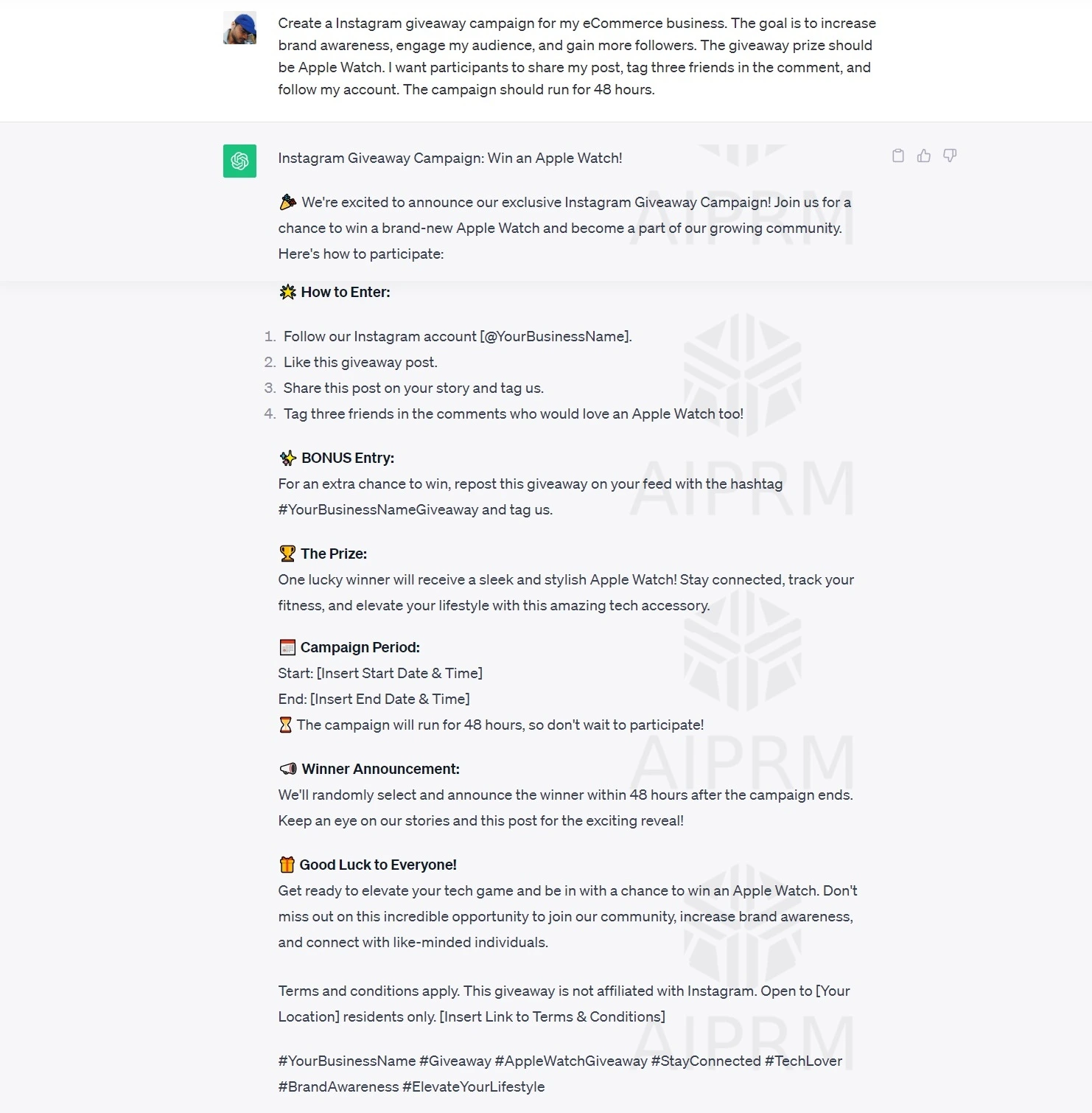
- This saves substantial time and resources spent on manual content creation — a Deal News survey found that 31% of product returns are caused by inaccurate or insufficient descriptions. ChatGPT eliminates that gap.
- Dynamic, optimized copy tailored to customer intent can significantly boost engagement, dwell time, and conversions.
📋 Ready-to-use product description prompt:
Write a compelling product description for the following item: [product name]. Key features: [list features]. Target audience: [describe ideal customer]. Tone: [professional/casual/playful]. Include the keyword “[main keyword]” naturally. Structure it with a 2-sentence intro, a bullet list of 4–5 key benefits, and a short call-to-action. Keep it under 200 words.
In summary, by automating key customer service and marketing functions through AI, ChatGPT enables e-commerce businesses to provide 24/7 support, personalized recommendations, and optimized copy — transforming traditional shopping interactions and driving higher customer satisfaction.
Optimizing Search and Discovery with AI:
Harnessing AI tools like ChatGPT also presents a major opportunity for e-commerce businesses to optimize on-site search and improve product discoverability — both on your own website and inside AI platforms like ChatGPT itself. With its natural language processing capabilities, ChatGPT can help elevate the search experience to drive more traffic and conversions. Merchants can implement conversational AI to improve SEO, generate high-quality product descriptions, provide relevant recommendations, and map keywords to products.
Applying ChatGPT for SEO optimizations
ChatGPT can analyze website content, structure, and performance to provide AI-driven solutions to improve SEO. Specifically:
- It can identify issues like thin content, keyword gaps, technical problems, and weak internal linking structures — then suggest targeted fixes.
- The AI can rewrite existing pages to optimize them for chosen keywords and improve their chances of ranking higher in Google, Bing, and AI search engines.
- ChatGPT can generate new SEO-focused content to fill topical gaps that competitors are currently exploiting.
- Ongoing optimizations boost organic traffic, AI visibility, and ultimately revenues.
Generating meta descriptions, tags, and titles
Based on keyword research, ChatGPT can automatically create SEO-optimized page titles, meta descriptions, header tags, and image alt text. For example:
- Meta descriptions that compellingly describe the page, naturally include target keywords, and motivate search users to click.
- Titles that include primary keywords without keyword-stuffing — balancing SEO with readability.
- Header tags (H1, H2, H3) that properly structure content and emphasize the right keywords for Google’s content understanding algorithms.
📋 Ready-to-use SEO meta prompt:
Write an SEO-optimized meta title (max 60 characters) and meta description (max 155 characters) for a product page selling [product name]. Primary keyword: “[keyword].” The title should be compelling and include the keyword naturally. The description should summarize the page’s value and include a soft call-to-action.
This makes pages more visible and discoverable in both traditional search engine results and AI-generated answers.
Creating unique product listing content
ChatGPT can generate in-depth, unique product descriptions and specifications optimized to boost both search rankings and conversions:
- Detailed descriptions highlighting key features and differentiators in a compelling, customer-centric way — written to address the specific questions buyers ask before purchasing.
- Dynamic generation of key product specs, technical details, and complementary information that reduces pre-purchase uncertainty.
- Customized descriptions for each product variant — size, color, material, configuration — that help products appear in more specific search queries.
This provides shoppers with the information they need to buy confidently while optimizing pages for maximum search visibility.
Automating keyword research and mapping
With ChatGPT, e-tailers can dramatically reduce the time spent on keyword research by leveraging AI to:
- Instantly analyze market and competitor content to surface high-value keyword opportunities that manual research often misses.
- Map the most relevant keywords to specific products and categories to maximize search relevance for customers at different stages of the buying journey.
- Ensure keyword density and natural placement in content are optimized — avoiding over-optimization penalties.
- Continuously refresh keyword selections to adapt to changing search trends, seasonal demand, and new product launches.
📋 Ready-to-use keyword research prompt:
Act as an SEO specialist. My e-commerce store sells [product category]. Generate a table of 20 keywords. Columns: Keyword | Search Intent (Informational / Commercial / Transactional) | Suggested Content Type (Product Page / Blog Post / FAQ). Focus on keywords a buyer would use when they are close to making a purchase decision.
By leveraging ChatGPT to optimize SEO elements, generate high-quality product content, and automate keyword research, e-commerce businesses can significantly elevate their findability and drive more qualified traffic to their stores — from Google and from ChatGPT’s own search results.
Boosting Sales Through AI-Generated Content:
ChatGPT’s advanced natural language generation capabilities make it an invaluable asset for automating and enhancing e-commerce content to drive more sales. By leveraging AI to produce optimized, dynamic copy for elements like email campaigns, landing pages, and product descriptions, online retailers can create highly effective content that engages customers and compels them to purchase.
Crafting data-driven email campaigns and newsletters
Email marketing remains one of the highest ROI channels for driving e-commerce sales. As an eCommerce business, effective email marketing is essential to:
- Launch new products
- Run sales and promotions
- Retain customers
- Recover abandoned carts
- Gather customer feedback
With its natural language capabilities, ChatGPT enables any eCommerce merchant to easily create optimized, customized emails at scale for any marketing need. Automating copywriting with AI saves time while boosting engagement and conversions.
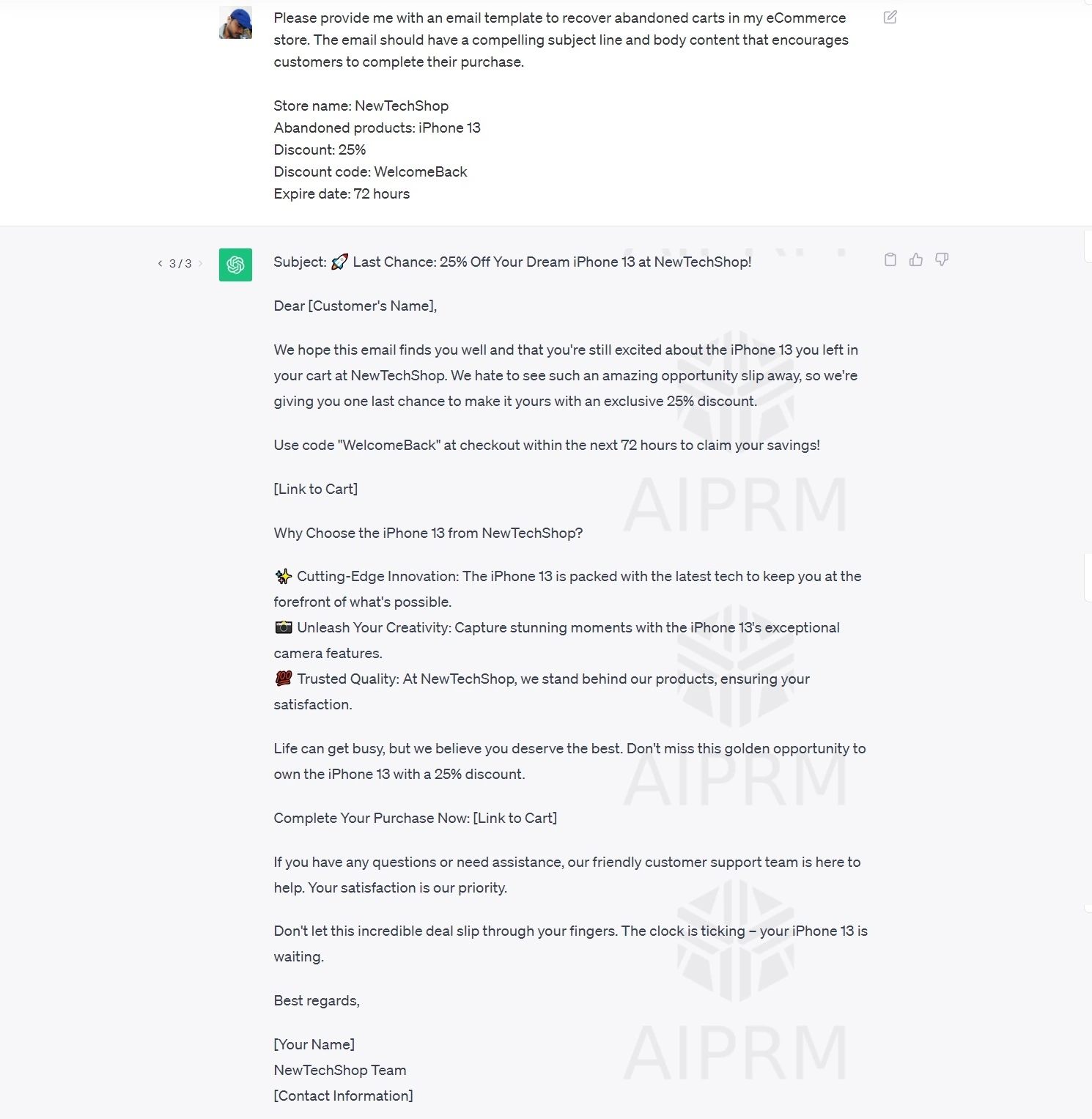
ChatGPT can maximize email performance by using customer data to deeply personalize messaging and promotions within campaigns and newsletters. Specifically, the AI can:
- Analyze purchase history, browsing behavior, and demographics to segment subscribers and personalize content for each segment.
- Create dynamic subject lines using customer names, recent browsing activity, and targeted promotions they are most likely to respond to.
- Generate email copy customized to subscriber personas — with relevant product recommendations, personalized offers, and brand-aligned tone.
- Draft abandoned cart sequences that feel personal and compelling rather than generic and automated.
📋 Ready-to-use abandoned cart email prompt:
Write a 3-email abandoned cart recovery sequence for an e-commerce store selling [product category]. Tone: [friendly/urgent/empathetic]. Email 1 (sent 1 hour after abandonment): Gentle reminder, no discount. Email 2 (sent 24 hours later): Highlight product benefits, add social proof. Email 3 (sent 48 hours later): Offer a [X]% discount with urgency. Keep each email under 150 words. Include a subject line for each.
This data-driven approach results in emails that feel customized and speak directly to the recipient, driving significantly more sales than generic broadcast campaigns.
Producing targeted landing pages and web copy
Optimized landing pages are critical for converting website visitors into customers. ChatGPT can generate high-converting copy for targeted landing pages including product pages, promotions, and seasonal campaigns. Drawing on buyer personas and keyword research, the AI can create pages with:
- Engaging headlines and hero copy tailored to specific customer segments — speaking directly to the problem the product solves.
- Detailed product descriptions, social proof elements, and benefit-led copy catering to visitor intent and stage in the buying journey.
- Clear, compelling calls-to-action for desired conversions — subscriptions, downloads, purchases, and more.
- Layouts and content structure formatted for easy consumption on both desktop and mobile.
ChatGPT-generated landing page copy, when refined with human oversight, compels visitors to convert at meaningfully higher rates.
Creating detailed product titles, descriptions, and specs
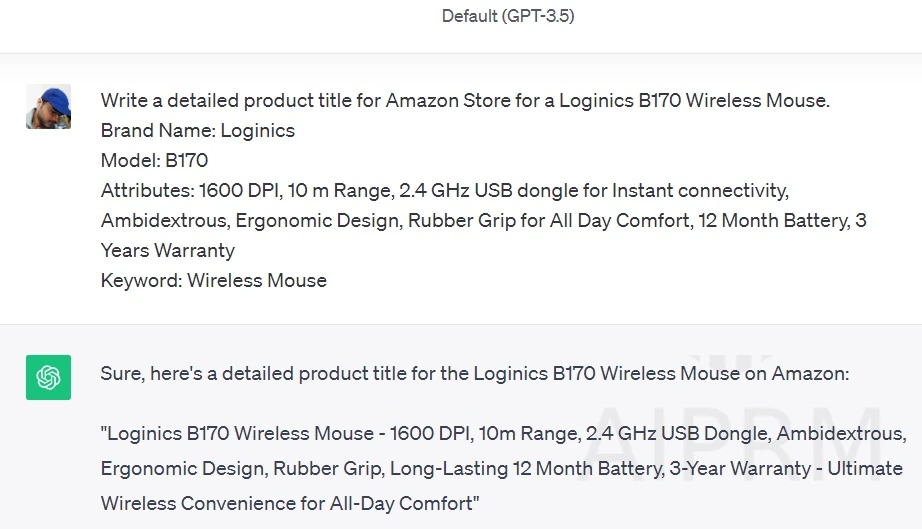
High-quality product page copy is essential for educating customers, building trust, and driving conversions. ChatGPT can automatically generate compelling product descriptions and specs tailored to each product. By leveraging AI, e-commerce brands can create product copy that highlights differentiators, provides relevant details, and motivates purchases such as:
- Detailed and compelling product titles optimized for search — including primary keywords without sacrificing readability.
- Descriptions highlighting the most compelling and differentiated features of the product — written in customer language, not technical jargon.
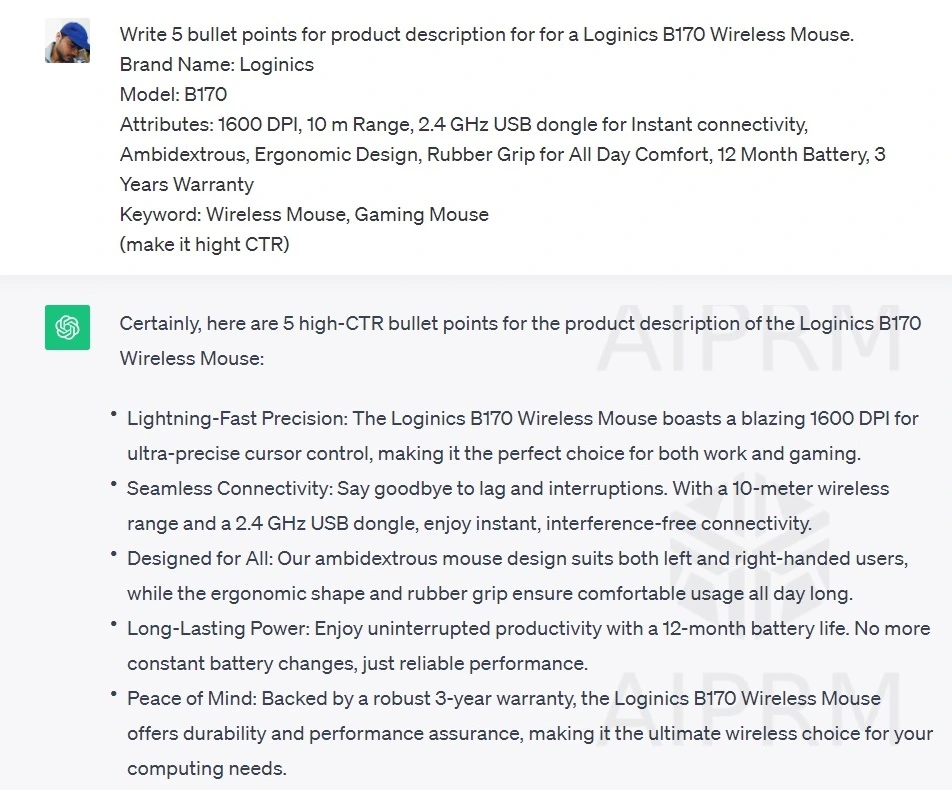
- Specific details like available colors, sizes, configurations, and compatibility information that reduce pre-purchase uncertainty.
- Complementary information on materials, manufacturing, certifications, and safety testing that builds buyer confidence.
- Comparisons with alternative options and key decision factors that help customers choose the right product without leaving your store.
This in-depth copy builds trust in the product, reduces returns caused by misaligned expectations, and nudges customers to add items to their cart.
Automating cross-selling and upselling recommendations
Intelligent cross-selling and upselling are key levers for increasing average order value. ChatGPT can generate personalized, context-aware recommendations for complementary or higher-tier products — using language that feels helpful rather than pushy. By analyzing customer data, the AI can:
- Suggest complementary or higher-end products based on what is currently in the customer’s cart or their past purchase history.
- Explain precisely why the additional product would add value for this specific customer — not just list it generically.
- Use compelling, benefit-led messaging tailored to the customer’s needs and stated interests.
- Make recommendations contextually at high-intent touchpoints: cart, checkout confirmation, and account pages.
📋 Ready-to-use upsell prompt:
A customer has added [product name] to their cart. Write a short upsell message (under 60 words) recommending [complementary product]. Explain specifically why the two products work well together for someone who [describe customer goal]. Include a friendly, benefit-focused call-to-action. Do not use discounts — lead with value.
The personalized, data-driven nature of these recommendations turns more visitors into buyers and converts one-time buyers into higher-value repeat customers.
Analyzing Data and Trends with ChatGPT:
ChatGPT also presents game-changing opportunities for e-commerce businesses to leverage AI for advanced data analytics and business intelligence. With its ability to process large volumes of data, identify patterns, and generate plain-language insights, ChatGPT helps online retailers make faster, more confident decisions across key functions like inventory planning, marketing optimization, and customer retention.
Using AI to analyze sales data and identify opportunities
With the ability to process large volumes of sales and customer data, ChatGPT can surface valuable insights that optimize marketing, merchandising, and product strategy. By pasting structured data directly into ChatGPT or connecting it to your analytics tools via API, you can:
- Identify customer segments with the highest purchase frequency or average order value, and focus marketing spend where it drives the most return.
- Analyze product performance to double down on top sellers and flag slow-moving inventory before it becomes a cost problem.
- Detect trends around seasonality, promotions, and external events to optimize future planning cycles.
- Compare channel and geographic performance to identify underserved markets and expansion opportunities.
📋 Ready-to-use data analysis prompt:
Here is my store’s sales data for the past 90 days: [paste data]. Identify the top 3 trends, the 3 best-performing products, and the 3 slowest-moving products. For each insight, suggest one specific action I can take to improve performance. Present the output as a concise table.
Generating reports and dashboards to inform strategy
ChatGPT enables easy synthesis of raw business data into clear, actionable summaries — reducing the time management spends building reports manually. ChatGPT can:
- Summarize raw KPI data — revenue, traffic, conversions, customer lifetime value, churn — into readable narrative reports.
- Identify which metrics are trending in the right direction and which require attention.
- Segment data by relevant dimensions — product category, geography, acquisition channel, customer segment — to surface the most actionable insights.
- Draft written commentary for board reports, investor updates, or team briefings based on performance data you provide.
Predicting customer behavior and product demand
Leveraging historical data, ChatGPT can help forecast future behavior and demand patterns to support smarter planning:
- Estimate customer response to upcoming campaigns based on historical performance of similar promotions.
- Identify early churn signals based on patterns in customer engagement and purchase recency data.
- Forecast product and category demand based on prior sales trends, seasonality, and market signals.
Providing insights for inventory and supply chain management
By correlating sales data with external drivers, ChatGPT provides supply chain insights to optimize inventory levels, logistics, and waste reduction. The AI identifies the optimal stock to maintain for each product based on demand signals:
- ChatGPT can correlate sales with external drivers like seasons, marketing campaigns, competitor activity, and macroeconomic signals.
- This powers better supply chain planning, logistics coordination, and inventory management decisions.
- The AI helps identify the optimal inventory levels to maintain for each SKU — avoiding stock-outs without tying up excess capital in slow-moving goods.
- Waste is reduced while service levels are maintained, improving both profitability and customer satisfaction.
With its powerful data processing and analytical capabilities, ChatGPT enables e-commerce businesses to derive key insights from sales, inventory, and customer data. This allows online retailers to make smarter, optimized decisions to boost KPIs across all areas of their operations.
Integrating ChatGPT within eCommerce Platforms:
To fully realize the benefits of conversational AI, e-commerce businesses need to properly integrate ChatGPT within their technology stack. While ChatGPT is accessible through its API, merchants must connect it with ecommerce platforms like Shopify, Magento, and custom systems. This involves strategies like developing specialized chatbot interfaces, integrating AI functions into the backend, and embedding capabilities on the front-end. With thoughtful integration, retailers can seamlessly leverage ChatGPT to elevate customer experiences and optimize operations across platforms.
API integration to connect ChatGPT with ecommerce backends
ChatGPT offers API access for seamless integration with various ecommerce backends. Developers can build connectors that synchronize customer data, product catalogs, and order histories with ChatGPT — enabling the AI to provide accurate, store-specific responses rather than generic answers. This integration empowers businesses to harness the full capabilities of ChatGPT while keeping their valuable customer information secure through role-based access controls and encrypted data handling.
Implementation guides for platforms like Shopify, Magento, WooCommerce
For popular ecommerce platforms such as Shopify, Magento, and WooCommerce, comprehensive implementation guides and native app integrations are readily available:
- Shopify: Apps like Tidio and Gorgias integrate ChatGPT-powered chat directly into your Shopify storefront. For more custom setups, OpenAI’s API can be connected via Shopify’s Flow automation or a third-party middleware tool.
- WooCommerce: ChatGPT can be embedded into WordPress/WooCommerce sites via OpenAI API plugins or no-code tools like Zapier and Make (formerly Integromat) — no developer required for basic use cases.
- Magento: API-first integration is the recommended approach for Magento, connecting ChatGPT to your product database and customer service workflows through custom modules or middleware.
Front-end integration to embed conversational UI
Moreover, businesses can take advantage of front-end integration to embed ChatGPT’s conversational interface directly into their ecommerce websites. This integration enables shoppers to engage with an AI assistant — seeking product recommendations, getting size guidance, comparing options, and obtaining customer support — all without leaving the store. By incorporating this conversational UI, ecommerce sites enhance the overall customer experience and engagement on the front-end, ultimately leading to improved customer satisfaction and increased sales.
ChatGPT Shopping and the Future of Agentic Commerce
As the digital landscape continues to evolve, perhaps the most significant development for e-commerce in 2025 and 2026 is the emergence of ChatGPT as a direct shopping channel — not just a research or content tool.
What Is ChatGPT Shopping?
OpenAI introduced ChatGPT Shopping in 2025, allowing the platform to surface product recommendations directly inside the chat interface. Instead of sending users to a search results page, ChatGPT delivers product carousels featuring images, titles, prices, star ratings, and review summaries — with direct links to purchase.
These product results are organic and unsponsored. There is no pay-to-play model. Products are ranked based on relevance to the user’s intent, the quality of your structured product data, and the AI’s assessment of factors like pricing, availability, and review sentiment. This means brands that optimize their product pages and structured data today are competing for a channel that their competitors have not yet prioritized.
ChatGPT Instant Checkout and the Agentic Commerce Protocol
In late 2025, OpenAI introduced Instant Checkout — a feature that allows users to complete purchases without ever leaving ChatGPT. Built on the Agentic Commerce Protocol (ACP) developed with Stripe, Instant Checkout is now available for Etsy sellers, with over a million Shopify merchants — including Glossier, SKIMS, and Vuori — joining imminently. Walmart and Sam’s Club have also announced integration.
This represents a fundamental shift: ChatGPT is no longer just a top-of-funnel discovery tool. It is becoming a full commerce layer — from first question to completed transaction — within a single conversation. WooCommerce and Magento merchants can participate via the open-source Agentic Commerce Protocol, even without a native ChatGPT checkout experience.
How to Optimize Your Store for ChatGPT Product Discovery
To get your products surfaced in ChatGPT’s recommendations and Shopping carousels, focus on these technical and content fundamentals:
- Allow AI crawlers: Update your robots.txt to explicitly allow OAI-SearchBot (OpenAI’s crawler), PerplexityBot, and Googlebot. If these bots cannot access your site, your products cannot be recommended.
- Implement Product Schema: Add comprehensive Schema.org structured data to all product pages — including price, availability, ratings, reviews, dimensions, and materials. The AI needs structured data to understand and recommend your products.
- Optimize product descriptions for natural language: ChatGPT recommends products that match how users actually phrase their needs. Write descriptions that answer conversational queries like “best [product] for [use case] under [price].”
- Build entity authority: Ensure your brand is mentioned in authoritative third-party contexts — review sites, industry directories, Reddit threads, and editorial coverage. ChatGPT uses these external trust signals to assess brand credibility when ranking recommendations.
- Maintain accurate product feeds: Keep pricing, inventory, and product details up-to-date across all feeds. Stale or inaccurate data reduces the likelihood of your products being recommended.
Preparing Your E-Commerce Business for the AI-Powered Future
To succeed in the AI-powered future of e-commerce, businesses should proactively prepare themselves for this transformative journey. This involves:
- Data Readiness: Ensure that your data infrastructure is robust and capable of handling the influx of customer data needed to fuel AI-driven recommendations and insights.
- AI Integration Strategy: Develop a clear plan for integrating AI, like ChatGPT, into your online store. This includes determining the use cases, selecting the right AI tools, and setting up a framework for continuous improvement.
- Staff Training: Invest in training your team to work effectively with AI technologies. This includes understanding how to craft effective prompts, interpret AI outputs, and maintain quality control over AI-generated content.
- Customer Education: Educate your customers about the benefits and limitations of AI in your e-commerce business. Transparency can help build trust and enhance the customer experience.
- Monitoring and Evaluation: Implement systems to monitor the performance of AI integrations and gather customer feedback. Set up GA4 to track AI referral traffic as a separate channel so you can measure ChatGPT’s growing contribution to your revenue.
Final Thoughts
ChatGPT is no longer a future opportunity for eCommerce — it is a present-day competitive advantage. Brands that integrate conversational AI across their customer service, content, marketing, and product discovery are already seeing higher conversion rates, more efficient operations, and a growing new traffic channel that converts better than traditional organic search.
The emergence of ChatGPT Shopping, Instant Checkout, and the Agentic Commerce Protocol means that the window to get ahead of this shift is right now. By implementing the strategies and prompts in this guide — from automating customer service to optimizing your product pages for AI discovery — your eCommerce store can be positioned to capture high-intent buyers wherever they are researching and shopping in 2026.
With an effective strategy, ChatGPT’s natural language capabilities enable you to provide 24/7 support, generate high-converting copy, uncover data insights, and elevate personalization at scale. Now is the time for forward-thinking eCommerce brands to explore integrating ChatGPT and pave the way for an intelligent future of conversational commerce. By leveraging this technology as a competitive advantage, online retailers can spearhead the next evolution of the customer journey while driving sustainable growth.