
📅 Last Updated: March 2026
In today's digital-first world, potential accounting clients no longer flip through the Yellow Pages — they open Google. Whether someone needs a tax accountant, a CPA firm, or a bookkeeper for their startup, their first step is a search engine query. If your accounting firm is not ranking on the first page of results, you are effectively invisible to the majority of your potential clientele.
This comprehensive guide covers 100+ SEO keywords for accountants, organized by category — from broad primary terms and local SEO keywords to long-tail phrases, bookkeeping terms, CPA-specific queries, and country-specific data for the USA, India, UK, and UAE. We also walk you through how to do keyword research step-by-step, on-page SEO best practices, and a full on-page checklist to rank in the Top 10 in 2026.
Let us introduce you to search engine optimization (SEO) — a potent, cost-effective strategy that can transform an accountant's online presence and client acquisition approach when applied correctly.
What Are SEO Keywords for Accountants?
SEO stands for Search Engine Optimization, and keywords are the words and phrases that potential clients type into search engines when looking for accounting services. For accountants, these keywords fall into three main types:
- Primary Keywords: Broad, high-volume terms that describe your core services — for example, accountant, accounting services, or CPA firm. These are competitive but essential for brand visibility.
- Long-Tail Keywords: More specific phrases with lower competition and higher purchase intent — for example, small business tax accountant for freelancers or bookkeeping services for real estate investors. These convert at a higher rate because they reflect specific, ready-to-hire intent.
- Local Keywords: Location-modified search terms such as accountant near me, CPA in Chicago, or tax preparation services Houston. Local keywords are the most valuable for practices serving a specific geographic area.
When you incorporate these keyword types into your website — in page titles, headings, body content, meta descriptions, and image alt text — search engines understand what your site is about, which helps your pages rank higher when potential clients search for your services.
💡 Key Fact: Google processes over 8.5 billion searches per day. Accounting-related queries generate hundreds of thousands of monthly searches in the United States alone. Ranking for the right keywords means capturing a share of those actively-searching, high-intent prospects.
Understanding Search Intent
Not all keywords carry the same intent. Google's 2026 algorithm prioritizes matching content to the purpose behind a search — not just the words themselves. For accountants, there are four intent types:
- Informational Intent: The user wants to learn — e.g., "what does an accountant do" or "how to choose a CPA." Target these with blog posts and FAQ content.
- Commercial Intent: The user is evaluating options — e.g., "best accounting firm for small businesses." Target these with service pages and comparison content.
- Transactional Intent: The user is ready to hire — e.g., "hire a tax accountant near me." Target these with landing pages featuring strong CTAs and contact forms.
- Navigational Intent: The user is looking for a specific brand or directory — e.g., "find a CPA AICPA." Build branded content and directory listings for these.
Why Are SEO Keywords Important for Accountants?
Being visible online is not optional for accounting practices in 2026 — it is essential. Here is why investing in the right SEO keywords can dramatically transform your practice:
- Increased Visibility: The right keywords help your website appear higher in search results, making it more likely that potential clients will find you before they find your competitors. Studies show that the first three organic results capture over 50% of all clicks for a given query.
- Targeted Traffic: Keywords help attract people who are actively looking for the services you offer, leading to more qualified leads with higher conversion potential. Our SEO services are designed to identify and implement high-converting keywords that drive targeted traffic to your website, increasing the chances of turning visitors into loyal clients.
- Cost-Effective Marketing: Unlike paid advertising, organic search traffic driven by good SEO does not cost you for each click. Once you rank well, that traffic is essentially free — making SEO one of the highest-ROI marketing channels for accountants.
- Building Trust and E-E-A-T: When your site appears at the top of search results, it signals credibility. Google's 2026 ranking algorithm heavily weights E-E-A-T (Experience, Expertise, Authoritativeness, Trustworthiness) — especially for financial content, which falls under Google's "Your Money or Your Life" (YMYL) category.
- Local Client Acquisition: Local SEO keywords like "CPA near me" or "tax accountant in [your city]" connect you directly with clients in your area who are ready to book a consultation — often within hours of searching.
- Sustainable Long-Term Growth: Unlike ads that stop delivering the moment your budget runs out, SEO compounds over time. A well-optimized page can generate leads consistently for years after publication.

Request For More Details
Top SEO Keywords for Accountants
Below are the most effective SEO keywords for accountants, organized by service type. These terms represent what your potential clients are actually searching for — and targeting them strategically across your website is the foundation of any successful accountant SEO strategy.
Core Service Keywords
These are the primary, high-intent keywords that should appear on your homepage, service pages, title tags, and meta descriptions:
- Accountant near me: One of the highest-volume local queries for accounting services. If you have a physical office and serve local clients, this is a non-negotiable target keyword for your homepage and Google Business Profile.
- Tax preparation services: A high-intent commercial keyword with strong seasonal search volume spikes during tax season (January–April in the US). Ideal for a dedicated service landing page with a prominent CTA.
- Small business accounting: Targets the enormous market of small business owners and entrepreneurs seeking ongoing accounting support — one of the most profitable client segments for most accounting firms.
- Bookkeeping services: A common search term with strong commercial intent. Even if bookkeeping is a secondary service, targeting it can significantly expand your organic reach and lead volume.
- CPA firm: The go-to keyword for certified public accountants and multi-partner practices. High competition, but essential for brand authority and trust signals with potential enterprise clients.
- Financial planning: Targets individuals and businesses looking for broader financial advisory services beyond basic tax preparation — ideal if your practice offers wealth management or retirement planning.
- Payroll services: Many businesses search specifically for payroll management help, especially small-to-medium businesses without a dedicated HR team. This keyword carries consistent year-round search volume.
- Audit services: Targets businesses with compliance, investor, or financial reporting requirements. More relevant to mid-size and larger accounting firms but valuable for building authority.
- Business tax preparation: A more specific, higher-intent variation of "tax preparation" that targets business owners specifically, resulting in higher-quality leads and lower cost-per-acquisition.
- Accounting software consulting: Many business owners search for advice on QuickBooks, Xero, or Sage — positioning yourself as a software-knowledgeable accountant is a strong differentiator and content opportunity.
Top Performing Accountants Keywords (with Volume & CPC Data)
The tables below present the best-performing accountants' SEO keywords for 2026, complete with search volume and Cost-Per-Click (CPC) data. High CPC keywords indicate strong commercial intent — advertisers pay a premium to appear for these searches, which means organic rankings carry significant lead-generation value.
| S. No. | Search Term Keyword | Intent | Volume | CPC (USD) |
|---|---|---|---|---|
| 1 | quickbooks | Navigational | 1,000,000 | 5.68 |
| 2 | capital gains tax | Informational, Commercial | 165,000 | 2.08 |
| 3 | ebitda | Informational | 90,500 | 0.14 |
| 4 | reconciliation | Informational | 74,000 | 0.57 |
| 5 | payroll | Informational | 60,500 | 32.90 |
| 6 | audit | Informational | 49,500 | 6.38 |
| 7 | income statement | Informational | 49,500 | 8.73 |
| 8 | inventory | Informational | 49,500 | 3.11 |
| 9 | tax return | Informational | 49,500 | 2.71 |
| 10 | assets | Informational | 40,500 | 3.24 |
| 11 | bookkeeping | Informational | 40,500 | 10.04 |
| 12 | expenses | Informational | 40,500 | 2.64 |
| 13 | subsidiary | Informational | 40,500 | 1.10 |
| 14 | dividends | Informational | 33,100 | 2.24 |
| 15 | fiscal year | Informational | 33,100 | 0.30 |
| 16 | discounted cash flow | Informational, Commercial | 27,100 | 1.11 |
| 17 | investment banking | Informational | 27,100 | 4.61 |
| 18 | profit | Informational | 27,100 | 5.22 |
| 19 | annuities | Informational | 22,200 | 2.88 |
| 20 | cash flow statement | Informational | 18,100 | 7.78 |
| 21 | Trail Balance | Informational | 14,800 | 0.00 |
| 22 | hedging | Informational | 14,800 | 0.60 |
| 23 | liabilities | Informational | 14,800 | 10.53 |
| 24 | value added tax | Informational | 14,800 | 1.18 |
| 25 | contingencies | Informational | 12,100 | 2.71 |
| 26 | pestel analysis | Informational, Commercial | 9,900 | 0.83 |
| 27 | purchase orders | Informational, Transactional | 8,100 | 12.21 |
| 28 | securities | Informational, Commercial | 8,100 | 6.40 |
| 29 | certified management accountant | Informational | 5,400 | 4.02 |
| 30 | cost accounting | Informational | 5,400 | 5.86 |
| 31 | continuing professional education | Informational | 4,400 | 8.60 |
| 32 | deferred tax assets | Informational, Commercial | 4,400 | 0.00 |
| 33 | accruals | Informational | 3,600 | 2.84 |
| 34 | chartered accountant | Informational | 3,600 | 4.58 |
| 35 | days payable outstanding | Informational | 2,900 | 2.63 |
| 36 | ledgers | Informational | 2,900 | 3.34 |
| 37 | Trail Balance | Informational | 1,900 | 11.02 |
| 38 | corporation tax | Informational | 1,900 | 4.66 |
| 39 | offsetting | Informational | 1,900 | 1.06 |
| 40 | management accounting | Informational, Commercial | 1,600 | 6.53 |
| 41 | special purpose entities | Informational, Commercial | 1,000 | 5.60 |
| 42 | bank accounting | Informational | 720 | 14.90 |
| 43 | electronic invoicing | Informational, Commercial | 720 | 11.04 |
| 44 | indexation | Informational | 720 | 0.00 |
| 45 | information and communication | Informational, Commercial | 390 | 2.32 |
Long-Tail Keywords for Accountants: Lower Competition, Higher Conversion
Long-tail keywords are specific, multi-word phrases that may have lower monthly search volume than broad terms but deliver significantly higher conversion rates. When someone searches "bookkeeping services for e-commerce startups," they know exactly what they need — making them far more likely to become a paying client. These keywords are also ideal for appearing in Google's AI Overviews and People Also Ask (PAA) boxes.
| S. No. | Long-Tail Keyword | Intent | Best Used On | Difficulty |
|---|---|---|---|---|
| 1 | how to find a good accountant for small business | Informational | Blog post / FAQ | Low |
| 2 | accountant for self-employed freelancers | Commercial | Service landing page | Low |
| 3 | bookkeeping services for e-commerce startups | Commercial | Service landing page | Low |
| 4 | small business tax accountant near me | Transactional | Homepage / local page | Medium |
| 5 | how much does an accountant cost per month | Informational | Blog post / FAQ | Low |
| 6 | best CPA for real estate investors | Commercial | Niche service page | Low |
| 7 | tax planning services for high income earners | Commercial | Service landing page | Low |
| 8 | accountant vs bookkeeper what is the difference | Informational | Blog post / FAQ | Low |
| 9 | online bookkeeping services for small business | Commercial | Service page | Medium |
| 10 | do I need an accountant for my LLC | Informational | Blog post / FAQ | Low |
| 11 | QuickBooks bookkeeper for small business | Commercial | Service page | Low |
| 12 | forensic accounting services for law firms | Commercial | Niche service page | Low |
| 13 | tax preparation checklist for self-employed | Informational | Blog post | Low |
| 14 | affordable accounting services for nonprofits | Commercial | Service page | Low |
| 15 | Xero accountant for small business UK | Commercial | Service page (UK) | Low |
SEO Keywords for Bookkeeping Services
Bookkeeping is a distinct sub-niche within the accounting industry with its own high-value search queries. Whether you offer bookkeeping as a standalone service or as part of a full package, targeting these keywords can open a significant new stream of organic leads.
| S. No. | Bookkeeping Keyword | Intent | Volume (Est.) | CPC (USD) |
|---|---|---|---|---|
| 1 | bookkeeping services | Commercial | 12,100 | 14.93 |
| 2 | bookkeeper near me | Transactional | 9,900 | 9.50 |
| 3 | small business bookkeeping | Commercial | 5,400 | 11.20 |
| 4 | online bookkeeping services | Commercial | 4,400 | 13.80 |
| 5 | cloud bookkeeping services | Commercial | 1,600 | 8.40 |
| 6 | QuickBooks bookkeeper | Commercial | 1,300 | 7.20 |
| 7 | Xero bookkeeper | Commercial | 880 | 6.10 |
| 8 | virtual bookkeeper for small business | Commercial | 720 | 9.80 |
| 9 | bookkeeping for startups | Commercial | 590 | 10.50 |
| 10 | monthly bookkeeping services | Commercial | 480 | 12.30 |
SEO Keywords for CPA Firms & Tax Advisors
CPA firms and tax professionals have credential-specific keywords that high-intent clients use to find licensed practitioners. Mentioning entities like AICPA, CPA licensure, and enrolled agent status also strengthens your E-E-A-T signals with Google.
CPA-Specific Keywords
| S. No. | CPA Keyword | Intent | Volume (Est.) | CPC (USD) |
|---|---|---|---|---|
| 1 | CPA near me | Transactional | 18,100 | 8.90 |
| 2 | certified public accountant | Informational, Commercial | 12,100 | 5.86 |
| 3 | CPA firm | Commercial | 8,100 | 5.47 |
| 4 | CPA services | Commercial | 5,400 | 6.80 |
| 5 | find a CPA | Navigational | 4,400 | 5.10 |
| 6 | CPA for small business | Commercial | 2,900 | 7.20 |
| 7 | licensed CPA accountant | Commercial | 1,600 | 6.40 |
| 8 | CPA tax advisor | Commercial | 1,300 | 7.80 |
Tax Advisor Keywords
Tax-specific searches peak from January through April (US tax season) and again in September–October during extension season. Building content around these keywords ahead of each season yields significant traffic spikes.
| S. No. | Tax Keyword | Intent | Volume (Est.) | CPC (USD) |
|---|---|---|---|---|
| 1 | tax preparation services | Commercial | 12,100 | 5.04 |
| 2 | tax accountant near me | Transactional | 9,900 | 7.45 |
| 3 | tax planning services | Commercial | 5,400 | 8.20 |
| 4 | income tax accountant | Commercial | 4,400 | 6.90 |
| 5 | tax filing services | Commercial | 3,600 | 5.50 |
| 6 | IRS enrolled agent near me | Transactional | 2,900 | 7.80 |
| 7 | small business tax preparation | Commercial | 2,400 | 6.10 |
| 8 | tax advisor for self-employed | Commercial | 1,600 | 8.40 |
| 9 | business tax accountant | Commercial | 1,300 | 7.20 |
| 10 | estimated tax payments help | Informational | 880 | 4.60 |
Accountants Keyword In The USA
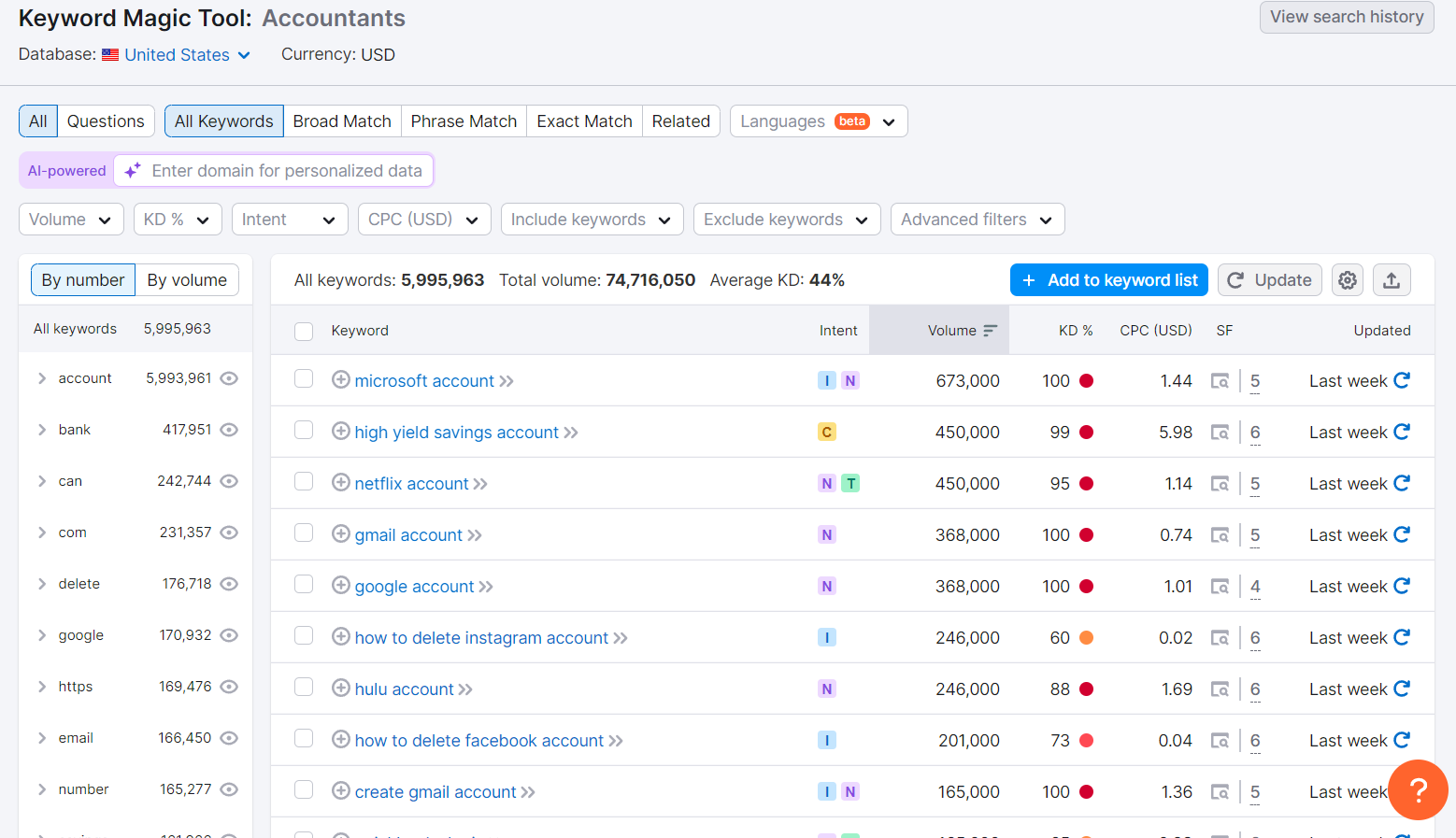
| S. No. | Search Term Keyword | Intent | Volume | CPC (USD) |
|---|---|---|---|---|
| 1 | Accountant | Informational | 74,000 | 10.07 |
| 2 | Accounting | Informational, Commercial | 60,500 | 3.88 |
| 3 | Bookkeeping | Informational | 40,500 | 10.04 |
| 4 | Bookkeeping services | Commercial | 12,100 | 14.93 |
| 5 | Certified Public Accountant | Commercial | 12,100 | 5.86 |
| 6 | Tax Preparation Services | Commercial | 12,100 | 5.04 |
| 7 | Accounting firm | Commercial | 9,900 | 5.85 |
| 8 | Tax Accountant | Commercial | 9,900 | 7.45 |
| 9 | CPA firm | Commercial | 8,100 | 5.47 |
| 10 | Accounting services | Commercial | 5,400 | 13.43 |
Accountants Keyword In India
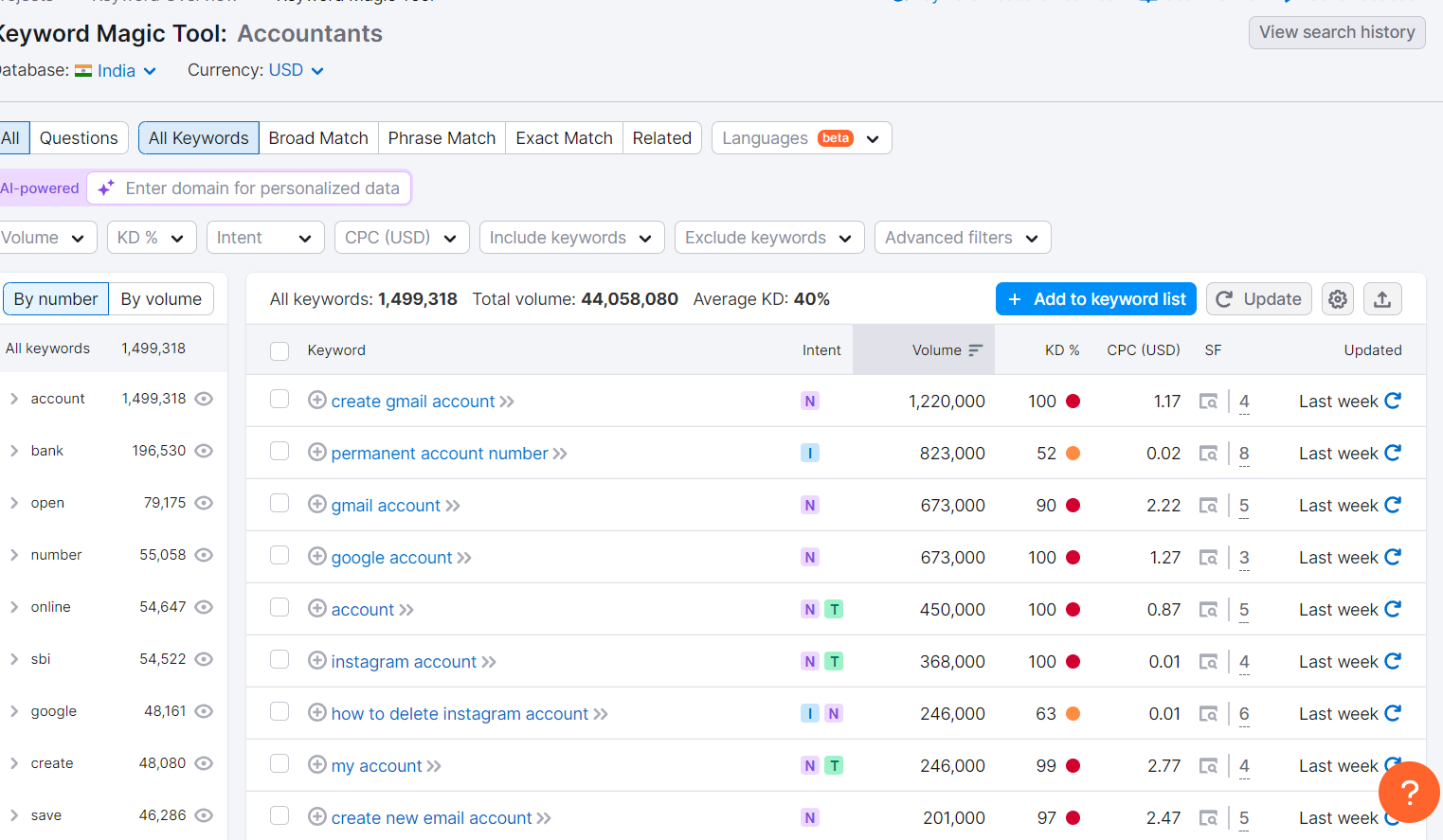
| S. No. | Search Term Keyword | Intent | Volume | CPC (USD) |
|---|---|---|---|---|
| 1 | Income tax filing | Navigational | 201,000 | 0.30 |
| 2 | CA near me | Transactional | 74,000 | 0.22 |
| 3 | Business accountant India | Navigational, Commercial | 1,200 | 0.32 |
| 4 | GST consultant | Navigational, Commercial | 1,600 | 0.27 |
| 5 | Online accounting services | Informational, Commercial | 770 | 0.43 |
| 6 | Tax consultant Mumbai | Commercial | 390 | 0.41 |
| 7 | CA firm | Commercial | 6,600 | 0.16 |
| 8 | Audit services India | Commercial | 540 | 0.53 |
| 9 | CA for startups | Navigational, Commercial | 310 | 0.79 |
| 10 | TDS services | Commercial | 720 | 0.01 |
Accountants Keyword In The UK
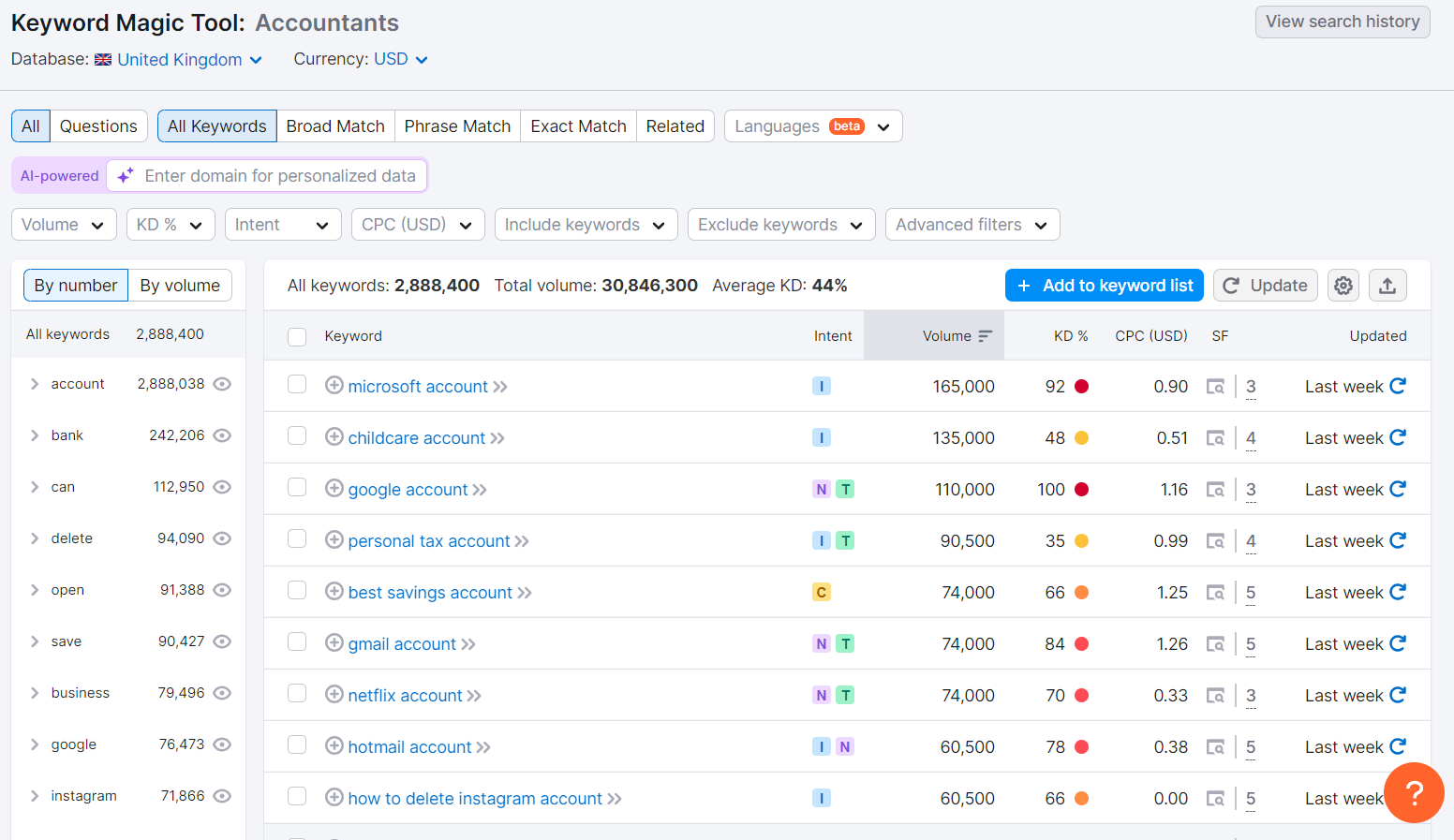
| S. No. | Search Term Keyword | Intent | Volume | CPC (USD) |
|---|---|---|---|---|
| 1 | Accountants near me | Transactional | 8,100 | 6.77 |
| 2 | Payroll accountants UK | Commercial | 980 | 0.70 |
| 3 | Online accountants UK | Navigational | 470 | 14.99 |
| 4 | Certified accountants UK | Commercial | 610 | 2.94 |
| 5 | Small business accountants | Commercial | 880 | 17.26 |
| 6 | Tax advice UK | Informational, Commercial | 720 | 4.30 |
| 7 | VAT accountants | Commercial | 140 | 11.80 |
| 8 | Bookkeeping services UK | Commercial | 110 | 4.98 |
| 9 | Accountancy consultation | Informational | 340 | 1.32 |
| 10 | Chartered accountants UK | Navigational | 140 | 3.84 |
Accountants Keyword In The UAE
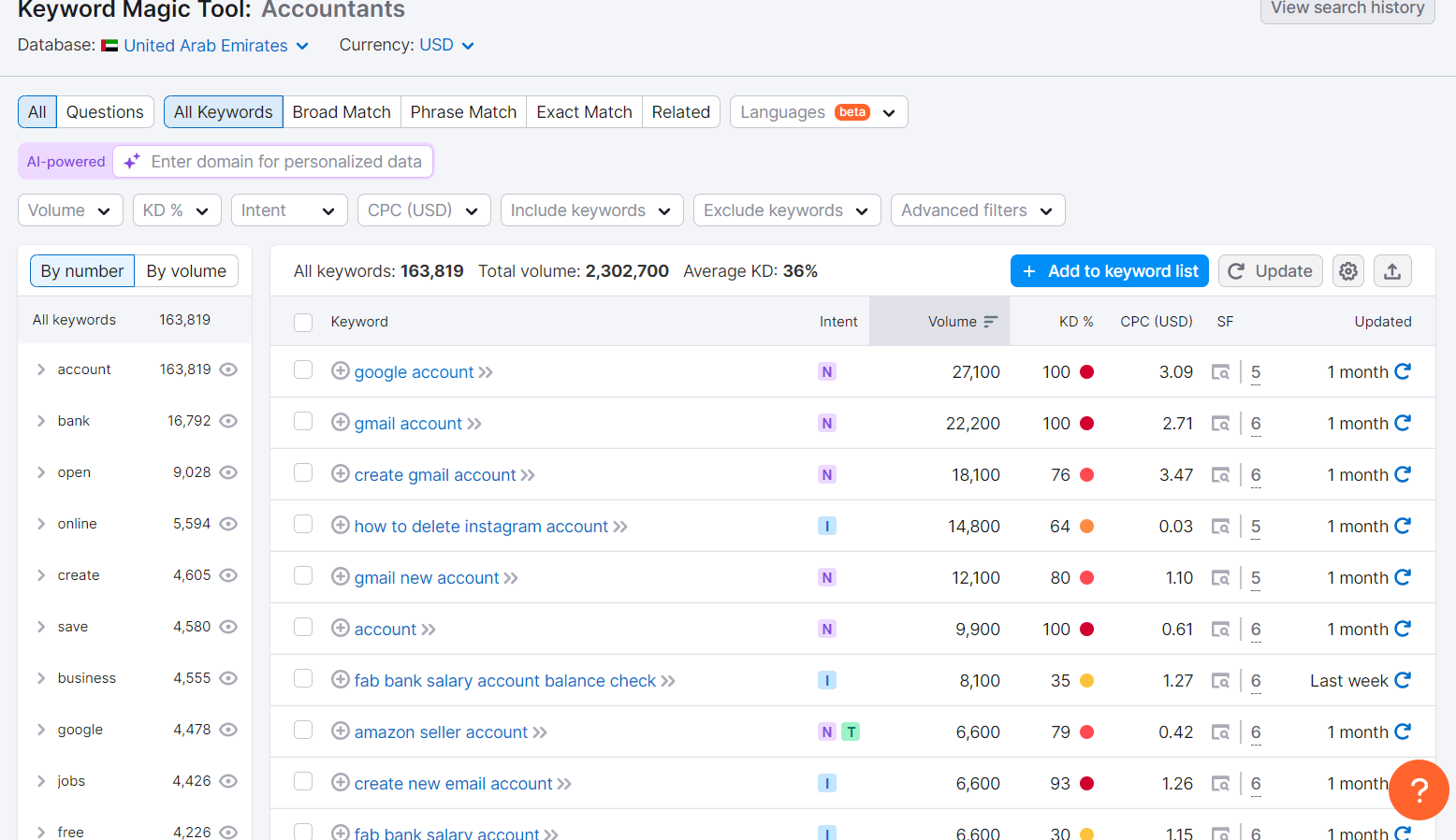
| S. No. | Keywords | Intent | Volume | CPC (USD) |
|---|---|---|---|---|
| 1 | VAT registration UAE | Informational | 2,900 | 6.04 |
| 2 | Corporate audit UAE | Commercial | 1,200 | 0.60 |
| 3 | Finance consultant UAE | Commercial | 830 | 1.80 |
| 4 | Accounting services Abu Dhabi | Navigational, Commercial | 580 | 5.78 |
| 5 | Outsourced accounting UAE | Informational | 490 | 2.30 |
| 6 | Tax agent UAE | Commercial | 360 | 3.81 |
| 7 | Accountant Dubai | Informational, Commercial | 1,000 | 5.45 |
| 8 | Audit firms UAE | Commercial | 390 | 2.80 |
| 9 | VAT consultant UAE | Navigational | 170 | 5.92 |
| 10 | Bookkeeping Dubai | Commercial | 140 | 5.58 |
Local SEO for Accountants: How to Rank in Your City
Local SEO is one of the most powerful — and most underutilized — strategies for accounting firms. When a potential client searches for "accountant near me" or "CPA in [city]", Google shows a local pack (a map with three business listings) above standard organic results. Appearing in this local pack can generate significantly more phone calls and leads than a standard organic ranking.
Key Local SEO Strategies for Accountants
1. Optimise Your Google Business Profile (GBP)
Your Google Business Profile is your single most important local SEO asset. Ensure your business name, address, and phone number (NAP) are accurate, select the correct categories (Accountant, Tax Consultant, Bookkeeping Service), add office photos, and actively collect client reviews. A fully optimised GBP dramatically increases your chances of appearing in the local 3-pack.
2. Use Location-Modified Keywords Throughout Your Site
Include city-specific keywords in your page titles, headings, meta descriptions, and body content. Examples: "Tax accountant in Dallas", "CPA firm Chicago", "bookkeeping services for small businesses in Miami." Create dedicated location pages if you serve multiple cities.
3. Build Consistent Local Citations
List your accounting firm on major directories including Yelp, Yellow Pages, Bing Places, and the AICPA's CPA Locator. Ensure your NAP (Name, Address, Phone) information is identical across all listings — any inconsistency weakens your local ranking signals.
4. Earn and Respond to Client Reviews
Google uses review quantity, recency, and sentiment as key local ranking factors. Ask satisfied clients to leave a Google review immediately after a positive engagement. Always respond professionally to both positive and negative reviews — this signals active management and builds trust with prospective clients.
5. Create Locally-Relevant Content
Write blog posts about local tax deadlines, city-specific business regulations, or case studies featuring local clients (with permission). Content mentioning your city and neighborhood strengthens geographic relevance signals in Google's algorithm.
High-Value Local SEO Keywords to Target
| Local Keyword Pattern | Intent | Where to Use |
|---|---|---|
| accountant near me | Transactional | Homepage, GBP, meta title |
| CPA near me | Transactional | Homepage, service pages |
| tax accountant near me | Transactional | Tax service page |
| bookkeeper near me | Transactional | Bookkeeping service page |
| [city] accountant | Commercial | Location page, H1 tag |
| [city] CPA firm | Commercial | Location page |
| [city] tax preparation | Commercial | Tax landing page |
| small business accountant [city] | Commercial | Service + location page |
| accounting firm [state] | Commercial | Regional service page |
| local accountant for [niche] [city] | Commercial | Niche service page |
How to Do Keyword Research for Your Accounting Firm: Step-by-Step
Having a keyword list is only the starting point. The real competitive advantage comes from knowing how to identify the right keywords for your specific practice, location, and ideal client profile. Here is a step-by-step keyword research process designed specifically for accountants and CPA firms:
Step 1: Define Your Core Services & Ideal Client
Start by listing every service you offer: tax preparation, bookkeeping, payroll, audit, financial planning, advisory, etc. Then define your target client — are they small business owners, individual filers, real estate investors, freelancers, startups, or nonprofits? This determines which keyword clusters to prioritize.
Step 2: Use Free & Paid Keyword Research Tools
Use the following tools to generate and validate keyword ideas:
Google Keyword Planner
Free. Best for volume estimates and CPC data. Connect to a Google Ads account for full data access.
Google Search Console
Free. Shows which keywords your site already ranks for — invaluable for finding quick wins and fixing underperforming pages.
SEMrush / Ahrefs
Paid. The most powerful tools for keyword difficulty scores, competitor analysis, and finding keyword gaps your competitors rank for but you do not.
Google Autocomplete & PAA
Free. Type your seed keyword into Google and note the autocomplete suggestions and "People Also Ask" questions — these are real searches by real users.
Step 3: Analyse Search Intent for Each Keyword
Before targeting any keyword, ask: what is the user trying to accomplish? Informational queries are best served by blog posts and FAQ pages. Commercial and transactional queries are best served by service landing pages with strong calls to action. Matching your content type to search intent is one of the most important ranking factors in 2026.
Step 4: Evaluate Keyword Difficulty vs. Search Volume
If your website is relatively new or has low domain authority, start with keywords that have a Keyword Difficulty (KD) score below 30. These are easier to rank for and can generate early wins. As your authority grows, you can begin competing for higher-volume terms like "accountant" or "CPA firm."
Step 5: Map Keywords to Specific Pages
Each page on your website should target one primary keyword and two to four secondary keywords. Avoid targeting the same keyword on multiple pages (keyword cannibalization), which confuses search engines and dilutes ranking signals. Keep a simple spreadsheet: URL | Primary Keyword | Secondary Keywords | Page Type.
Step 6: Monitor & Refresh Every 3–6 Months
Keyword performance changes over time due to algorithm updates, competitor activity, and seasonal trends. Use Google Search Console to monitor your keyword rankings monthly and run a full keyword refresh every quarter. Update content, add new sections, and target emerging queries to maintain and improve your rankings.
How to Use These Keywords Effectively
Website Content & Service Pages
Include your primary and secondary keywords naturally within your service page copy, especially in the first 100 words, subheadings (H2 and H3 tags), and concluding paragraph. For example, a page titled "Small Business Accounting Services in [Your City]" should naturally contain variations like "small business accountant," "local accounting services," and "bookkeeping for small businesses" throughout the content.
Blog Posts
Writing regular blog posts about accounting topics is a great way to naturally include keywords while building topical authority. You might write a post titled "10 Tax Preparation Tips for Small Businesses" or "How to Choose the Right Accounting Software for Your Business." Each post targets a different long-tail keyword cluster and signals to Google that your site is a comprehensive resource on accounting topics.
Meta Titles and Descriptions
These are the titles and short descriptions that appear in search results. Include your keywords here, but make sure they read naturally. Your title tag should lead with your primary keyword within the first 60 characters. Your meta description should include your primary keyword and a clear call to action within 155 characters — for example: "Expert Tax Preparation Services in [City] — Book a Free Consultation Today."
Local SEO
If you serve a specific geographic area, include location-based keywords like "accountant in [City Name]" or "tax preparation services [State]" throughout your website — in your homepage title, about page, contact page, and footer. Your Google Business Profile description should also naturally include your top service keywords and city name.
FAQs
Create a frequently asked questions page or FAQ sections within service pages that naturally incorporate question-based keywords like "What bookkeeping services do you offer?" or "Do you provide payroll services for small businesses?" Mark up these FAQs with FAQPage schema to enable rich results in Google search and increase click-through rates.
Image Alt Text
When you include images on your site, use the alt text field to describe the image using keywords where appropriate — for example: alt="CPA firm team meeting in [City]" or alt="Small business bookkeeping services overview." This improves accessibility and provides additional keyword signals to search engines.
Video Content
If you create videos, include keywords in the title and description. A video titled "Small Business Accounting Tips for 2026" targets a high-value informational keyword while positioning you as a trusted authority in your field.
Remember, the key is to use these keywords naturally. Stuffing your content with keywords can actually hurt your search engine rankings and turn off potential clients.
📋 On-Page SEO Quick Checklist for Accountants:
- Primary keyword in title tag (within first 60 characters)
- Primary keyword in H1 tag (unique from title tag)
- Primary keyword in first 100 words of body content
- Secondary keywords in at least 2–3 H2 or H3 subheadings
- Internal links to 3–5 related pages on your site
- At least 1–2 external links to authoritative sources (AICPA, IRS, Google)
- All images have keyword-relevant alt text
- FAQPage schema markup implemented
- Meta description includes primary keyword and a clear CTA
- Page loads in under 2.5 seconds (Core Web Vitals: LCP)
Staying Current with SEO Trends in 2026
The world of SEO is always changing, and it is important to stay up-to-date. Here are the most important trends and tips accountants should be aware of in 2026:
- AI Overviews & Generative Search: Google's AI-generated summaries now appear above organic results for many informational queries. To appear in these, your content must directly and clearly answer specific questions. Structured, FAQ-format content with schema markup is most likely to be cited in AI Overviews.
- E-E-A-T is More Critical Than Ever: Google's Experience, Expertise, Authoritativeness, and Trustworthiness signals now directly influence rankings — especially for financial and accounting content, which falls under Google's "Your Money or Your Life" (YMYL) category. Add author bios with credentials, cite industry bodies like AICPA, and include client testimonials.
- Keep Learning: Follow reputable SEO blogs such as Google's Search Central Blog, Moz Blog, and Ahrefs Blog, or consider taking an online course to stay current with best practices.
- Monitor Your Analytics: Use Google Search Console and Google Analytics 4 to track which keywords are driving traffic, which pages have high bounce rates, and where visitors are dropping off in the conversion funnel. Data-driven decisions are far more effective than guesswork.
- Voice Search Optimization: An increasing share of searches are conducted via voice assistants. Voice searches tend to be longer and more conversational — for example, "Who is the best CPA for small businesses near me?" Target these with natural-language FAQ content.
- Adjust as Needed: If certain keywords are not driving qualified traffic or conversions, adjust your strategy. SEO is not a set-and-forget exercise — it requires ongoing monitoring, testing, and refinement.
- Consider Professional Help: If managing SEO feels overwhelming on top of running your accounting practice, consider engaging a specialist SEO agency for accountants that understands both the technical and content requirements of ranking in financial services.
Beyond Keywords: Technical SEO & Other Factors
In 2026, Google's Core Web Vitals are a confirmed ranking factor. Technical SEO ensures your accounting website not only has the right keywords but is also fast, crawlable, and accessible. Key technical requirements include:
- Core Web Vitals: Target a Largest Contentful Paint (LCP) under 2.5 seconds, a Cumulative Layout Shift (CLS) below 0.1, and an Interaction to Next Paint (INP) under 200ms. Use Google PageSpeed Insights to measure and improve these scores regularly.
- Mobile-First Indexing: Google predominantly uses the mobile version of your site for indexing and ranking. Ensure all content, tables, and keyword-rich sections are fully accessible and readable on mobile devices.
- Schema Markup: Implement LocalBusiness schema, FAQPage schema, and BreadcrumbList schema at minimum. These structured data types help Google understand your content and can trigger rich results (star ratings, FAQ dropdowns) in search results.
- SSL Certificate & HTTPS: An HTTPS site is a baseline requirement. Without it, browsers mark your site as "Not Secure," which immediately erodes client trust and can hurt your rankings.
- Quality Content Depth: Search engines favor sites with high-quality, comprehensive content. Pages in the top 10 for competitive accounting keywords average 2,500–4,000 words. Focus on creating thorough, valuable resources rather than thin pages with minimal information.
- Backlinks: When other reputable websites link to yours — accounting directories, local business associations, guest posts on financial blogs, or mentions in local press — it significantly boosts your domain authority and rankings. Focus on quality links from relevant, authoritative sources rather than quantity.
- User Experience: A site that is easy to navigate and use can indirectly help your SEO by keeping visitors on your site longer. Reduce friction in your contact and booking processes to maximize conversion rates.
Balancing SEO and User Experience
While technical optimization matters, never forget that you are ultimately writing for people — not search engines. Google's algorithm is designed to surface the most helpful, authoritative content. Ensure all your content is:
- Clear and written in plain English (minimize accounting jargon where possible, or explain it clearly)
- Genuinely helpful and informative — answer the question fully
- Well-organized with H2 and H3 subheadings that guide the reader
- Free of errors — proofread everything before publishing
- Action-oriented — include clear next steps (book a consultation, call us, download a guide)
Measuring Your SEO Success
How do you know if your SEO investment is paying off? Track these key performance indicators (KPIs) monthly using Google Analytics 4 and Google Search Console:
- Organic Traffic: The number of visitors arriving from search engines — your baseline growth metric.
- Keyword Rankings: Track your position in Google for your target keywords. Aim to move from page 2–3 into the top 10 within 3–6 months of optimization.
- Click-Through Rate (CTR): The percentage of searchers who click your result when it appears. A low CTR despite good rankings indicates your title tag and meta description need improvement.
- Bounce Rate & Engagement Rate: Google Analytics 4 tracks "engagement rate" (sessions where the user interacted or stayed 10+ seconds). A high bounce rate may indicate a mismatch between your keyword targeting and content.
- Conversion Rate: The percentage of visitors who take a desired action — filling out a contact form, calling your office, or booking a consultation. This is the ultimate measure of SEO success.
- Core Web Vitals Scores: Monitor your LCP, CLS, and INP scores in Google Search Console's Core Web Vitals report and resolve any flagged issues promptly.
How We Can Help Accountants with SEO
As a digital marketing agency specialising in SEO solutions for financial professionals, Media Search Group understands the unique competitive landscape that accountants and CPA firms face online. We are here to boost your visibility, attract more qualified clients, and grow your practice through tailored SEO services for accountants.
Our team of SEO experts works closely with each client to identify the highest-converting keywords for their specific practice, location, and target client profile. We do not just focus on generic terms like "accountant" or "tax services." Instead, we dig deep to uncover niche-specific, low-competition keywords that create real competitive advantage — such as "forensic accounting services for litigation support" or "tax planning for medical professionals."
We optimise your website's architecture, content, and technical foundation to improve search engine rankings across all key metrics — page speed, Core Web Vitals, mobile usability, structured data, and E-E-A-T signals. This includes enhancing your site's performance, making it mobile-first, and creating valuable, keyword-rich content that showcases your expertise and credentials.
Our local SEO strategies ensure your firm appears in the Google local 3-pack for "near me" and city-specific searches. We optimise your Google Business Profile, build local citations, and manage your online reputation — ensuring that when a potential client searches for an accountant in your city, your firm is one of the first they see.
We also build your topical authority through strategic content marketing — creating informative blog posts, FAQ pages, service guides, and pillar content that positions your firm as the definitive resource in your niche. With our ongoing SEO monitoring and quarterly strategy reviews, we ensure your online presence adapts to algorithm changes and stays ahead of your competitors.
The Long-Term Value of SEO for Accountants
Implementing a strong SEO strategy requires time and consistent effort — but the long-term return on investment is exceptional. Unlike paid advertising that stops the moment your budget runs out, SEO compounds over time. A well-optimized page can generate qualified leads consistently for years after it is published. By using the right keywords and creating genuinely valuable content, you can:
- Attract a steady stream of pre-qualified potential clients who are actively searching for your services.
- Establish your firm as a trusted authority in your local market and specialist niche.
- Build lasting credibility with potential clients before they even contact you — through informative content that answers their questions.
- Create a sustainable, scalable, cost-effective marketing channel that grows your practice year over year.
- Reduce dependency on referrals and paid advertising by building a reliable organic traffic engine.
Start by incorporating the keywords from this guide into your existing website content, then systematically expand your efforts — adding new service pages, a blog, local SEO optimizations, and technical improvements. Over time, you will see measurable increases in organic traffic, phone enquiries, and new client acquisitions. To accelerate results, consider investing in an SEO package tailored for accounting professionals, providing you with a structured approach to keyword integration, content optimization, and ongoing performance tracking.