Keyword List Updated: March 2026
Finding the best SEO keywords for education websites is the single most important step in a school, college, coaching centre, or university's digital growth strategy. The right keyword strategy connects your institution to prospective students and parents at the exact moment they are searching — whether for admissions, courses, coaching, or career guidance.
Not all education keywords are created equal. A keyword that drives admissions for a CBSE school in Delhi will look very different from one that attracts MBA applicants in the UK or nursing programme students in the USA. Effective SEO for educational institutions requires matching the right keyword intent to the right audience segment.
In this comprehensive guide, you will find 200+ best SEO keywords for education industry across all major institution types — schools, coaching centres, universities, vocational institutes, and more — covering India, USA, UK, and UAE markets. Every keyword list is paired with search volume data, intent classification, and actionable on-page guidance so you can start ranking in the Top 10 faster.
Whether you are a school administrator looking to improve admission rates, a coaching institute owner targeting NEET and JEE aspirants, or a university marketing team building enrolment pipelines, this guide gives you everything you need to build a winning SEO keyword strategy.
Why SEO Keywords Matter for Educational Institutions
In today's digital-first education landscape, SEO for educational institutions has become as essential as any admission or marketing campaign. Research consistently shows that over 70% of prospective students begin their institution search on Google — meaning that without strong keyword visibility, your institution simply does not exist for a large portion of your target audience.
A well-researched education keywords list does far more than push your website up the rankings. It directly connects your courses, programmes, and admission pages to students, parents, and administrators who are actively searching for exactly what you offer. Below are the seven most important reasons why strategic keyword targeting is non-negotiable for educational institutions in 2026.
1. Increasing Student Enrolment Through Search Visibility
Over 63% of higher education students use search engines as their primary research tool when evaluating institutions. When your website ranks for high-intent keywords like "best engineering college near me" or "NEET coaching in Delhi," you are placing your institution directly in front of motivated, ready-to-act prospects.
Strategic use of education SEO keywords directly drives more enquiry form submissions, campus visit bookings, and admission applications — all without paying for each click the way paid advertising requires. Organic rankings deliver compounding returns over time, making keyword investment one of the highest-ROI activities in education marketing.
2. Targeting High-Intent Audiences by Institution Type
One of the most powerful features of keyword targeting is audience precision. Rather than broadcasting to a general audience, keywords let you reach students at every stage of their decision journey — from early awareness ("what is a Montessori school") through consideration ("best Montessori near me") to conversion ("Montessori school admission open 2026").
Coaching centres benefit most from exam-specific keywords like "CAT preparation institute" or "online IELTS coaching." Schools perform best with local and geo-modified terms. Universities and colleges see the strongest results from programme-level keywords paired with location — for example, "online MBA India" or "psychology degree UK universities."
3. Improving User Experience and Reducing Bounce Rates
A well-planned keyword strategy also shapes your website's information architecture. When your site is structured around the topics students are actually searching for — courses, fees, admission requirements, faculty — visitors find what they need quickly, stay longer, and engage more deeply.
This directly reduces bounce rates and signals to Google that your pages satisfy search intent, which in turn improves your rankings further. It is a virtuous cycle where better keyword alignment creates better user experience, which creates better rankings.
4. Gaining Competitive Advantage Over Rival Institutions
Most educational institutions underinvest in keyword research, particularly at the long-tail and geo-targeted level. This creates significant ranking opportunities for institutions willing to invest in systematic keyword research and content expansion.
By identifying gaps in your competitors' keyword coverage — for example, exam-specific landing pages, neighbourhood-level local SEO, or programme-comparison content — you can capture search traffic your rivals are missing entirely. A competitor gap analysis using tools like Ahrefs or Semrush often reveals dozens of high-volume, low-competition opportunities within weeks.
5. Building Institutional Authority and E-E-A-T Signals
Google's search quality guidelines place enormous weight on Experience, Expertise, Authoritativeness, and Trustworthiness (E-E-A-T) — particularly for YMYL (Your Money or Your Life) topics, which education firmly falls under. Consistently publishing high-quality, keyword-optimised content that genuinely helps students make better education decisions is one of the strongest ways to build topical authority.
When your institution ranks for dozens of education-related queries — course comparisons, admission guides, scholarship information, career outcome data — Google's algorithms begin treating your domain as an authoritative source in the education space, which creates a lasting ranking advantage that compounds over time.
6. Maximising ROI Compared to Paid Advertising
Education is one of the most expensive PPC verticals. Keywords like "MBA college admissions" or "best engineering colleges India" carry CPCs of ₹200–₹800 or more. Organic rankings eliminate this per-click cost entirely while delivering traffic that is often better qualified, as organic searchers tend to show higher intent and trust than paid ad visitors.
Institutions that invest in SEO consistently see cost-per-lead figures 60–80% lower than equivalent paid campaigns over a 12-month horizon. Pairing targeted education keywords with our expert SEO services or a tailored SEO packages ensures sustainable, cost-efficient student acquisition.
7. Adapting to Voice Search and Conversational Queries
Voice search and mobile-first searching have reshaped how students research educational options. Queries like "Which is the best school near me for science?" or "Show me nursing programmes accepting applications now" are increasingly common — and they require a different keyword approach than traditional typed search.
Institutions that incorporate natural-language, question-based keywords alongside traditional terms capture both voice search traffic and featured snippet positions, giving them dominant above-the-fold visibility that paid ads cannot always match.
7-Step SEO Keyword Strategy for Education Websites
Building a high-performing SEO strategy for educational institutions requires more than downloading a keyword list. It demands a systematic process that aligns keyword selection with your institution's audience, competitive landscape, and conversion goals. Use this proven 7-step framework to build an education keyword strategy that drives measurable results in 2026.
Step 1: Define Your Audience Segments and Their Search Intent
Start by mapping out every distinct audience your institution serves: prospective students (undergraduate, postgraduate, professional), parents researching on behalf of children, working professionals seeking upskilling, and international students. Each segment has different search intent — informational ("what is an IB curriculum"), navigational ("Delhi Public School Gurgaon"), or transactional ("school admission form 2026"). Mapping intent to segment is the foundation of a keyword strategy that converts, not just attracts traffic.
Step 2: Research and Identify High-Value Keywords by Category
Use Google Keyword Planner to identify seed keywords, then expand using Ahrefs or Semrush to find related terms, keyword difficulty scores, and competitor rankings. Organise findings into clear categories: institution-type keywords (school, college, coaching), programme keywords (engineering, MBA, nursing), exam-specific keywords (NEET, JEE, GMAT), and geo-targeted keywords (city, neighbourhood, region). Aim for a mix of high-volume head terms and lower-competition long-tail phrases.
Step 3: Cluster Keywords and Map Them to Pages
Group related keywords into topical clusters and assign each cluster to a specific page. For example, cluster all NEET-related keywords to a dedicated NEET coaching landing page rather than spreading them across multiple pages. One primary keyword per page, supported by 4–6 semantically related terms. This prevents keyword cannibalisation and gives each page a clear topical focus that search engines reward.
Step 4: Implement Keywords Across On-Page Elements
Place your primary keyword in the title tag, H1, meta description, URL slug, and within the first 100 words of body content. Use variations and related terms naturally throughout H2 and H3 subheadings, body paragraphs, image alt text, and internal link anchor text. Avoid keyword stuffing — Google's natural language processing can detect unnatural keyword density and penalise pages for it.
Step 5: Build Topical Authority Through Content Expansion
Thin content (under 1,000 words) rarely ranks in competitive education niches. Create comprehensive guides, programme comparison pages, admission process walkthroughs, and student outcome data pages that address every question a prospective student might have. Internal link these content pieces to form a clear topical cluster that signals deep expertise in your subject areas to Google's crawlers.
Step 6: Build Authority Through Link Acquisition
Even the best on-page keyword strategy is limited without authoritative backlinks. Earn links from education directories (NIRF rankings, Shiksha, CollegeDunia), local news publications, partner schools and universities, and industry bodies. Guest posting on education-focused blogs and PR campaigns tied to student outcomes or research results are highly effective link-building tactics for educational institutions.
Step 7: Monitor Rankings and Refine Based on Data
Track keyword rankings using Google Search Console (free) or Ahrefs/Semrush. Monitor which keywords are driving the most impressions, clicks, and conversions each month. Double down on keywords approaching Page 1 with additional content and link building. Replace underperforming keywords with better-matched alternatives. Refresh keyword data every six months to capture emerging search trends, new exam cycles, and seasonal admission peaks.
Best Keyword Research Tools for Education SEO
Choosing the right keyword research tool gives your institution's SEO strategy a significant data advantage. Here are the top five tools recommended for education website SEO:
| Tool | Free / Paid | Best For | Key Feature |
|---|---|---|---|
| Google Keyword Planner | Free | Schools, coaching centres, all sizes | Accurate search volumes, seasonal trends, regional data |
| Ahrefs | Paid | Universities, large institutions | Competitor keyword gap analysis, keyword difficulty scoring |
| Semrush | Paid | Multi-campus institutions, EdTech | Topical authority mapping, position tracking, content templates |
| Ubersuggest | Free / Low cost | Small schools, coaching institutes | Long-tail keyword discovery, site audit functionality |
| Mangools KWFinder | Paid (affordable) | Local schools, regional colleges | Excellent for local and long-tail keyword research |
Top Performing SEO Keywords For Education Website (Global)
The following table presents the highest-performing global education SEO keywords based on average monthly search volumes. These keywords cover a broad range of institution types — from trade schools and community colleges to nursing programmes and online degrees — and form the core of any education website's keyword strategy. Use these as your primary targets on programme pages, admission landing pages, and course description content.
| S. No. | Keywords | Avg. monthly searches |
|---|---|---|
| 1 | bachelor's degree | 74,000 |
| 2 | ivy league schools | 165,000 |
| 3 | counselling | 14,800 |
| 4 | ency education | 590 |
| 5 | masters degree | 49,500 |
| 6 | trade school | 110,000 |
| 7 | associate degree | 40,500 |
| 8 | hustlers university | 8,100 |
| 9 | chemical engineering | 33,100 |
| 10 | online school | 22,200 |
| 11 | forensic psychology | 60,500 |
| 12 | physical education | 8,100 |
| 13 | industrial engineering | 27,100 |
| 14 | preschool near me | 49,500 |
| 15 | higher education | 12,100 |
| 16 | colleges near me | 110,000 |
| 17 | private school | 27,100 |
| 18 | early childhood education | 33,100 |
| 19 | trade schools near me | 60,500 |
| 20 | oxford brookes university | 3,600 |
| 21 | montessori school | 110,000 |
| 22 | private schools near me | 60,500 |
| 23 | community college | 90,500 |
| 24 | homeschool | 14,800 |
| 25 | virtual university | 1,300 |
| 26 | nursing school | 40,500 |
| 27 | online MBA | 12,100 |
| 28 | online colleges | 33,100 |
| 29 | high schools near me | 49,500 |
| 30 | post secondary education | 18,100 |
| 31 | psychology degree | 18,100 |
| 32 | community colleges near me | 74,000 |
| 33 | online degrees | 8,100 |
| 34 | charter school | 40,500 |
| 35 | CNA Classes | 27,100 |
| 36 | play school near me | 1,000 |
| 37 | accelerated nursing programs | 27,100 |
| 38 | nursing schools near me | 22,200 |
| 39 | universal technical institut | 110 |
| 40 | british school | 1,600 |
| 41 | dental hygienist school | 33,100 |
| 42 | K 12 | 6,600 |
| 43 | medical college | 2,400 |
| 44 | nursing programs near me | 22,200 |
| 45 | k12 online school | 27,100 |
| 46 | LPN programs | 33,100 |
| 47 | online mba programs | 40,500 |
| 48 | pre school near me | 8,100 |
| 49 | charter schools near me | 22,200 |
| 50 | primary schools near me | 1,600 |
| 51 | RN programs near me | 14,800 |
| 52 | online nursing programs | 27,100 |
| 53 | MBA programs | 12,100 |
| 54 | CNA programs | 22,200 |
| 55 | montessori schools near me | 22,200 |
| 56 | LPN programs near me | 27,100 |
| 57 | online college courses | 14,800 |
| 58 | university near me | 14,800 |
| 59 | phlebotomy classes near me | 22,200 |
| 60 | online universities | 12,100 |
| 61 | lesson plans | 6,600 |
| 62 | best online colleges | 9,900 |
| 63 | home school programs | 9,900 |
| 64 | MyCAA | 6,600 |
| 65 | online school programs | 12,100 |
| 66 | technical schools near me | 18,100 |
| 67 | mcgrawhill connect | 14,800 |
| 68 | open universities | 2,400 |
| 69 | vocational schools near me | 9,900 |
| 70 | educational institute | 1,300 |
Top Keywords For Educational Institutions In USA
The US education market is dominated by proximity-based and institution-type searches. American students and parents overwhelmingly use near-me modifiers when looking for schools, colleges, and vocational programmes. The keywords below represent the highest-volume search terms in the US education sector. Geo-targeted variations — for example "trade schools near me in Texas" or "community college near Chicago" — can deliver even higher conversion rates for location-specific landing pages.
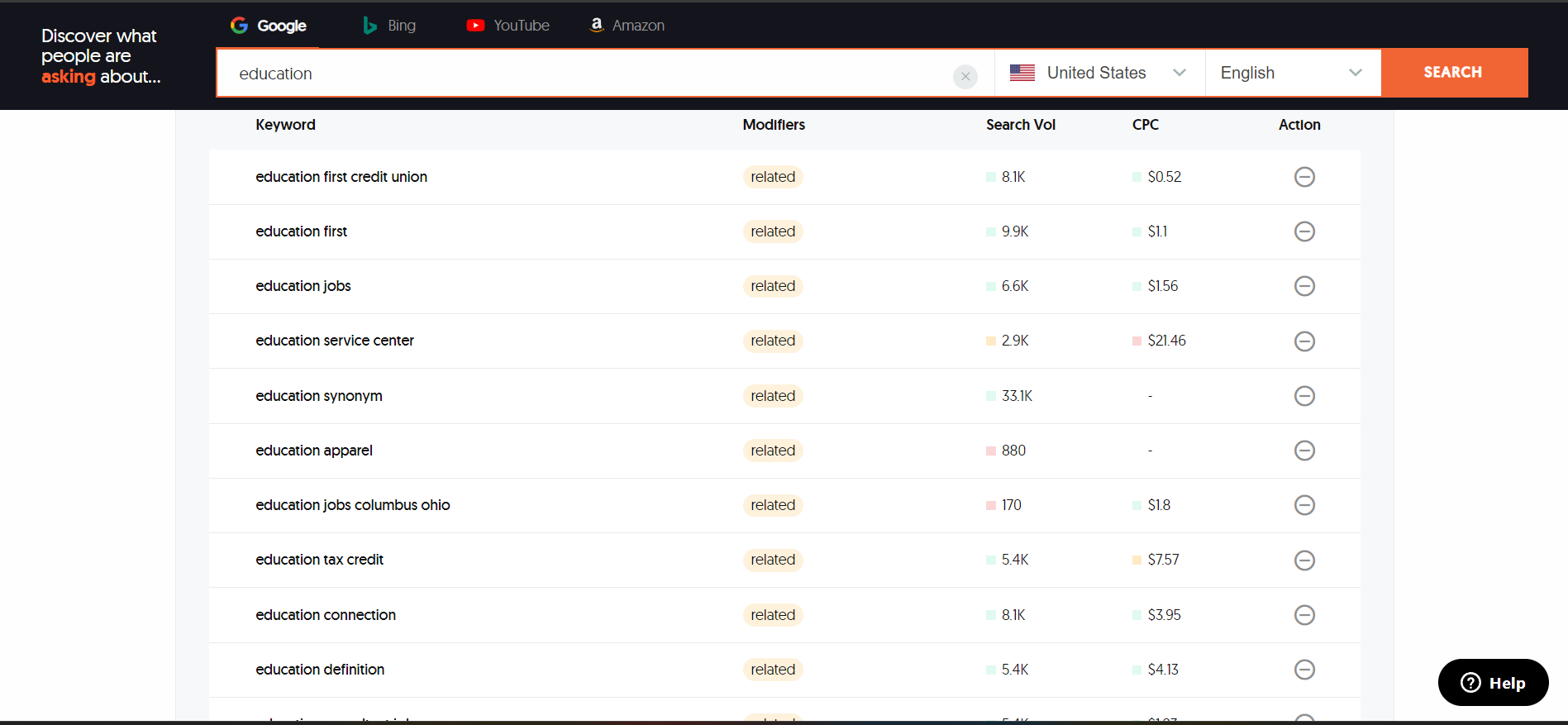
| S. No. | Keywords | Avg. monthly searches |
|---|---|---|
| 1 | trade school | 110,000 |
| 2 | associate degree | 40,500 |
| 3 | preschool near me | 49,500 |
| 4 | trade schools near me | 60,500 |
| 5 | driving school near me | 135,000 |
| 6 | colleges near me | 110,000 |
| 7 | preschool | 60,500 |
| 8 | private schools near me | 60,500 |
| 9 | community colleges near me | 74,000 |
| 10 | montessori school | 110,000 |
| 11 | community college | 90,500 |
| 12 | high schools near me | 49,500 |
| 13 | universal technical institute | 33,100 |
| 14 | charter school | 40,500 |
| 15 | nursing schools near me | 22,200 |
| 16 | charter schools near me | 22,200 |
| 17 | drivers ed near me | 27,100 |
| 18 | nursing programs near me | 22,200 |
| 19 | driving schools | 22,200 |
| 20 | technical schools near me | 18,100 |
Best Education Keywords List of India (2026)
India is one of the world's largest and most competitive education markets, with millions of students searching for admissions, competitive exam coaching, and professional certification every month. The Indian education keyword landscape is dominated by IGNOU-related searches, exam preparation terms (NEET, JEE, PMP), and proximity-based queries for play schools and colleges. Institutions targeting the Indian market should prioritise localised variants of these keywords — for example, "NEET coaching in Kota" or "top engineering colleges in Maharashtra" — and create dedicated landing pages for each major city they serve.
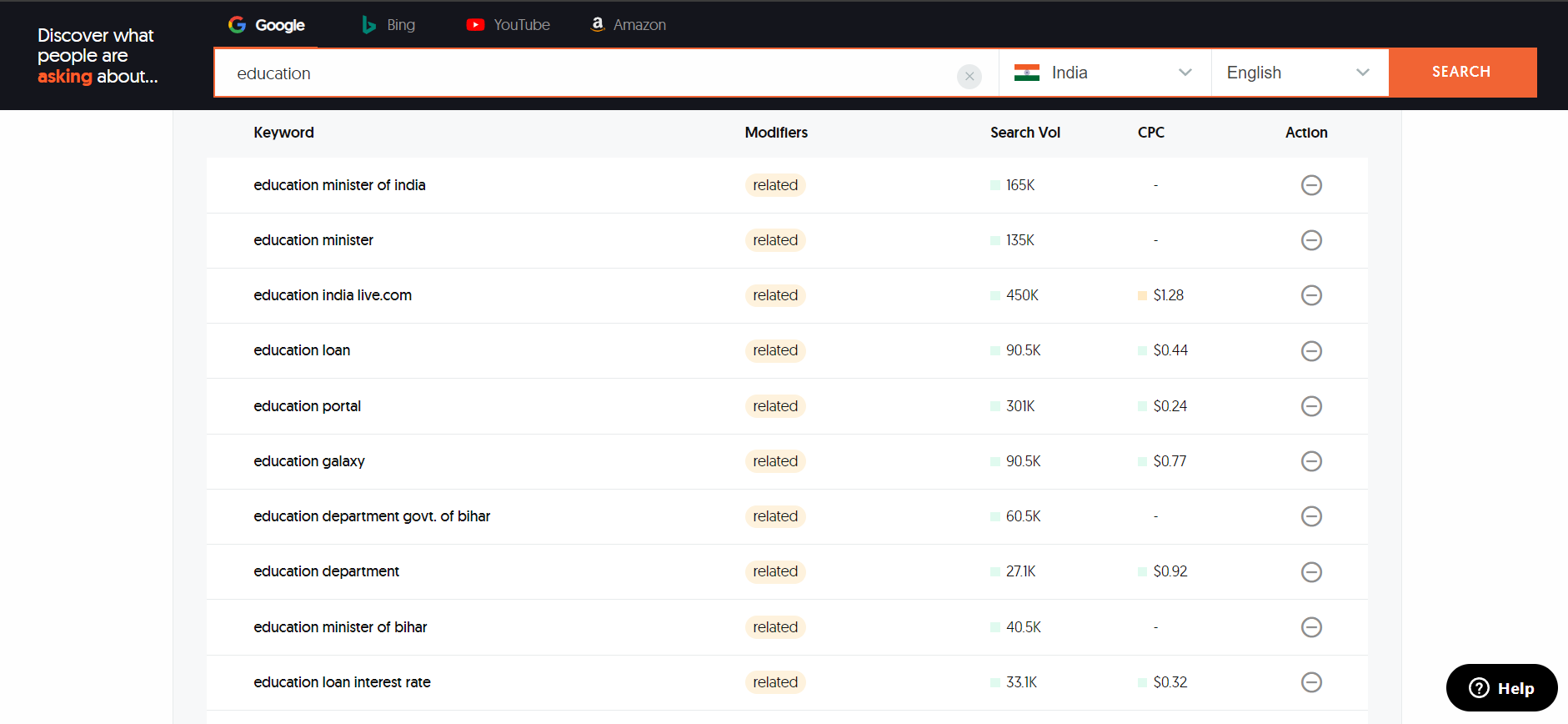
| S. No. | Keywords | Avg. monthly searches |
|---|---|---|
| 1 | IGNOU admission | 450,000 |
| 2 | IGNOU assignment | 246,000 |
| 3 | digital marketing course | 165,000 |
| 4 | driving school near me | 165,000 |
| 5 | higher education | 74,000 |
| 6 | indira gandhi national open university | 135,000 |
| 7 | PMP certification | 49,500 |
| 8 | play school near me | 201,000 |
| 9 | online MBA | 22,200 |
| 10 | indira gandhi open university | 9,900 |
| 11 | project management certification | 18,100 |
| 12 | colleges near me | 165,000 |
| 13 | educational institution | 14,800 |
| 14 | nursing schools near me | 880 |
| 15 | certified financial analyst | 1,000 |
Top SEO Keywords For Education In The UK (2026)
The UK education keyword landscape is shaped by the country's distinctive education system — student finance, UCAS applications, Ofsted-rated schools, and the A-levels and GCSE curriculum. "Student finance" alone generates 450,000 monthly searches, making it the single highest-volume education keyword in the UK market. Institutions targeting UK students should also create content around proximity-based secondary and primary school searches, project management certification, and university clearing — the latter experiencing dramatic search spikes each August.
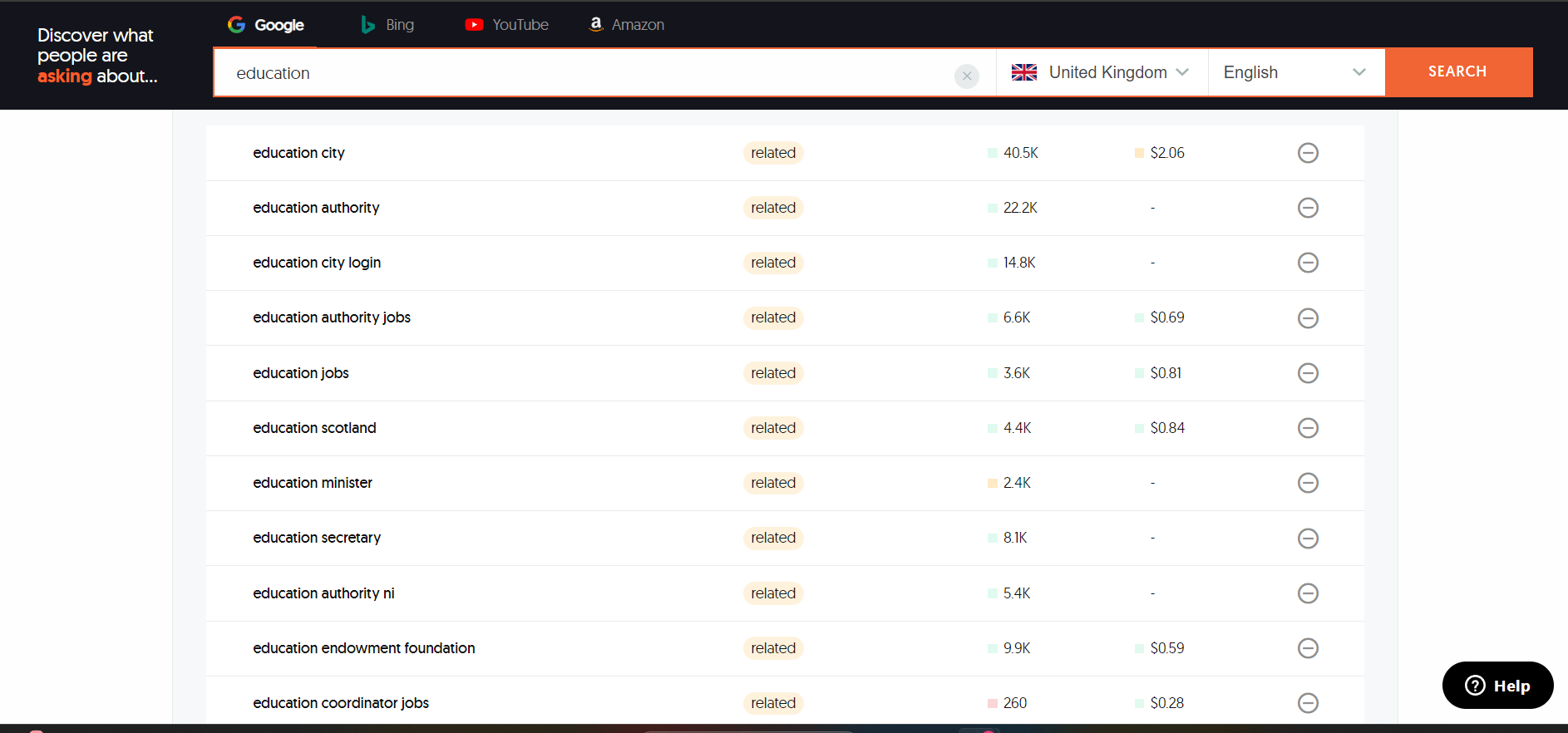
| S. No. | Keywords | Avg. monthly searches |
|---|---|---|
| 1 | student finance | 450,000 |
| 2 | artificial intelligence | 27,100 |
| 3 | student finance england | 110,000 |
| 4 | adobe creative cloud | 33,100 |
| 5 | AI voice generator | 22,200 |
| 6 | driving school near me | 18,100 |
| 7 | bachelor's degree | 9,900 |
| 8 | colleges near me | 27,100 |
| 9 | forensic psychology | 9,900 |
| 10 | gas safety certificate | 8,100 |
| 11 | Ivy league schools | 9,900 |
| 12 | primary schools near me | 33,100 |
| 13 | secondary schools near me | 22,200 |
| 14 | project management courses | 6,600 |
| 15 | chemical engineering | 8,100 |
| 16 | private schools near me | 8,100 |
| 17 | first aid courses | 3,600 |
| 18 | private school | 9,900 |
| 19 | university near me | 9,900 |
| 20 | preschool near me | 3,600 |
Best SEO Keywords List For Education Marketing In The UAE
The UAE education market is characterised by a large expatriate population, strong demand for professional certifications, and high interest in technology-adjacent education. Professional certifications — PMP, AWS, CCNA, Six Sigma — consistently outperform general academic keywords in the UAE, reflecting the market's professional development focus. International schools offering IB, British, or American curricula also generate significant search traffic. Keywords incorporating "Dubai", "Abu Dhabi", or "UAE" as geo-modifiers consistently improve click-through rates for location-specific pages.
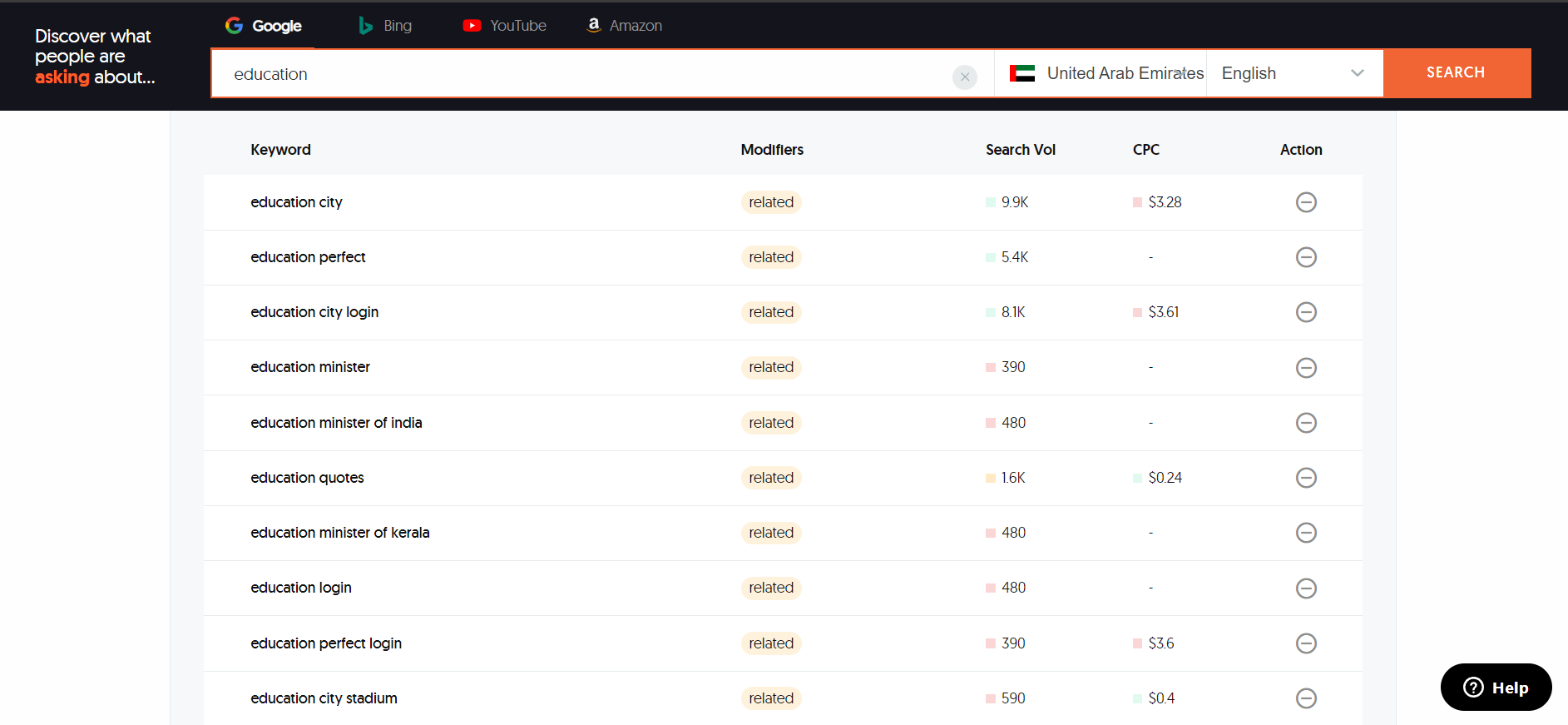
| S. No. | Keywords | Avg. monthly searches |
|---|---|---|
| 1 | artificial intelligence | 9,900 |
| 2 | PMP certification | 4,400 |
| 3 | adobe creative cloud | 3,600 |
| 4 | ai voice generator | 2,900 |
| 5 | driving school near me | 14,800 |
| 6 | charter school | 12,100 |
| 7 | information technology | 1,600 |
| 8 | CCNA | 1,600 |
| 9 | lean six sigma | 1,300 |
| 10 | aws certification | 1,000 |
| 11 | six sigma certification | 1,000 |
| 12 | bachelor's degree | 3,600 |
| 13 | project management courses | 880 |
| 14 | masters degree | 1,300 |
| 15 | early childhood education | 1,000 |
Best SEO Keywords for Coaching Centres & Test Prep Institutes (India)
Coaching centres and test preparation institutes operate in one of India's most keyword-competitive spaces. NEET and JEE keywords alone generate millions of searches every month, and the top-ranking pages for these terms attract enormous volumes of high-intent prospective students. The keywords below are organised by exam category to help coaching institutes create dedicated landing pages — one per exam or course — rather than trying to target all terms from a single generic page.
Pro tip: Pair each of these keywords with your city name (e.g., "best NEET coaching in Kota", "IIT JEE coaching in Delhi") for dramatically lower keyword difficulty and higher local conversion rates.
| S. No. | Keywords | Avg. monthly searches |
|---|---|---|
| 1 | best coaching institute in India | 22,200 |
| 2 | NEET coaching near me | 60,500 |
| 3 | best NEET coaching in India | 33,100 |
| 4 | IIT JEE coaching | 40,500 |
| 5 | best coaching for JEE mains | 27,100 |
| 6 | CAT coaching near me | 18,100 |
| 7 | best MBA coaching institute | 9,900 |
| 8 | GMAT coaching online | 8,100 |
| 9 | IELTS coaching classes | 22,200 |
| 10 | online IELTS coaching | 14,800 |
| 11 | UPSC coaching centre | 27,100 |
| 12 | best UPSC coaching in Delhi | 18,100 |
| 13 | SSC coaching near me | 12,100 |
| 14 | digital marketing course near me | 40,500 |
| 15 | spoken English classes near me | 33,100 |
| 16 | online tuition for class 10 | 22,200 |
| 17 | best online coaching for NEET 2026 | 14,800 |
| 18 | JEE advanced coaching fees | 9,900 |
| 19 | class 12 tuition near me | 18,100 |
| 20 | commerce tuition near me | 8,100 |
Admission & Conversion-Focused Keywords for Education Websites
While informational keywords drive awareness and research-stage traffic, admission and conversion keywords capture students who are ready to act. These bottom-of-funnel terms are among the most valuable in education SEO — they signal strong purchase intent and typically deliver your highest enquiry-to-admission conversion rates. Create dedicated admission landing pages optimised specifically for these terms, with clear CTAs, phone numbers, and enquiry forms prominently placed above the fold.
| S. No. | Keywords | Avg. monthly searches |
|---|---|---|
| 1 | school admission 2026 | 22,200 |
| 2 | admission open near me | 18,100 |
| 3 | school admission form online | 14,800 |
| 4 | college admission 2026 | 27,100 |
| 5 | apply for college online | 12,100 |
| 6 | online enrollment school | 9,900 |
| 7 | university application deadline | 8,100 |
| 8 | how to improve school admission rates | 6,600 |
| 9 | school fees 2026 | 12,100 |
| 10 | free school admission inquiry | 5,400 |
| 11 | enrol in college near me | 9,900 |
| 12 | CBSE school admission near me | 14,800 |
| 13 | ICSE school near me admission | 8,100 |
| 14 | private school admission requirements | 6,600 |
| 15 | international school admission Dubai | 4,400 |
Long-Tail Keywords For Education Websites
Long-tail education keywords typically have lower search volumes but significantly higher conversion intent. A visitor searching "best online learning platforms for working professionals" is far more qualified than someone simply searching "online learning." These terms also tend to have lower keyword difficulty, making them achievable ranking targets for institutions that do not yet have strong domain authority. Use long-tail keywords in blog posts, FAQs, programme guides, and course comparison pages.
| S. No. | Keywords | Avg. monthly searches |
|---|---|---|
| 1 | distance learning centre | 218,400 |
| 2 | online learning platforms | 31,800 |
| 3 | online math learning | 26,800 |
| 4 | master degree online | 22,200 |
| 5 | online learning courses | 11,300 |
| 6 | online teaching degree | 11,200 |
| 7 | online teaching platforms | 9,900 |
| 8 | online teaching courses | 9,900 |
| 9 | best online learning platforms | 5,700 |
| 10 | online schools for psychology | 5,600 |
Semantic (LSI) Keywords For Education Institutions
Latent Semantic Indexing (LSI) keywords are contextually related terms that help search engines understand the full topical scope of your content. Incorporating these semantic keywords naturally throughout your page — in subheadings, body paragraphs, and image alt text — signals topical depth and authority to Google, which increasingly rewards pages that comprehensively cover a subject over pages that simply repeat a target keyword. These terms should be used naturally across all education content, not forced or crammed artificially into copy.
| S. No. | Keywords | Avg. monthly searches |
|---|---|---|
| 1 | Character education | 1,300 |
| 2 | Study guides | 1,300 |
| 3 | Scientific literacy | 1,300 |
| 4 | Global education | 1,300 |
| 5 | Personalized learning | 1,300 |
| 6 | Home schooling resources | 1,300 |
| 7 | Interactive learning | 880 |
| 8 | Education blogs | 720 |
| 9 | Educational documentaries | 720 |
| 10 | Gifted education | 880 |
Latest SEO Tools We Use












Using AI-Powered Keyword Intelligence for Education SEO
Traditional keyword research — analysing search volume, CPC, and competition scores — remains foundational, but AI-powered tools are transforming how educational institutions discover, prioritise, and execute keyword strategies in 2026. AI does not just report on historical search data; it predicts emerging search trends before they reach peak volume, giving forward-thinking institutions a first-mover advantage in capturing new keyword clusters before competitors even identify them.
For example, AI-driven tools can identify that a keyword cluster around "AI learning platforms for students" is growing at 40% month-on-month before it reaches mainstream awareness — allowing an edtech platform or university to build topical authority in that space early, rather than entering a crowded field later. Similarly, conversational and voice-search queries like "Which universities near me offer data science courses?" require entirely different keyword strategies than typed searches, and AI tools excel at identifying these patterns.
Here are the four most impactful ways AI is improving education keyword research:
- Predictive Search Analysis: AI models analyse student behaviour patterns, course demand cycles, and regional education policy changes to forecast which search terms will peak in the next 3–6 months. This allows institutions to build and optimise content before demand peaks rather than chasing it reactively.
- Voice and Conversational Keyword Discovery: As voice assistants like Siri, Google Assistant, and Alexa become primary research tools for mobile-first students, AI tools decode natural language question patterns and surface long-tail, conversational keyword opportunities that traditional tools miss entirely.
- Automated Keyword Clustering by Intent: AI clusters thousands of keywords by search intent (informational, navigational, transactional) and maps them to the optimal page types automatically — reducing weeks of manual analysis to hours and ensuring every page on your site is optimised for the right intent stage.
- Competitor Content Gap Detection: AI scans competitor sites to identify which high-value keywords and topics they rank for that your institution does not currently address — surfacing specific content creation opportunities that represent the shortest path to meaningful ranking gains.
Educational institutions that integrate AI-powered keyword intelligence into their SEO strategy gain a measurable competitive advantage — publishing more relevant content faster, targeting higher-intent audiences more precisely, and building topical authority more efficiently than institutions relying on manual research alone.
How to Use Education Keywords Effectively On Your Website
Identifying the right keywords is only half the battle. The other half is implementing them correctly across your website so that both search engines and prospective students can find, understand, and act on your content. Below are the five most critical on-page implementation principles for education websites in 2026.
1. Create High-Quality, Intent-Matched Content
Every piece of content on your education website should be built around a specific keyword cluster and written to satisfy the precise search intent behind those keywords. Informational keywords — "what is a charter school", "how does NEET scoring work" — require educational, factual content. Commercial investigation keywords — "best NEET coaching institutes in India" — require comparison content with social proof and trust signals. Transactional keywords — "apply for admission 2026" — require conversion-optimised landing pages with prominent CTAs.
The one rule that applies to all content types: never keyword stuff. Google's algorithms penalise pages where keywords appear unnaturally dense. A keyword density of 1–2% for the primary keyword, supported by natural use of related terms and LSI keywords, consistently produces the best results.
2. Optimise All On-Page Metadata
Your title tag, meta description, H1, and URL slug are the four highest-impact on-page SEO elements. Every important page on your education website should have a unique title tag (50–60 characters) containing the primary keyword, a compelling meta description (150–160 characters) that includes both the keyword and a clear value proposition, an H1 that naturally incorporates the primary keyword, and a short, descriptive URL slug.
These elements provide search engines with essential context about your page's topic and purpose. Well-optimised metadata also improves click-through rates from SERPs, which itself is a positive ranking signal that compounds over time.
3. Refresh and Update Keyword Lists Regularly
The education search landscape changes significantly with each academic year, exam cycle, and policy change. New courses gain popularity, exam formats change, and student priorities shift. Keyword lists that were accurate in 2024 may no longer reflect current search behaviour in 2026.
Review your keyword strategy at minimum every six months. Monitor changes in search trends using AI-driven SEO analysis tools, Google Search Console impression data, and Google Trends. Update your highest-traffic pages with fresh data, updated examples, and expanded keyword coverage to maintain and improve rankings year-round.
4. Optimise for User Experience and Core Web Vitals
Google's Page Experience signals — including Core Web Vitals (LCP, FID, CLS), mobile-friendliness, and HTTPS security — directly influence rankings, particularly for pages with otherwise similar content quality. Education websites that load slowly, render poorly on mobile, or have significant layout shift lose ranking positions to faster, better-optimised competitors regardless of keyword quality.
Ensure your site achieves LCP under 2.5 seconds, CLS under 0.1, and passes the Google Mobile-Friendly Test. Compress images, use browser caching, defer non-critical JavaScript, and ensure keyword tables and content blocks are fully responsive on all screen sizes.
5. Track Performance and Make Data-Driven Decisions
Tracking keyword rankings in Google Search Console should be a weekly activity, not a quarterly one. Monitor which keywords are driving the most impressions, clicks, and page-one positions. Identify keywords sitting in positions 8–15 — the "striking distance" zone — as these represent the highest-impact optimisation opportunities, as a relatively small amount of additional work can push them onto Page 1.
Connect keyword ranking data with Google Analytics goal completions (enquiry submissions, admission page views, phone call clicks) to understand which keywords are not just generating traffic but actually generating leads. This conversion-level attribution ensures your keyword investment is always directed toward the terms that drive real institutional growth. Pairing this data-driven approach with our expert SEO services or a tailored SEO packages ensures consistent, measurable growth in student enrolment and institutional visibility.
How Media Search Group Can Help With SEO For Education Websites
In 2026's highly competitive education market, a strong search presence is no longer optional — it is the primary driver of student discovery, institutional credibility, and admissions growth. Schools, coaching centres, colleges, and universities that invest in a comprehensive SEO strategy for educational institutions consistently outperform rivals who rely solely on word-of-mouth and offline marketing.
At Media Search Group, we specialise in education SEO. Our team has delivered measurable ranking improvements, enrolment increases, and digital authority gains for educational institutions across India, USA, UK, and UAE. We understand the unique seasonal patterns of education search, the distinct keyword strategies required for different institution types, and the technical SEO requirements that separate page-one institutions from those stuck on page three.
By consistently implementing education SEO best practices — from keyword clustering and intent mapping through to technical site health and authoritative link building — institutions that partner with us see sustainable improvements in organic rankings, organic traffic, and qualified admissions enquiries.
Our education SEO services cover every dimension of organic search performance:
- Keyword Research & Strategy: Comprehensive keyword research across all institution types, audience segments, and target geographies, with full intent mapping and keyword-to-page assignment
- On-Page Optimisation: Title tags, meta descriptions, heading structure, content rewriting, and internal linking aligned with target keyword clusters
- Local SEO Strategies: Google Business Profile optimisation, local citation building, and geo-targeted landing page creation for every city or region you serve
- Technical SEO: Core Web Vitals improvement, schema markup implementation (FAQ, Course, Organization), crawl error resolution, and site architecture optimisation
- Content Optimisation & Creation: Programme pages, admission guides, blog content, and comparison pages built around high-value keyword clusters
- Link Building: Authority backlink acquisition from education directories, news publications, partner institutions, and relevant industry sources
Our SEO services for educational institutions are designed to deliver measurable outcomes: more organic traffic, more qualified student enquiries, improved admission rates, and stronger institutional reputation online.
Contact us today to receive a free SEO audit for your educational institution and discover exactly which keyword opportunities your competitors are currently capturing that you are missing.
Conclusion
Educational institutions that invest in a systematic, data-driven SEO keyword strategy in 2026 will have a decisive advantage over rivals that continue relying on generic digital marketing approaches. The institutions that appear at the top of Google for queries like "best school near me", "NEET coaching in Delhi", "online MBA India", or "university admission 2026" are capturing the largest share of motivated, ready-to-act prospective students — often before those students even consider looking elsewhere.
The keywords in this guide provide the foundation. But achieving and sustaining Top 10 rankings in competitive education niches requires more than a keyword list — it demands the right on-page implementation, technical site health, authoritative content, strategic backlink acquisition, and continuous performance monitoring. Each of these elements reinforces the others, creating a compounding SEO advantage that grows stronger and more valuable every month.
For educational institutions ready to turn keyword intelligence into measurable enrolment growth, partnering with an experienced education SEO company is the most direct path to sustainable results. Mobile-first design, localised SEO campaigns, and genuinely helpful content that answers the specific questions of prospective students — combined with systematic keyword targeting — form the complete framework for digital dominance in the education sector.
Why Partner With a Specialist Education SEO Company?
Partnering with an experienced education SEO company gives your institution access to deep expertise in education-specific keyword strategy, technical SEO, and content development — without the time investment of building these capabilities in-house. From targeted keyword research and on-page optimisation through to authority link building and comprehensive performance reporting, a specialist education SEO partner ensures your institution remains consistently visible, competitive, and growing in an increasingly search-driven student acquisition landscape.