With Google’s algorithm growing increasingly sophisticated and AI-powered search reshaping how buyers discover products, e-commerce businesses can no longer afford to rely on a checklist of isolated ranking tactics. Ranking on Google’s first page in 2026 demands a holistic E-commerce SEO strategy built on technical strength, topical authority, and genuine user value — all working together as a system.
But before mapping out a strategy, it pays to understand why SEO is worth the investment in the first place. Once you have that foundation, every tactic in this guide will make far more sense.
Why Is SEO Important for E-commerce Websites?
The numbers make a compelling case on their own. Research, surveys, and industry studies consistently show the outsized role organic search plays in e-commerce revenue:
- Pages listed on Google’s first page capture approximately 91.5% of all search traffic — leaving the remaining 8.5% to fight over everything else (Chitika)
- 51% of all website traffic comes from organic search, while paid search accounts for only around 10% — BrightEdge
- Organic traffic is responsible for more than 40% of total online revenue — BrightEdge
- 4 out of 5 consumers use search engines to find local product and service information — Think With Google
- Google processes over 8.5 billion searches per day, with more than 1 billion users monthly — Google via Business Insider
- Google holds approximately 91% of the global search engine market share — Statcounter, 2024
These figures tell a clear story: organic search is the single most cost-effective and scalable customer acquisition channel for e-commerce businesses. Paid advertising produces traffic only as long as you keep spending. SEO compounds — a well-optimised page earns traffic for years. That is why choosing the right SEO services is one of the most important investment decisions an e-commerce brand can make.
Now that the “why” is clear, here are all the pillars of an effective e-commerce SEO strategy for 2026:
- E-commerce Website Architecture
- On-Page SEO for E-commerce Websites
- Technical SEO for E-commerce Websites
- Keyword Research for E-commerce Websites
- Content Marketing for E-commerce Websites
- Link Building for E-commerce Websites
- E-E-A-T: Building Trust and Authority
- AI Search & Generative Engine Optimisation (GEO)
E-commerce Website Architecture
Website structure is more critical for e-commerce than for almost any other site type. When shoppers browse, they are already weighing decisions — any friction caused by poor navigation, confusing categories, slow loading, or disorganised product naming can push them away before they ever see your product. This is why investing in professional e-commerce web development is essential to create a seamless and conversion-focused user experience. Equally important, a poorly structured site makes it harder for Googlebot to crawl, understand, and index your pages efficiently.
What to Do to Improve E-commerce Website Architecture
To build a site structure that performs for both users and search engines:
- Keep the design clean and scalable — avoid clutter that distracts buyers at decision points
- Apply the 3-click rule — every product page should be reachable within three clicks from the homepage
- Use a flat hierarchy — the fewer levels between your homepage and a product page, the more link equity flows to those pages
- Concentrate link authority on product and category pages — these pages generate revenue; they deserve the strongest internal linking signals
- Add breadcrumb navigation — breadcrumbs help both users and crawlers understand where they are in the site hierarchy, and they display in Google’s search results to improve click-through rates
- Use descriptive, keyword-rich URLs — a URL like /mens-running-shoes/lightweight/ communicates context immediately; avoid parameter-heavy URLs where possible
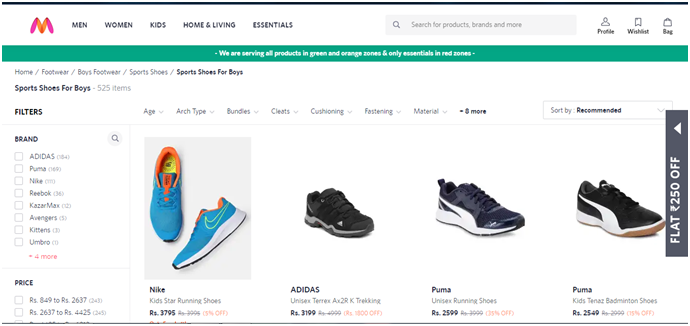
Real-world example: Myntra demonstrates excellent site architecture. A visitor searching for sports shoes for kids can navigate: Homepage → Kids → Boys Footwear → Sports Shoes in just two clicks. Google has no difficulty crawling this flat, logical structure — and neither do shoppers.
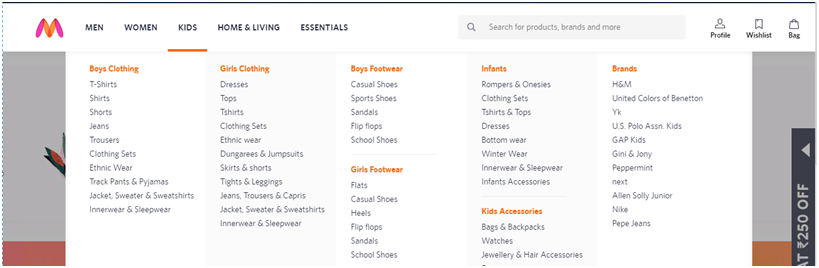
This clean architecture ensures that category and product pages are easy to find, easy to index, and fully eligible to earn strong rankings.
On-Page SEO for E-commerce Websites
Once the architecture is solid, the focus shifts to the individual pages that generate traffic and revenue: your category pages and product pages. On-page SEO is the process of optimising every element on these pages so Google understands their relevance and users are compelled to click and convert.
For each important category or product page, ask yourself three questions:
- Is my title tag compelling and keyword-rich?
- Does my meta description drive clicks?
- Does the page contain enough unique, helpful content?
Title Tag Optimisation
Title tags are one of Google’s most heavily weighted on-page signals — and the first thing a potential customer reads in the search results. Avoid plain, generic titles. Instead, add modifiers that reflect genuine buying intent and product attributes: words like buy, best, cheap, online, free shipping, discount, deals, or off all help capture long-tail search intent and improve click-through rates.
Keep titles under 60 characters to prevent truncation in the SERP. Place your primary keyword as close to the beginning as possible.
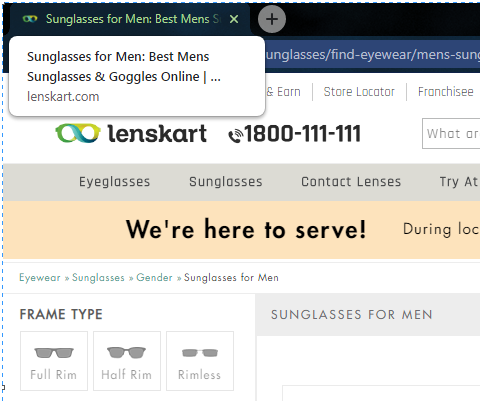
Example from Lenskart: Their men’s sunglasses category title includes “best” and “online” — modifiers that align with commercial-intent searches.
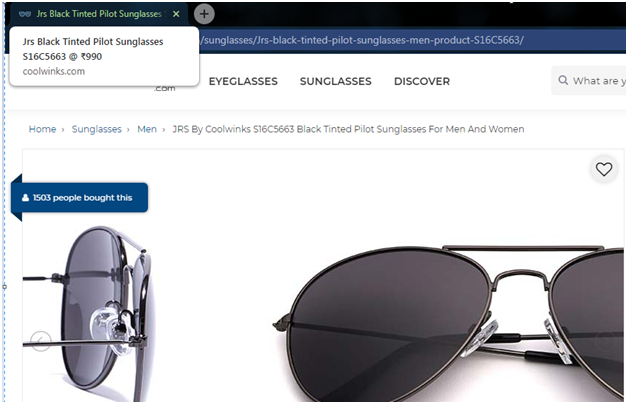
Example from Coolwinks: Their product page title includes the price point (“@”) and a specific descriptor (“Black Tinted”) — details that signal relevance to highly specific searches.
Meta Description Optimisation
While meta descriptions are not a direct ranking factor, they have a significant impact on click-through rate — which does influence your rankings indirectly. Think of the meta description as your 155-character sales pitch. Use the same buyer-intent modifiers as your title, but go further: include a unique value proposition, promotional hooks, and a call to action.
Phrases like “Up to 30% Off”, “Offers End Soon”, “COD Available”, “Top Brands”, and “100% Genuine Products” are proven attention-grabbers that convert SERP impressions into clicks.


Category and Product Page Content
Thin or duplicate content is one of the most common reasons e-commerce pages fail to rank. Each category and product page must contain unique, original content that genuinely helps a buyer make a decision — and gives Google enough context to understand exactly what you are selling.
a) Write detailed, in-depth descriptions. For key category pages, 500–1,000 words is a realistic minimum. Buyers want to know not just what the product is, but why it is the right choice, how it compares to alternatives, and what makes your store the best place to buy it. More genuinely useful content correlates strongly with higher rankings.
b) Use your target keyword naturally — not mechanically. Include your primary keyword in the first 100 words and use it and related variants naturally throughout. Google’s NLP models understand context — you do not need to stuff keywords; you need to write content that thoroughly covers the topic.
c) Research semantic and LSI keywords. Modern SEO is about topical coverage, not isolated keywords. Tools like Google Keyword Planner, Ahrefs, and SEMrush reveal the related terms, synonyms, and questions that belong alongside your primary keyword.
d) Keep URLs short, clean, and keyword-rich. On category and product pages, a URL like /womens-running-shoes/ outperforms /category?id=4472&filter=shoes on every level — usability, crawlability, and click-through rate.
e) Build a strategic internal linking structure. Link from your highest-authority pages (blog posts, pillar guides, your homepage) to your most important category and product pages. This distributes link equity and signals to Google which pages deserve priority indexing.
f) Implement Schema Markup for Rich Results. Product schema enables Google to display price, availability, ratings, and review count directly in the search results. FAQ schema targets the People Also Ask box. These rich results dramatically improve visibility and click-through rate, even before a user visits your site.
Technical SEO for E-commerce Websites
E-commerce sites face unique technical challenges at scale: hundreds or thousands of product pages, faceted navigation generating duplicate URLs, large image files slowing load times, and crawl budget constraints. A solid technical SEO foundation ensures none of these issues prevent Google from finding, crawling, and ranking your pages.
Start with a technical SEO audit using tools such as SEMrush, Ahrefs, or Moz to identify and prioritise issues. Then address the following critical areas:
Core Web Vitals (LCP, INP & CLS)
Since 2021, Google has used Core Web Vitals as confirmed ranking signals. In 2024, Interaction to Next Paint (INP) replaced First Input Delay as the responsiveness metric. In 2026, these are the targets every e-commerce site must hit:
- Largest Contentful Paint (LCP) — measures loading performance. Target: under 2.5 seconds
- Interaction to Next Paint (INP) — measures responsiveness to clicks and interactions. Target: under 200 milliseconds
- Cumulative Layout Shift (CLS) — measures visual stability. Target: under 0.1
Research shows that a one-second delay in mobile load time can reduce conversions by up to 20%. Use Google PageSpeed Insights and the Core Web Vitals report in Google Search Console to monitor performance. Convert product images to WebP format, implement lazy loading for below-the-fold images, and minimise render-blocking JavaScript.
Duplicate Content and Faceted Navigation
Faceted navigation — the filter system that lets shoppers sort by size, colour, price, and brand — creates a significant duplicate content risk. Each filter combination can generate a unique URL containing essentially the same products, wasting crawl budget and diluting link equity across near-identical pages.
- Use canonical tags to tell Google which version of a filtered URL is the authoritative one
- Apply noindex directives to low-value parameter combinations that add no unique content
- Configure robots.txt and XML sitemaps carefully to guide Googlebot toward pages worth crawling
- Combine near-identical category pages where possible rather than maintaining thin variants
Crawl Budget Management
For large e-commerce catalogues, crawl budget — the number of pages Googlebot will crawl on your site within a given period — becomes a strategic consideration. Minimise crawl waste by ensuring your most important category and product pages are the easiest and fastest for Googlebot to access. A clean XML sitemap, a well-configured robots.txt file, and fast server response times all contribute to efficient crawling.
Other Critical Technical Issues to Fix
- Site speed — identify bloated code, unoptimised images, and slow servers using PageSpeed Insights and Lighthouse
- Thin content — aim for a minimum of 300–500 words of unique content on all significant product and category pages
- Mobile-first indexing — Google now indexes the mobile version of your site first; test every critical page on mobile and resolve usability issues
- HTTPS — a secure connection is a baseline requirement; any page still on HTTP will face ranking penalties and browser security warnings
- Broken links and redirect chains — use crawl tools to audit for 4xx errors and inefficient redirect chains that waste link equity
Keyword Research for E-commerce Websites
Keyword research is not a one-time exercise — it is an ongoing process that underpins every other element of your SEO strategy. Without the right keywords, no amount of technical optimisation or content creation will bring the right buyers to your site. Your keywords inform your URL structure, your content, your page titles, and your internal linking architecture.
Common Types of Keywords in E-commerce SEO
Short-tail keyword — 3 words or fewer; high search volume; highly competitive
Example: shoes online; sports shoes; running shoes
Long-tail keyword — more than 3 words; more specific; lower volume; easier to identify search intent; higher conversion rate
Example: best shoes for running on concrete; buy cheap shoes online with free delivery
Product-defining keyword — describes a specific product characteristic; less competitive; high conversion rate
Example: Bata party wear shoes; wide-fit shoes for women size 8
Customer-defining keyword — based on your buyer persona and their specific needs
Example: sports shoes for kids; comfortable shoes for diabetics
Geo-targeting keyword — essential for local and delivery-based e-commerce
Example: designer shoe stores in New Delhi; next-day shoe delivery London
LSI (Latent Semantic Indexing) keyword — thematically related terms that reinforce topical relevance
Example: best shoes for formal events; shoe care tips; how to measure shoe size
Intent-targeting keyword — informational (how to / what is), commercial (best / reviews), transactional (buy / order / discount)
Example: how to find the right running shoes; buy men’s formal shoes at discount
Branded keyword — includes a specific brand name
Example: Adidas running shoes; Nike Air Max online
Competitor keyword — targets the brand names of competing businesses
Example: Puma vs Adidas running shoes; alternative to Nike Air Force 1
Transactional keyword — indicates purchase readiness; these are the highest-converting keyword type
Example: buy cheap formal shoes online; order running shoes with free returns
How to Find Keywords for E-commerce Websites
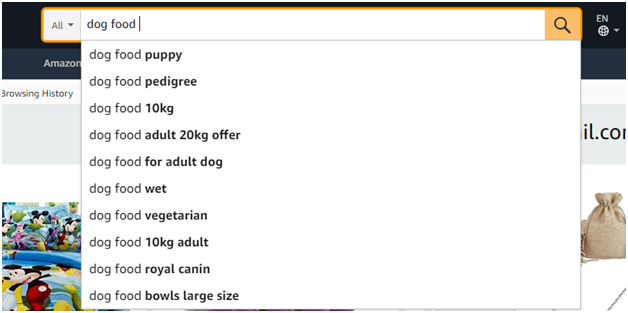
Amazon’s search autocomplete remains one of the best free sources of long-tail keyword ideas — because those suggestions reflect what actual buyers are searching for right now. Start by entering your main product term and recording every suggestion.
Supplement this with dedicated keyword research tools:
- Google Keyword Planner — free; provides search volume, trends, CPC, and competition data
- Google Search Console — shows the exact queries your site already receives impressions for; a goldmine of intent data
- Ahrefs and SEMrush — industry-standard paid tools for competitor keyword gap analysis, volume data, and keyword difficulty scoring
- Google Autocomplete and Related Searches — type your main keyword into Google and record every autocomplete suggestion and the “Searches related to” section at the bottom of the SERP
How to Select Keywords for Your E-commerce Pages
Choosing the right keywords requires weighing several factors simultaneously:
- Search intent alignment — does the keyword match what this specific page offers? A product page should target transactional intent; a buying guide should target informational or commercial investigation intent
- Search volume — high volume is not always better; a highly targeted keyword with 300 monthly searches may convert far better than a broad term with 30,000
- Keyword difficulty — new or low-authority sites should prioritise lower-competition keywords and build toward higher-difficulty terms over time
- Keyword clustering — group related keywords together and assign each cluster to a dedicated page rather than creating separate thin pages for every variation
- Commercial relevance — ensure the keyword describes your product accurately; irrelevant traffic does not convert
Content Marketing for E-commerce Websites
With your site architecture optimised, technical SEO addressed, and keyword strategy in place, content marketing is how you build the topical authority that separates consistently ranking sites from those that stall. The goal is not to publish for the sake of volume — it is to become the most genuinely helpful resource in your niche, so both Google and buyers come to trust you.
Building a Topical Authority Strategy with Content Clusters
Modern content strategy for e-commerce is built around the pillar-cluster model. Rather than publishing isolated blog posts, you create a hub (a comprehensive pillar page on a broad topic) surrounded by a cluster of supporting articles that cover related subtopics in depth. Each cluster article links back to the pillar, and the pillar links to each cluster article. This structure sends strong topical authority signals to Google and helps the entire cluster rank more effectively.
Example: If you sell running shoes, a pillar page titled “The Complete Guide to Running Shoes” could be surrounded by cluster articles on topics like “How to choose the right running shoe for your gait”, “Best trail running shoes 2026”, and “How to care for running shoes”.
How to Develop Your Content Marketing Strategy
- Research where your audience spends time — identify the forums, communities, social platforms, and question-and-answer sites where your target buyers discuss your products
- Mine their language — note the exact words, phrases, questions, and pain points they use; these are your content topics and keywords
- Create genuinely useful content — produce buying guides, comparison articles, tutorials, and FAQs that answer real questions, not content that exists purely to target a keyword
- Leverage user-generated content (UGC) — customer reviews, Q&A sections, and customer photo galleries all add fresh, authentic content to product and category pages. Review schema markup allows this content to display as rich results in the SERP
- Link content to revenue-driving pages — every blog post and buying guide should include relevant internal links to the category or product pages it references
- Pursue guest posting on authoritative sites — in addition to your own blog, publishing on respected industry publications builds domain authority and referral traffic
Link Building for E-commerce Websites
Backlinks remain one of Google’s most important ranking signals in 2026. But the emphasis has decisively shifted from quantity to quality. A single contextual link from a respected industry publication delivers more ranking power than hundreds of low-quality directory or forum links. The goal is to earn links — by creating content, products, and experiences worth linking to — rather than to manufacture them.
Find authoritative blogs, publications, and communities relevant to your industry. Create content that provides genuine value to their audiences:
- Detailed buying guides that help shoppers choose the right product
- Educational articles that identify and address common buyer mistakes
- Data-driven research or original studies that other sites will want to reference
- Infographics and visual assets that are easy to embed and share
- Content that debunks myths or addresses common pain points in your product category
- Seasonal roundups, trend reports, or expert opinion pieces
Knowing exactly what your target audience wants to learn — and then creating the best available answer to those questions — is the foundation of a link-earning strategy that compounds over time. This is also the content that gets cited by AI-powered search systems. For more on link building services tailored to e-commerce, see our dedicated guide.
E-E-A-T: Building Experience, Expertise, Authoritativeness & Trustworthiness
In 2022, Google updated its content quality guidelines to reflect a new signal: Experience. The framework is now E-E-A-T — Experience, Expertise, Authoritativeness, and Trustworthiness. This is not a single ranking factor but a collection of quality signals that Google’s algorithms and human quality raters use to evaluate whether content genuinely serves users.
For e-commerce businesses, building E-E-A-T means:
- Author bios with real credentials — content authors should be identified by name, with relevant expertise and a link to their professional profile
- Citing sources for all statistics and claims — link to original research, industry reports, and authoritative sources rather than making unsupported assertions
- Case studies and customer success stories — real-world evidence of your products’ performance builds trust with both users and Google
- Verified customer reviews — authentic reviews are an “Experience” signal; implement Review schema so they appear as rich results
- Trust signals throughout the site — clear return policies, secure payment badges, contact information, and privacy policy pages all contribute to trustworthiness
- Regular content updates — keeping articles accurate and current signals that your site is actively maintained by experts who care about accuracy
E-E-A-T is especially important for e-commerce sites selling products in health, finance, or safety-related categories — categories Google classifies as “Your Money or Your Life” (YMYL) and scrutinises with the highest quality standards.
AI Search & Generative Engine Optimisation (GEO)
The search landscape has undergone a fundamental shift. In 2026, buyers do not only use traditional Google search — they increasingly discover products through AI-powered tools including Google AI Overviews, ChatGPT Search, and Perplexity. These platforms generate answers rather than simply listing links, drawing from authoritative, well-structured content that their models have identified as trustworthy and topically relevant.
Generative Engine Optimisation (GEO) is the practice of ensuring your e-commerce brand and content are cited and surfaced by these AI systems. It is not a replacement for traditional SEO — it is an additional layer built on top of the same technical foundations.
How to Improve Your Visibility in AI-Powered Search
- Structure your content for AI comprehension — use clear headings, concise definitions, and direct answers to questions. AI systems prefer content that is easy to parse and cite
- Implement FAQ sections with structured markup — FAQ schema and well-formatted question-and-answer content are frequently pulled into AI-generated answers
- Write factual, citation-worthy content — include verifiable statistics, expert quotes, and original data that AI models can reference confidently
- Build brand authority — the more your brand name appears in trusted online sources (press coverage, industry publications, partner sites), the more likely AI systems are to include you in generated responses
- Optimise for featured snippets — content that earns a featured snippet in traditional search is also well-positioned for AI Overview inclusion
GEO and traditional SEO are complementary disciplines. The technical foundations — fast pages, clean structure, authoritative content, strong backlink profiles — support performance across both channels.
Final Thoughts
E-commerce SEO in 2026 is not a collection of isolated tactics — it is an interconnected system. A technically sound site structure enables efficient crawling. Keyword research informs content and architecture decisions. High-quality, expert-authored content builds topical authority and earns backlinks. E-E-A-T signals build the trust that both Google and buyers need before making a decision. And GEO-ready content ensures your brand remains visible as AI-powered search continues to reshape discovery.
The competition in e-commerce grows more intense every year. The brands that invest consistently in all of these pillars — rather than chasing short-term tricks — are the ones that build durable, compounding organic visibility. Start with the areas that represent your biggest current gaps, measure progress through Google Search Console and GA4, and iterate continuously. The effort is significant, but so are the returns.