Keyword List Updated: 12 March, 2026
Over 71% of patients search online before booking a dental appointment — and the words they type into Google determine which practice they call first. Mastering the right dental SEO keywords is no longer optional for dentists who want to grow their patient base. It is the single most important step in your entire digital marketing strategy.
This comprehensive guide — built on extensive keyword research and real search volume data — gives dentists, orthodontists, and specialist practitioners a complete, data-backed list of the most searched dental keywords in 2026. Whether you are targeting local patients with "dentist near me" searches, running Google Ads on high-CPC procedure keywords, or building long-term organic authority through dental content marketing, you will find exactly what you need here.
We cover the global Top 50 dental SEO keywords, a dedicated Top 20 USA keyword list, a Top 20 UAE keyword list, the highest-CPC terms for Google Ads, the best long-tail keywords for conversion, and a practical step-by-step guide on how to do dental keyword research yourself — all with search volume, CPC data, and keyword intent classifications.
Why SEO Keywords Matter for Dentists in 2026
Patients no longer open the phone book to find a dentist. They open Google. Search terms like "dentist near me" generate over 823,000 monthly searches in the USA alone, and the practices that appear in the Google Maps Local 3-Pack and top organic results capture the overwhelming majority of those clicks. If your dental website is not optimised for the keywords your patients are actually using, you are handing those patients directly to your competitors.
The right dental SEO keywords serve three critical business functions: they drive organic traffic from patients actively seeking your services; they lower your patient acquisition cost compared to paid advertising; and they build long-term topical authority that compounds in value over time. Unlike Google Ads that stop the moment your budget runs out, well-optimised keyword content continues ranking and generating new patient enquiries 24 hours a day.
Understanding keyword intent — the reason behind a patient's search — is the key to choosing the right terms. A patient typing "how to fix a chipped tooth" is in the research phase. A patient typing "emergency dentist near me open now" is ready to book immediately. Your SEO keyword strategy needs to capture both.
Understanding Keyword Intent for Dental Practices
Before diving into the keyword lists, it is essential to understand what drives a patient's search behaviour. Every dental keyword falls into one of four intent categories, and knowing which category a keyword belongs to determines which page on your website it should target.
Informational Keywords
Patients use informational keywords when they are researching a condition, procedure, or treatment option — not yet ready to book. Examples include "what is a root canal", "how long do dental implants last", or "wisdom tooth extraction recovery time." These keywords are best targeted through blog posts, FAQs, and educational service pages. They build trust and introduce your practice to patients at the earliest stage of their journey.
Local / "Near Me" Keywords
Local keywords are the most valuable for dental practices because they connect you with patients in your immediate service area who are ready to act. Terms like "dentist near me", "pediatric dentist near me", and "dental clinic near me" all signal that the searcher wants a local result, right now. Optimising for these terms requires a fully optimised Google Business Profile, consistent local citations across directories like Yelp and Healthgrades, and location-specific landing pages. These keywords also trigger the coveted Google Maps Local 3-Pack — the three map listings that appear above organic results and capture the highest click-through rates on the page.
Commercial / Comparison Keywords
Commercial intent keywords indicate that a patient is comparing options before making a decision. Examples include "best cosmetic dentist", "dental implants cost", "veneers vs bonding", and "affordable dental implants." These keywords work well on detailed service pages, comparison guides, and before/after gallery pages that help patients understand why your practice is the right choice.
Transactional Keywords
Transactional keywords signal high urgency and immediate booking intent. "Emergency dentist near me", "same-day dental appointment", and "dental implants near me" are prime examples. These should be targeted on your core service and contact pages with prominent calls-to-action, click-to-call buttons, and online booking widgets. These terms also carry the highest CPC in Google Ads because advertisers know that one conversion more than covers the cost.
💡 Pro Tip: The most effective dental SEO strategies target all four intent types simultaneously — informational keywords via the blog, local keywords via the homepage and Google Business Profile, commercial keywords via service pages, and transactional keywords via landing pages and Google Ads.
Categories of Keywords For Dentists
Dental keywords are not one-size-fits-all. The most effective dental SEO strategies organise keywords into distinct categories, each serving a different patient need and mapped to a specific type of content on your website. Here are the seven essential keyword categories every dental practice should be targeting in 2026.
1. Localised Dental Keywords
Localised dental keywords are the backbone of any dental practice's SEO strategy. Because dentistry is an inherently local service, patients search for providers within their immediate area — and Google's algorithm rewards practices that signal strong local relevance. Keywords like "dentist near me" (823,000 searches/month in the US), "dental clinic near me", and "emergency dentist [city name]" consistently drive the highest-converting traffic of any dental keyword category.
Strategy Tip: Incorporate your practice's city, neighbourhood, and surrounding service areas into your homepage title tag, meta description, H1 heading, Google Business Profile, and local directory listings. Create individual location landing pages if you serve multiple cities. Pair each local keyword with your core service — for example, "dental implants in [City]" or "teeth whitening near me [City]" — to capture both local and procedure-specific intent simultaneously.
2. Dental Treatment and Service Keywords
As patients become more informed about dental procedures, procedure-specific keywords have grown in search volume and commercial value. Terms like "dental implants" (135,000/month globally), "all on 4 dental implants", "teeth whitening" (165,000/month), "root canal" (165,000/month), and "composite bonding" attract patients who are actively researching specific treatments — often at the decision stage of their patient journey.
Strategy Tip: Create a dedicated service page for every treatment you offer. Each page should target 2–3 primary keywords related to that procedure, answer the most common patient questions (procedure steps, recovery time, cost), and include a clear call-to-action to book a consultation. Service pages optimised this way regularly rank for dozens of related long-tail keyword variations without any additional effort.
3. Dental Health and Educational Keywords
Educational keywords target patients in the awareness and consideration phases — people researching dental problems, oral hygiene tips, and treatment options before they are ready to visit a practice. Examples include "how to prevent gum disease", "signs you need a root canal", "receding gums treatment options", and "TMJ treatment at home." While these keywords typically have lower direct conversion rates, they introduce your practice to a large pool of future patients and establish your authority as a trusted dental resource.
Strategy Tip: Build a robust dental blog or patient resource centre on your website. Publish regular, in-depth articles targeting informational keywords. Include calls-to-action within every article directing readers to your relevant service pages — for example, an article on "signs you need a dental implant" should naturally link to your dental implants service page.
4. Dental Practice and Office Keywords
Patients often use search engines to research and evaluate dental practices before committing to an appointment. Keywords in this category include "best dentist near me", "dental office near me", "family dentistry", "dentist accepting new patients", and branded searches for your practice name. Appearing prominently for these keywords is critical because patients searching them are in the final evaluation stage — comparing you directly against competitors.
Strategy Tip: Actively cultivate Google reviews from satisfied patients — star ratings are prominently displayed in search results and significantly influence click-through rates. Feature patient testimonials on your website and ensure your practice's name, address, phone number (NAP), and opening hours are consistently listed across Google Business Profile, Yelp, Healthgrades, and all major local directories.
5. Dental Insurance and Financing Keywords
Cost and affordability are among the most significant barriers to dental care. Keywords related to insurance coverage and payment options — such as "affordable dental implants", "dental care with insurance", "cheap dental implants", and "dental payment plans" — attract a large segment of price-conscious patients who may not visit a practice if they cannot find answers to their financial questions online.
Strategy Tip: Dedicate a section of your website — or a standalone page — to explaining the insurance plans you accept and the financing options available. Use natural language that mirrors how patients search: "Do you accept [Insurance Plan Name]?" or "What does a dental implant cost with insurance?" This approach captures featured snippet opportunities and directly addresses the most common patient objection.
6. Voice Search and Long-Tail Keywords
With over 50% of searches now conducted via mobile devices and the rapid growth of voice assistants like Siri and Google Assistant, conversational, question-based, and long-tail keywords have become increasingly important in dental SEO. Voice searches tend to be longer and more specific than typed queries — for example, "Who is the best emergency dentist open near me tonight?" rather than simply "emergency dentist."
Long-tail keywords like "affordable dental implants for seniors in [city]", "same-day emergency tooth extraction near me", or "best Invisalign orthodontist for adults" have significantly lower search volume than broad terms but consistently deliver higher conversion rates — because the patient searching them already knows exactly what they need and is ready to book.
Strategy Tip: Structure your website content in a natural, conversational question-and-answer format. An FAQ section on every service page targets both voice search queries and Google's "People Also Ask" (PAA) boxes, which appear in approximately 43% of all Google search results.
7. Emerging and Trending Dental Keywords for 2026–2026
The dental industry is evolving rapidly, and new patient search behaviours are emerging alongside new technologies and care models. In 2026 and looking ahead to 2026, the following keyword trends are gaining significant traction and represent early-mover ranking opportunities for dental practices willing to act now:
- AI-assisted dental diagnostics — patients searching for tech-forward practices
- Tele-dentistry / virtual dental consultations — especially post-pandemic growth
- Dental sleep medicine — sleep apnoea treatment via oral appliance
- Biomimetic dentistry — conservative, tooth-preserving treatments
- Holistic / biological dentistry — mercury-free, biocompatible materials
- Eco-friendly dental practices — sustainability-conscious patient segment
Strategy Tip: Monitor Google Trends and your Google Search Console "Queries" report monthly to identify emerging keyword opportunities before your competitors. Early-mover advantage in low-competition emerging niches can deliver Top 3 rankings within 60–90 days of publishing well-optimised content.

Top 50 SEO Keywords For Dentists Globally (2026)
The table below presents the 50 most searched dental SEO keywords worldwide, ranked by monthly global search volume. Each keyword includes its dominant search intent, estimated monthly search volume, and average cost-per-click (CPC) in USD — giving you everything you need to prioritise your dental SEO and Google Ads strategy. Keywords marked as Transactional or Commercial represent the highest-value targets for patient acquisition.
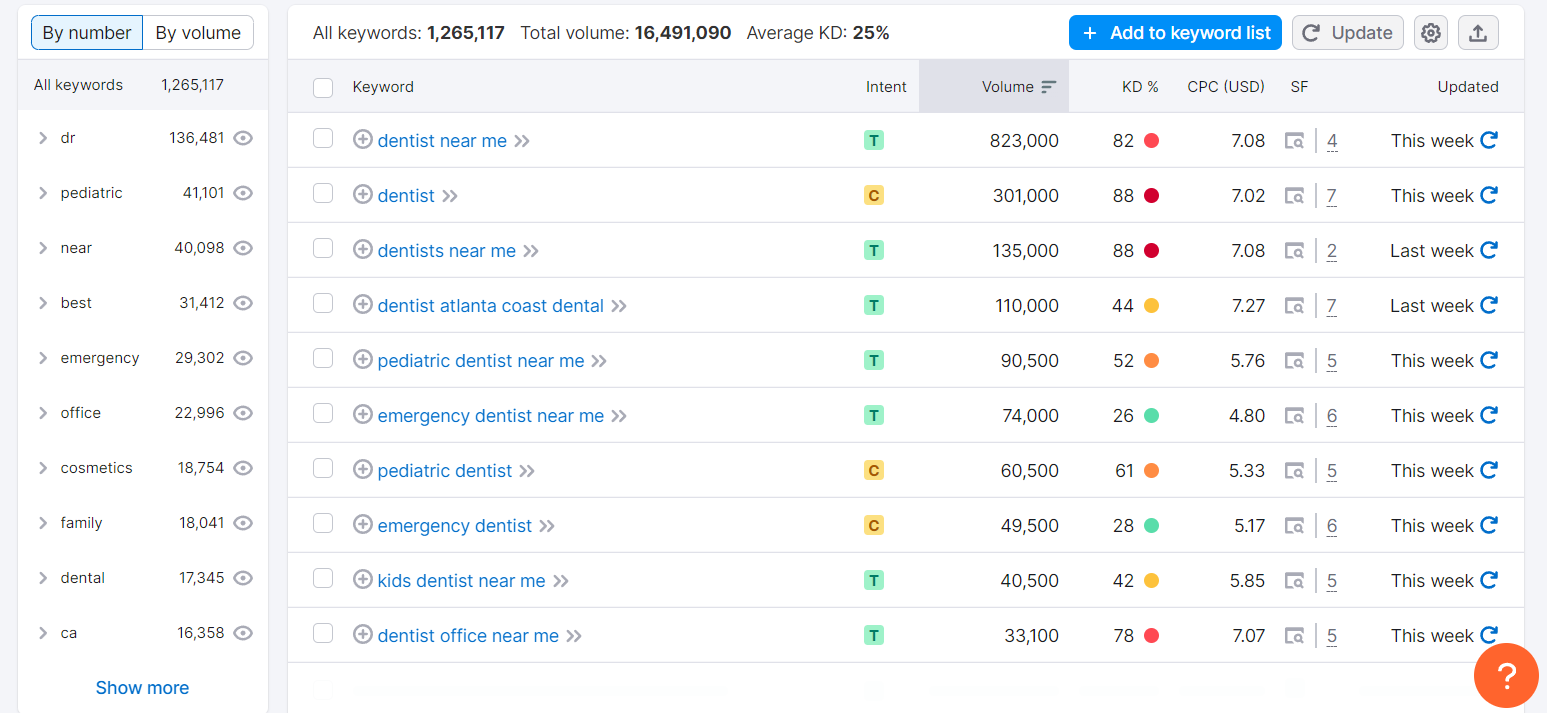
| S.No. | Search Term Keyword | Intent | Volume | CPC (USD) |
|---|---|---|---|---|
| 1 | dentist near me | Transactional | 823,000 | 6.78 |
| 2 | root canal | Informational | 165,000 | 12.16 |
| 3 | dental implants | Commercial | 135,000 | 10.11 |
| 4 | wisdom teeth | Informational | 90,500 | 0.12 |
| 5 | teeth whitening | Commercial | 165,000 | 2.33 |
| 6 | dental clinic near me | Commercial | 40,500 | 5.14 |
| 7 | orthodontist | Commercial | 165,000 | 5.06 |
| 8 | wisdom teeth removal | Informational | 90,500 | 0.32 |
| 9 | composite bonding | Commercial | 9,900 | 5.24 |
| 10 | tooth extraction | Informational | 49,500 | 0.90 |
| 11 | dental clinic | Commercial | 49,500 | 0.43 |
| 12 | emergency dentist near me | Informational | 60,500 | 0.51 |
| 13 | receding gums | Commercial | 33,100 | 5.36 |
| 14 | emergency dentist | Commercial | 49,500 | 0.61 |
| 15 | dental bridge | Transactional | 49,500 | 0.80 |
| 16 | endodontist | Transactional | 110,000 | 5.21 |
| 17 | periodontist | Transactional | 90,500 | 4.79 |
| 18 | TMJ treatment | Informational | 60,500 | 4.84 |
| 19 | pediatric dentist | Transactional | 74,000 | 15.07 |
| 20 | dental hygienist | Informational | 49,500 | 0.70 |
| 21 | cost of full mouth dental implants | Informational | 49,500 | 4.93 |
| 22 | pediatric dentist near me | Commercial | 60,500 | 4.69 |
| 23 | dental implants near me | Transactional | 60,500 | 5.30 |
| 24 | cosmetic dentist | Transactional | 27,100 | 6.50 |
| 25 | wisdom tooth extraction | Informational | 14,800 | 0.78 |
| 26 | veneer teeth | Informational | 12,100 | 0.27 |
| 27 | veneers cost | Informational | 40,500 | 10.49 |
| 28 | best dentist near me | Commercial | 40,500 | 4.26 |
| 29 | tooth filling | Informational | 18,100 | 0.34 |
| 30 | root canal procedure | Informational | 40,500 | 10.49 |
| 31 | dental care | Commercial | 33,100 | 5.02 |
| 32 | all on 4 dental implants | Transactional | 33,100 | 5.61 |
| 33 | kids dentist near me | Informational | 27,100 | 0.23 |
| 34 | gum disease treatment | Commercial | 22,200 | 3.60 |
| 35 | braces for teeth | Commercial | 3,600 | 0.98 |
| 36 | family dentistry | Informational | 33,100 | 4.51 |
| 37 | dental office near me | Commercial | 40,500 | 5.35 |
| 38 | smile dental | Informational, Transactional | 22,200 | 3.85 |
| 39 | crown dental | Informational | 14,800 | 0.87 |
| 40 | tooth decay treatment | Informational | 8,100 | 0.56 |
| 41 | tooth removal | Informational | 18,100 | 1.48 |
| 42 | silver diamine fluoride | Informational | 18,100 | 0.15 |
| 43 | cheap dental implants | Informational | 5,400 | 3.96 |
| 44 | gingivitis treatments | Commercial | 9,900 | 7.43 |
| 45 | all on four dental implants | Transactional | 22,200 | 0.66 |
| 46 | teeth braces cost | Informational, Transactional | 2,900 | 1.79 |
| 47 | dentist nearby | Informational | 5,400 | 4.12 |
| 48 | mouth guards | Informational | 4,400 | 0.50 |
| 49 | invisible teeth braces | Informational, Commercial | 1,900 | 0.30 |
| 50 | TMD treatment | Commercial | 2,400 | 3.71 |
Ready to Stand Out in the Dental Industry?
Let Our Expert SEO Team Optimize Your Dental Website!
Top 20 Most Searched Dental Keywords in the USA (2026)
The United States represents the largest and most competitive dental services market in the world. American patients search for dental care using highly local, intent-specific language — and the keywords that drive the most bookings consistently combine a procedure or service term with a location modifier. The table below lists the 20 most searched dental keywords across the US market in 2026, with search volume, intent, and CPC data to guide your Google Ads and organic SEO prioritisation.
Key insight: Notice that "pediatric dentist" ($15.07 CPC) and "dental implants near me" ($15.07 CPC) carry the highest cost-per-click in this list — a direct signal of the high patient lifetime value these services command. For Google Ads campaigns, these terms offer the strongest return on investment when paired with high-converting landing pages.
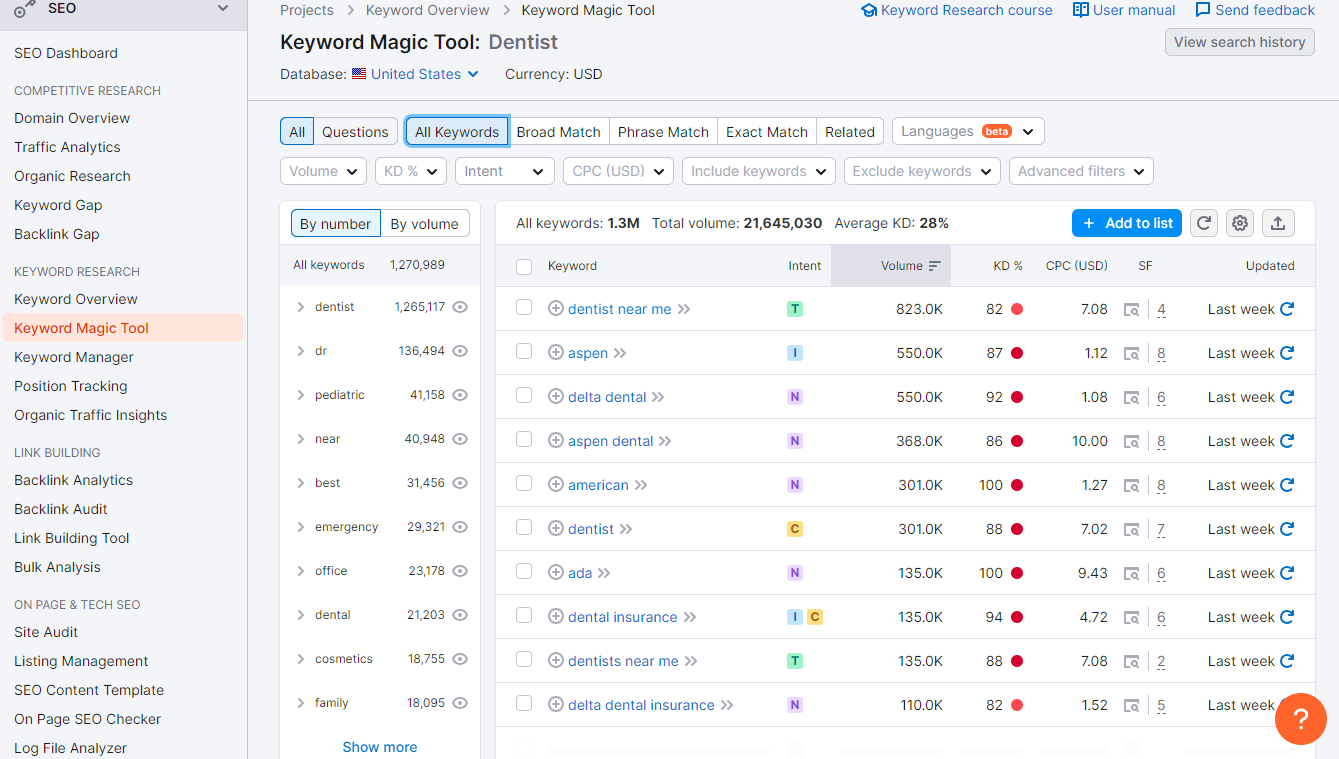
| S.No. | Search Term Keyword | Intent | Volume | CPC (USD) |
|---|---|---|---|---|
| 1. | Dentist near me | Transactional | 823,000 | 6.78 |
| 2. | dental implants | Informational | 135,000 | 12.16 |
| 3. | teeth whitening | Commercial | 165,000 | 10.11 |
| 4. | orthodontist | Commercial | 165,000 | 2.33 |
| 5. | endodontist | Commercial | 110,000 | 5.14 |
| 6. | pediatric dentist near me | Commercial | 60,500 | 5.24 |
| 7. | pediatric dentist | Commercial | 74,000 | 5.36 |
| 8. | emergency dentist near me | Commercial | 60,500 | 0.79 |
| 9. | teeth whitening near me | Transactional | 40,500 | 0.36 |
| 10. | emergency dentist | Transactional | 49,500 | 5.21 |
| 11. | dental implants near me | Transactional | 60,500 | 15.07 |
| 12. | kids dentist near me | Transactional | 27,100 | 5.30 |
| 13. | dentures near me | Transactional | 33,100 | 3.78 |
| 14. | dental clinic | Transactional | 49,500 | 0.56 |
| 15. | dental clinic near me | Commercial | 40,500 | 5.02 |
| 16. | affordable dentures and implants | Transactional | 22,200 | 5.61 |
| 17. | gum disease treatment | Navigational, Transactional | 22,200 | 0.80 |
| 18. | cosmetic dentist | Informational | 27,100 | 0.46 |
| 19. | root canal treatment | Commercial | 12,100 | 3.83 |
| 20. | best dentist | Informational | 18,100 | 0.23 |
Top 20 Best Dental SEO Keywords in UAE (2026)
The UAE dental market is highly competitive, particularly in Dubai and Abu Dhabi where a large expatriate population creates demand for premium dental services. UAE patients search primarily in English, with "dental clinic near me" leading at 33,100 monthly searches — reflecting the dominant preference for proximity and convenience in the GCC market. Cosmetic and aesthetic dental procedures command particularly high interest, with "teeth whitening", "veneer teeth", and "zirconia crown" all featuring strong search volumes and competitive CPCs.
| S.No. | Search Term Keyword | Intent | Volume | CPC (USD) |
|---|---|---|---|---|
| 1. | dental clinic near me | Commercial | 33,100 | 2.30 |
| 2. | dentist near me | Informational | 18,100 | 3.20 |
| 3. | teeth whitening | Commercial | 3,600 | 2.97 |
| 4. | dental clinic | Navigational | 27,100 | 1.87 |
| 5. | micris dental clinic | Informational, Commercial | 3,600 | 2.05 |
| 6. | orthodontist | Informational | 2,900 | 3.74 |
| 7. | teeth cleaning | Informational | 1,900 | 4.55 |
| 8. | tooth extraction | Commercial | 1,000 | 1.97 |
| 9. | veneer teeth | Informational | 2,400 | 1.80 |
| 10. | zirconia crown | Informational | 1,300 | 1.75 |
Long-Tail Dental Keywords That Drive High-Intent Traffic
While broad keywords like "dentist near me" drive enormous search volume, long-tail dental keywords — multi-word phrases that are highly specific to a treatment, location, or patient need — often deliver significantly higher conversion rates. A patient searching "affordable same-day dental implants in Chicago" is far further along the decision journey than someone who simply types "dental implants." They know what they want, where they want it, and they are ready to book.
Google's search algorithm increasingly rewards content that answers specific, natural-language queries — making long-tail keyword optimisation one of the highest-ROI activities in dental SEO. The following long-tail keywords are among the most valuable for driving qualified patient traffic in 2026:
- affordable dental implants near me — high commercial intent; price-conscious patients at decision stage
- same-day emergency tooth extraction near me — urgent, high-conversion local search
- best Invisalign orthodontist for adults in [city] — specialty + age + location = highly qualified lead
- dental implants cost with insurance — financial intent; pre-consultation research
- how much do veneers cost per tooth — informational + commercial; featured snippet opportunity
- children's dentist accepting new patients near me — high urgency, parent demographic
- dentist that accepts Medicaid near me — underserved segment with high search volume
- full mouth dental implants cost all on 4 — high CPC ($5.61); high patient lifetime value
- teeth whitening before wedding near me — seasonal, high-intent cosmetic search
- emergency root canal near me open now — maximum urgency; immediate booking intent
- clear braces for teenagers in [city] — specialty + demographic + location
- how long does a dental implant procedure take — informational; targets PAA box and blog traffic
- dental bonding vs veneers which is better — comparison keyword; featured snippet target
- receding gums treatment without surgery — condition + treatment preference; high-intent periodontics traffic
- invisalign vs braces cost and effectiveness — comparison keyword; decision-stage orthodontic traffic
💡 Long-Tail Keyword Strategy: Target long-tail dental keywords through dedicated FAQ sections on service pages, standalone blog posts answering specific patient questions, and location-specific landing pages. Each long-tail keyword page requires only 600–1,000 words of well-structured content to rank, making it one of the fastest paths to new patient bookings from organic search.
Highest CPC Dental Keywords for Google Ads (2026)
For dental practices running paid search campaigns, understanding which keywords carry the highest cost-per-click (CPC) is essential for budget allocation and ROI forecasting. High CPC values reflect intense advertiser competition — which in turn signals that these keywords convert at high rates and deliver high patient lifetime value. The table below highlights the highest-CPC dental keywords from the global dataset:
| Keyword | CPC (USD) | Intent | Why High Value |
|---|---|---|---|
| pediatric dentist | $15.07 | Transactional | High lifetime value; family converts to long-term patient base |
| dental implants | $12.16 | Commercial | High-value procedure; single treatment worth $3,000–$6,000+ |
| root canal | $12.16 | Informational | Urgent procedure; patient must act fast |
| veneers cost | $10.49 | Informational | High-ticket cosmetic; patient in decision stage |
| root canal procedure | $10.49 | Informational | Variant of top-converting emergency/restorative term |
| teeth whitening | $10.11 (US) | Commercial | Cosmetic treatment; high repeat-visit potential |
| gingivitis treatments | $7.43 | Commercial | Recurring condition; patient needs ongoing dental care |
| cosmetic dentist | $6.50 | Transactional | High-value cosmetic procedures; affluent patient segment |
| dentist near me | $6.78 | Transactional | Mass volume + ready-to-book intent = highest total ad ROI |
| all on 4 dental implants | $5.61 | Transactional | Full-arch restoration; among the highest-value dental procedures |
Google Ads Tip: For dental practices new to paid search, start by bidding on 3–5 high-intent local keywords (e.g., "dentist near me," "emergency dentist [city]," "dental implants [city]") with tightly themed ad groups and dedicated landing pages. A well-structured dental Google Ads campaign targeting these high-CPC terms can deliver a 5:1 to 10:1 return on ad spend when conversion tracking is properly configured.
How to Do Dental Keyword Research: A Step-by-Step Guide
Effective dental keyword research is the foundation of any successful dental SEO campaign. It tells you exactly which terms your ideal patients are using, how competitive those terms are, and where the best opportunities lie for your specific practice. Here is a practical, step-by-step process you can follow — whether you are doing this yourself or briefing an dental SEO agency.
Step 1: Define Your Dental Services and Target Patient
Before opening any keyword tool, map out every service your practice offers — from routine check-ups and hygiene appointments to specialist procedures like dental implants, Invisalign, or sleep apnoea appliances. Then define your target patient: their age range, location, insurance status, and primary dental concern. This clarity ensures your keyword research is grounded in real patient intent rather than generic search data.
Step 2: Build Your Initial Keyword List with Research Tools
Use a combination of keyword research tools to build your initial list. The best tools for dental keyword research include:
- Google Keyword Planner — free; provides search volume ranges and CPC data directly from Google Ads
- Ahrefs — premium; the most comprehensive keyword database with keyword difficulty scores and SERP analysis
- SEMrush — premium; excellent for competitor keyword gap analysis and local keyword research
- Moz Keyword Explorer — strong for local SEO keyword prioritisation
- Google Search Console — free; reveals the actual queries your existing pages are already ranking for
- Google Autocomplete and "People Also Ask" — free; reveals real patient search language directly in Google
Start with 5–10 broad "seed" keywords (e.g., "dentist," "dental implants," "teeth whitening," "orthodontist") and let the tools surface hundreds of related variations. Export your full list for analysis in the next step.
Step 3: Analyse Search Volume and Keyword Difficulty
Filter your keyword list by two key metrics: monthly search volume (how many people search for this term each month) and keyword difficulty (how hard it is to rank on page one). For dental practices targeting local patients, focus on keywords with a local modifier — these typically have lower difficulty scores than national terms while still capturing high-intent searchers. A keyword with 500 monthly local searches and low-medium difficulty is often more valuable than a term with 50,000 national searches and very high difficulty.
Step 4: Categorise Keywords by Search Intent
Sort your filtered keyword list into the four intent buckets described earlier in this guide: Informational, Local/Navigational, Commercial, and Transactional. This step is critical because it determines which type of page each keyword should target. Mixing intents on a single page — for example, targeting both a commercial keyword and an informational keyword on the same service page — dilutes your page's focus and reduces its ranking potential.
Step 5: Map Keywords to Specific Website Pages
Create a keyword map — a simple spreadsheet that assigns your primary and secondary keywords to each existing and planned page on your website. Every page should have one primary keyword and 2–3 supporting secondary keywords. Avoid keyword cannibalism — multiple pages targeting the same keyword — as this confuses search engines and dilutes ranking authority across your site.
- Homepage: Broad local terms (e.g., "dentist in [City]", "dental practice [City]")
- Service pages: Procedure + local keywords (e.g., "dental implants [City]", "teeth whitening near me")
- Blog posts: Informational + long-tail keywords (e.g., "how long do dental implants last", "signs of gum disease")
- About/Team page: Branded keywords and credential-based terms (e.g., "Dr. [Name] dentist [City]")
Step 6: Optimise On-Page Elements with Your Target Keywords
Once you have mapped your keywords, optimise each page's on-page elements. For each target keyword, ensure it appears naturally in the: title tag (60 characters max), meta description (150–160 characters), H1 heading (once, at the top), first paragraph of body content, at least one H2 or H3 subheading, image alt text (for at least one image), and the page URL slug (e.g., /dental-implants-chicago/). Avoid keyword stuffing — natural, readable content that serves the patient's needs will always outperform keyword-stuffed copy.
Step 7: Track Rankings, Measure Results, and Refine
SEO is not a one-time task — it is an ongoing process. Set up monthly rank tracking for your target keywords in Google Search Console and a dedicated rank tracking tool like Ahrefs or SEMrush. Monitor your click-through rate (CTR) in Search Console — if a page is ranking on page one but not generating clicks, your title tag and meta description need optimisation. Review and refresh your keyword list every 6 months to incorporate new search trends, remove obsolete terms, and capitalise on newly emerging keyword opportunities.
💡 Quick Win: Before spending hours on new keyword research, open your Google Search Console and check the "Queries" report. You will likely find dozens of keywords your pages are already ranking in positions 8–20 for. These are your fastest ranking opportunities — a targeted content update and on-page optimisation push can often move them to the top 5 within 30–60 days.

Request For More Details
Our Recent Client Ranking Results
USA
- Black Triangle Teeth 1
- Front Tooth Implant Columbus 1
- Dental Implants Columbus 5
- Ohio Cosmetic Dentists 7
- Teeth Whitening Columbus 6

UK
- cosmetic dentist london 2
- Best Cosmetic Dentist London 3
- Invisible Braces London 4
- Laser Teeth Whitening London 5
- Bad Breath Treatment London 8

UAE
- Root Canal Drill Dubai 3
- Dental Clinic Deira 4
- Root Canal Dubai 7
- Dental Emergency Dubai 9
- Laser Teeth Whitening Dubai 10

USA
- Dentist in Covina CA 5
- yellow braces 1
- Jaw Surgery vs Braces 6
- Pediatric Dental Care San Dimas 8
- orthodontist covina 10
Optimising Your Dental Website for SEO Success
Identifying the right dental keywords is only the first step. The real work — and the real ranking power — comes from implementing those keywords correctly across every element of your dental website. In addition to targeting the right keywords for dental clinic pages, the following SEO best practices are essential for achieving and sustaining top search engine rankings in 2026.
1. On-Page Optimisation
On-page optimisation means configuring each individual web page so that search engines can clearly understand its topic, relevance, and value to the searcher. For dental websites, this involves a precise set of elements that must all work together:
- Title Tags: Your title tag is the single most important on-page ranking factor. Every page should have a unique, descriptive title (55–60 characters) that includes your primary keyword and a local modifier where relevant. Example: "Dental Implants in Chicago | Affordable Implants — [Practice Name]".
- Meta Descriptions: While not a direct ranking factor, compelling meta descriptions directly improve your click-through rate (CTR) from search results. Write 150–160 character descriptions that include your keyword, your practice's unique value proposition, and a clear call-to-action.
- H1 and Heading Structure: Use a single H1 heading per page that includes your primary keyword. Use H2 and H3 subheadings to organise your content logically and incorporate secondary keywords and LSI (latent semantic indexing) terms.
- Body Content: Create high-quality, patient-focused content that answers the searcher's intent comprehensively. Include your primary keyword in the first 100 words, use natural keyword variations throughout, and aim for a minimum of 800 words for service pages and 1,500 words for pillar content.
- Images: Optimise every image with a descriptive, keyword-rich filename and alt text. Example: alt="dental implants procedure Chicago" instead of alt="img001". This also improves accessibility and can drive traffic from Google Image Search.
- Internal Linking: Link related pages together using descriptive anchor text. For example, your dental implants page should link to your financing page (anchor: "dental implants payment plans") and your contact page (anchor: "book a dental implants consultation"). Strong internal linking distributes page authority across your site and improves crawlability.
- Schema Markup: Implement structured data to enhance your search result appearance. For dental websites, the most valuable schema types are LocalBusiness, MedicalClinic, FAQPage, HowTo, and BreadcrumbList. Schema markup can win rich results — including FAQ dropdowns and star ratings — that dramatically increase click-through rates.
- Page Speed: Google's Core Web Vitals — Largest Contentful Paint (LCP), Interaction to Next Paint (INP), and Cumulative Layout Shift (CLS) — are direct ranking factors. A dental website that loads in under 2.5 seconds consistently outperforms slower competitors. Optimise images, minify CSS and JavaScript, and use a fast hosting provider.
2. Local SEO for Dental Practices
Local SEO is the single most impactful SEO discipline for dental practices. Patients searching for a dentist are almost always looking for a practice near them — and Google's local search algorithm is specifically designed to surface the most relevant, trusted, and nearby results. The key elements of a winning dental local SEO strategy include:
- Google Business Profile (GBP) Optimisation: Your GBP listing is your most important local SEO asset. Claim and fully complete your profile with accurate business name, address, phone number (NAP), website URL, opening hours, service categories, photos, and patient Q&As. Respond to all reviews — positive and negative — to demonstrate patient engagement. Practices with complete, actively managed GBP profiles consistently outrank competitors in the Local 3-Pack.
- NAP Consistency and Local Citations: Ensure your practice's name, address, and phone number are listed consistently across all online directories — including Yelp, Healthgrades, ZocDoc, Zocdoc, WebMD, and local business directories. Inconsistent NAP data is one of the most common and damaging local SEO errors. Tools like Moz Local or BrightLocal can audit and correct citation inconsistencies at scale.
- Location-Specific Website Content: Create dedicated landing pages for each city, neighbourhood, or suburb you serve. Each page should include location-specific keywords, references to local landmarks or communities, and unique content tailored to patients in that area.
- Localised Link Building: Earn backlinks from local organisations — the local Chamber of Commerce, community health initiatives, neighbourhood blogs, and local business associations. Local backlinks carry significant weight in Google's local ranking algorithm.
- Patient Reviews Strategy: Actively encourage satisfied patients to leave Google reviews. Send post-appointment follow-up emails with a direct link to your GBP review page. Practices with 50+ Google reviews and a 4.5+ star rating rank substantially higher in local search than competitors with fewer reviews.
3. Mobile-Friendliness and Core Web Vitals
More than 60% of dental searches now happen on mobile devices — and Google's mobile-first indexing means your mobile website experience directly determines your search rankings, not your desktop version. A dental website that performs poorly on mobile loses patients before they even see your services.
- Responsive Design: Your website must automatically adapt to any screen size — from desktop monitors to mobile phones — without loss of functionality or readability.
- Mobile Page Speed: Mobile pages should load in under 3 seconds. Compress images, use browser caching, and eliminate render-blocking JavaScript to achieve fast mobile load times.
- Click-to-Call Functionality: Make it effortless for mobile users to contact you. Your phone number should be prominently displayed as a tappable link on every page, particularly the homepage and contact page.
- Online Booking Widget: Integrate an online appointment booking tool that works seamlessly on mobile. Reducing friction in the booking process directly increases conversion rates from mobile traffic.
- Mobile Usability: Ensure all buttons and links are large enough to tap comfortably, text is legible without zooming, and forms are easy to complete on a small screen. Test your site regularly using Google's free Mobile-Friendly Test tool.
4. Technical SEO for Dental Websites
Technical SEO ensures that search engine crawlers can access, understand, and index every page of your dental website efficiently. Without a technically sound foundation, even the best content and keyword strategy will underperform.
- Site Architecture: Organise your website with a logical, flat hierarchy — every page should be reachable within 3 clicks from the homepage. Use a clear URL structure: yourdomain.com/dental-implants/ is far more effective than yourdomain.com/page?id=45.
- XML Sitemap: Submit a complete XML sitemap to Google Search Console to ensure all your service pages, location pages, and blog posts are discovered and indexed promptly.
- Robots.txt: Use a robots.txt file to prevent search engines from crawling low-value or duplicate pages (like login pages, admin areas, or parameter-based URLs) that dilute your site's crawl budget.
- HTTPS / SSL Security: Every dental website must run on HTTPS. Google flags non-secure HTTP sites in Chrome, which destroys patient trust and suppresses rankings. Ensure your SSL certificate is current and all pages redirect correctly from HTTP to HTTPS.
- Canonical Tags: Use canonical tags to prevent duplicate content issues — particularly important if your website generates URL variations for the same page (e.g., with/without trailing slashes, www/non-www, or filter parameters).
- Schema Markup: Implement structured data to give search engines additional context about your practice (LocalBusiness, MedicalClinic), your content (FAQPage, HowTo), and your website structure (BreadcrumbList). Schema is one of the fastest technical wins for dental websites — it can produce featured snippet appearances and rich results within weeks of implementation.
5. Dental Content Marketing
Content marketing is how dental practices build topical authority — the signal Google uses to identify websites that are genuinely expert in a subject area. A dental website with comprehensive, regularly updated content across all aspects of dental care signals far greater expertise than a sparse site with only a homepage and a few service pages.
- Blog Posts and Articles: Publish informative, in-depth articles on oral health topics, treatment explanations, and answers to the most common patient questions. Target one primary informational keyword per article. Blog posts targeting long-tail questions like "how painful is a root canal?" or "what is the recovery time for dental implants?" consistently rank in Google's "People Also Ask" boxes and featured snippets.
- Educational Videos: Create short, professional videos explaining dental procedures, showing virtual practice tours, or featuring patient testimonials. Video content increases dwell time on your pages — a positive engagement signal for Google — and can be embedded directly in relevant service pages and blog posts.
- Infographics and Visual Content: Design shareable infographics that break down complex dental topics — procedure steps, cost comparisons, oral hygiene charts — into visually accessible formats. Infographics attract organic backlinks from other websites, boosting your domain authority over time.
- Patient Resources and Downloadable Guides: Offer downloadable resources — post-procedure care guides, dental health checklists, insurance explanation sheets — that demonstrate genuine value to patients. These resources can also be used as lead magnets to capture email addresses for practice newsletters.
- Social Media Integration: Share your content consistently across social media platforms — Facebook, Instagram, and LinkedIn — to increase reach, drive traffic back to your website, and build a recognisable, trustworthy practice brand.
6. Link Building for Dental SEO
Link building — earning high-quality backlinks from authoritative websites — remains one of the most powerful ranking signals in Google's algorithm. For dental practices, a focused local and niche link building strategy delivers compounding results over time.
- Local Link Building: Earn links from your local Chamber of Commerce, community health organisations, neighbourhood websites, and complementary healthcare providers (GPs, physiotherapists, pharmacies) who serve the same patient community.
- Dental Directory Listings: Ensure your practice is listed on all major dental directories — Healthgrades, ZocDoc, Dentist.com, 1-800-Dentist, and the ADA member directory. These listings provide both citation signals for local SEO and authoritative backlinks.
- Guest Content: Contribute expert articles or oral health guides to local newspapers, community blogs, regional health publications, and national dental trade media. Each published piece earns a backlink and builds brand authority.
- Digital PR: Issue press releases about your practice's milestones, new technologies, community initiatives, or expert commentary on dental health topics. Coverage in local media and health publications generates powerful editorial backlinks.
- Unlinked Brand Mention Reclamation: Use tools like Ahrefs Content Explorer or Google Alerts to find websites that mention your practice name without linking to you. A polite outreach email requesting a link addition converts approximately 20–30% of unlinked mentions into live backlinks.
7. Analytics and Performance Monitoring
You cannot improve what you do not measure. A rigorous dental SEO analytics and monitoring programme is what separates practices that sustain top rankings year after year from those that see short-term gains followed by decline.
- Google Search Console: Your free, essential SEO monitoring tool. Track which queries are driving impressions and clicks, identify pages with declining rankings, monitor for crawl errors and indexing issues, and submit new content for rapid indexing.
- Google Analytics 4 (GA4): Track website traffic sources, user behaviour, time on page, bounce rate, and — most importantly — goal completions (phone call clicks, appointment form submissions, contact page visits). GA4 enables you to attribute new patient enquiries directly to specific pages and keywords.
- Rank Tracking: Use a dedicated rank tracking tool (Ahrefs, SEMrush, or AccuRanker) to monitor your weekly or monthly positions for all target keywords. Rank tracking reveals which optimisations are working and which need adjustment.
- Competitor Monitoring: Track the rankings, content updates, and backlink acquisition of your top 3–5 local dental competitors. Understanding their SEO strategy allows you to identify gaps and opportunities in your own approach.
- Conversion Tracking: Set up goal tracking in GA4 for every conversion point on your website — appointment form submissions, phone call clicks, live chat initiations, and direction requests from your Google Business Profile. This data enables you to calculate the true ROI of your dental SEO investment.
Latest SEO Tools We Use














What Our Clients Say About Us!

We're getting more client inquiries than ever.
We've been working with their SEO team for a few months now, and the results have been nothing short of fantastic. Their team is super friendly and always ready to help.

Thank you for all your hard work!
Their SEO services have truly transformed our online presence. We're now appearing at the top of search results, and our business has seen a significant boost in bookings.

Highly recommend their services!
Our cleaning company is now more visible online, and the increase in new clients has been amazing. The team is friendly, professional, and always available for any questions.

Leading to more traffic and leads.
Our online rankings have improved dramatically, leading to more traffic and bookings. The team is not only skilled but also incredibly friendly and supportive.

Wonderful SEO results for our cleaning company.
We've had an excellent experience with their SEO services. Our search rankings have improved. Thank you for helping us grow!
How Our SEO Services Can Help Dental Websites Rank Higher and Attract More Patients
At Media Search Group, we specialise exclusively in delivering measurable SEO results for dental practices across the USA, UK, UAE, and internationally. We understand that dentistry is a uniquely competitive local market — and that being on the second page of Google is functionally the same as being invisible to potential patients.
Our comprehensive SEO services for dental clinics are built on the same keyword research, intent analysis, and technical optimisation principles outlined in this guide — and are tailored to the specific competitive landscape of your practice's location and speciality. Here is exactly how we help dental websites rank higher and convert more visitors into booked appointments:
Expert Dental Keyword Research and Strategy: Our SEO team conducts in-depth keyword research specifically for your practice — analysing your location, services, specialty, and competitive environment to identify the exact keywords that will deliver the highest-quality patient traffic. We map every keyword to the right page on your website and provide a clear, prioritised action plan for implementation.
Complete On-Page Optimisation: We optimise every element of your dental website's on-page SEO — title tags, meta descriptions, H1 and H2 headings, body content, image alt text, internal linking structure, page speed, and schema markup. Our on-page work ensures every page on your site ranks for its targeted keywords and converts visitors into patient enquiries at the highest possible rate.
Dental Local SEO and Google Business Profile Management: With our dental local SEO strategies, we get your practice into the Google Maps Local 3-Pack — where the majority of clicks happen for location-based dental searches. This includes full Google Business Profile optimisation, local citation building and correction, review acquisition strategy, and the creation of location-specific landing pages for every suburb and neighbourhood you serve.
High-Quality Dental Content Creation: Our team of experienced dental copywriters creates original, patient-focused content that ranks for informational, local, and commercial keywords simultaneously. This includes service page rewrites, regular blog posts targeting long-tail keyword clusters, patient FAQ content, and educational guides — all optimised to build topical authority and drive sustained organic traffic growth.
Technical SEO Audit and Optimisation: We perform a comprehensive technical SEO audit of your dental website to identify and resolve issues that may be suppressing your rankings — including slow page speed, crawl errors, broken links, duplicate content, missing schema markup, and mobile usability problems. Our technical SEO work creates the solid foundation on which all other SEO efforts build.
Dental Link Building: We execute a targeted dental link building programme — earning high-quality backlinks from dental directories, local health organisations, community websites, and relevant editorial publications. Every backlink we build is legitimate, relevant, and adds genuine authority to your domain.
Transparent Reporting and Performance Tracking: You receive detailed monthly reports covering keyword ranking movements, organic traffic growth, new patient enquiry metrics, and a clear analysis of what is working and what is being refined. We track every key performance indicator from keyword position to appointment conversion rate — so you always know exactly what your SEO investment is delivering.
We have delivered top-10 Google rankings for dental clients across competitive markets including New York, London, Dubai, Sydney, and beyond. Our track record spans general dentistry, dental implant specialists, orthodontic practices, cosmetic dental clinics, and paediatric dentistry — each with a bespoke SEO strategy built around the unique keywords, patients, and competitive environment of that practice.
Each dental SEO package we offer is carefully crafted to include on-page optimisation, local SEO, dental content creation, link building, and technical SEO — driving consistent, compounding growth in visibility, traffic, and new patient bookings.
Frequently Asked Questions About Dental SEO Keywords
Everything dentists, practice managers, and dental marketing teams need to know about finding, using, and maximising the value of dental SEO keywords in 2026.
The best dental SEO keywords combine high search volume with strong local intent. Top performers include "dentist near me" (823,000 monthly US searches), "dental implants" (135,000), "teeth whitening" (165,000), "emergency dentist near me" (60,500), and "pediatric dentist near me" (60,500). Pair these with your city name and specific service for the highest-converting local keyword combinations.
"Dentist near me" is the most searched dental keyword globally, with approximately 823,000 monthly searches in the USA alone. It signals high transactional intent — patients searching this term are ready to book an appointment — making it the single most valuable keyword target for any dental practice. Optimise your Google Business Profile and homepage together to compete for this term.
Optimise your dental website by targeting location-specific keywords in your title tags and meta descriptions, claiming and fully completing your Google Business Profile, creating dedicated service pages for each treatment, publishing regular blog content targeting patient questions, building consistent local citations, implementing FAQ and LocalBusiness schema markup, and ensuring your site loads in under 3 seconds on mobile.
Over 71% of patients search online before booking a dental appointment, and most use location-based terms like "dentist near me." Local SEO ensures your practice appears in the Google Maps Local 3-Pack and top organic results for these searches — connecting you with high-intent patients in your area at the exact moment they are ready to book. Practices in the Local 3-Pack receive the vast majority of clicks on the page.
The top dental SEO keywords in the USA include "dentist near me" (823,000/mo), "teeth whitening" (165,000/mo), "dental implants" (135,000/mo), "orthodontist" (165,000/mo), "emergency dentist near me" (60,500/mo), and "pediatric dentist near me" (60,500/mo). Adding your city or neighbourhood to these terms maximises local relevance and reduces competition.
Long-tail dental keywords are specific, multi-word phrases like "affordable dental implants in [city]", "same-day emergency tooth extraction near me", or "best Invisalign for adults in [city]." They have lower search volume than broad terms but significantly higher conversion rates — because patients searching long-tail terms already know exactly what they need and are at the decision stage, ready to book an appointment.
The highest CPC dental keywords include "pediatric dentist" ($15.07), "dental implants" ($12.16), "root canal" ($12.16), "veneers cost" ($10.49), "teeth whitening" ($10.11), and "gingivitis treatments" ($7.43). High CPCs reflect intense advertiser competition and the high patient lifetime value these procedures generate. For Google Ads, target these terms on dedicated landing pages with strong calls-to-action for maximum ROI.
A dental website should target 1–3 primary keywords per page and a total of 30–100 keywords across the entire site depending on the number of service and location pages. Focus on 5–10 high-priority keywords for your homepage and core service pages, then expand keyword coverage through dedicated treatment pages and blog content targeting informational and long-tail queries.
Professional dental SEO services improve your website's search rankings by conducting expert keyword research, optimising on-page content and technical elements, building authoritative local citations, managing your Google Business Profile, creating high-quality dental content, and earning relevant backlinks — resulting in more organic traffic, higher-quality patient enquiries, and consistent growth in new patient bookings from Google search.
If your dental website is not ranking, start with a free technical SEO audit (available above) to identify specific issues. Common problems include slow page speed, missing or duplicate title tags, no Google Business Profile optimisation, weak or no local citations, insufficient content depth, and no backlinks. Address technical issues first, then strengthen your on-page keyword optimisation, build local citations, and create fresh content targeting your most valuable keywords. If your rankings do not improve within 60–90 days, consult a specialist dental SEO agency.